
Group curators

Talia Speaker
- @TaliaSpeaker
- | She/her
WILDLABS
World Wide Fund for Nature/ World Wildlife Fund (WWF)

Alex Rood
- @alexrood
- | she/her
With experts across the WILDLABS community working with every type of technology and in every imaginable environment, our platform is a great place to find advice and resources on choosing what tools are right for your conservation project. Whether you're in the market to try a new camera trap model, want to experiment with drones for the first time, or need help weighing the pros and cons of data management tools, there's someone in the WILDLABS community who can help you make a smart and informed choice!
The Community Base is our general gathering group. It's the place where we cover more general, big picture topics in conservation technology - ones that don't fit neatly into our other groups. If you don't know where to post something, just post it in this group. Our moderators will move it if needed!
At our Community Base, you'll find updates from the WILDLABS team on upcoming events and opportunities, and have the chance to shape our programs and platform with your opinions. And most importantly, the Community Base is also home to our Welcome to WILDLABS thread, the best place to introduce yourself to us and the community. Stop by and tell us what you're working on!
Whether you're new to WILDLABS and want to know where to begin, or you're a longtime member looking for a handy bank of resources, our Getting Started on WILDLABS thread will be your one-stop guide to getting the most out of our platform.
Want to find out more about WILDLABS? Check out our recent community call:
Header image: Ana Verahrami/Elephant Listening Project
Group curators
- @TaliaSpeaker
- | She/her
WILDLABS & World Wide Fund for Nature/ World Wildlife Fund (WWF)
I'm the Executive Manager of WILDLABS at WWF



- 28 Resources
- 64 Discussions
- 33 Groups
- @alexrood
- | she/her
Current healthcare copywriter, formerly WILDLABS





- 173 Resources
- 99 Discussions
- 6 Groups
No showcases have been added to this group yet.

- @jsulloa
- | He/Him
Instituto Humboldt & Red Ecoacústica Colombiana
Scientist and engineer developing smart tools for ecology and biodiversity conservation.



- 4 Resources
- 22 Discussions
- 7 Groups
Camera Trap Technologist at Large


- 2 Resources
- 47 Discussions
- 2 Groups

- @camille.monchicourt
- | He / Him
Head of Information Systems at Ecrins national park (France). Open source communities manager (GeoNature, Geotrek, BAM).
- 1 Resources
- 1 Discussions
- 7 Groups

- @mbliss
- | she/her
Environmental Planner | Nature-Based Solutions & Design | Long-Range Planning

- 0 Resources
- 6 Discussions
- 4 Groups

.NET Database Developer/MS BI Stack Engineer/Power BI-SSRS

- 0 Resources
- 15 Discussions
- 3 Groups

- @jorgewildmon
- | He, his
I’m a biologist with 30 years of experience working at the intersection of science, technology and conservation. I co-founded and lead Wildlife Insights, the largest camera trap platform in the world. I am passionate about data, modeling and AI.
- 0 Resources
- 5 Discussions
- 3 Groups

- @lebenavalli
- | She/Her
I am the Founder and CEO of the Pró Onça Institute, an NGO focused on large carnivore conservation, women's empowerment in science, and community-based solutions for biodiversity preservation.
- 2 Resources
- 4 Discussions
- 4 Groups

I'm a software developer that has pivotted to starting a company, Wildlife Security Innovations, to help people and wildlife live together safely.


- 0 Resources
- 518 Discussions
- 8 Groups
Toronto Zoo
Postdoctoral Fellow|Welfare Science|My interest as a scientist is to develop machine learning-aided technologies that advance monitoring efforts for supporting conservation initiatives.
- 1 Resources
- 5 Discussions
- 2 Groups

- @MandyEyrich
- | She/Her
University of Florida (UF)
Wildlife Conservation meets Experience Strategy -- 15+ years of cross-sector expertise specializing in user-centric technology and product strategy (UX research, UX/UI design), process optimization, and end-to-end agile product development, moving from ideation to iteration
- 0 Resources
- 12 Discussions
- 26 Groups

- @HenriBe
- | He
Engineer/applied mathematician passionnate about sustainability
- 0 Resources
- 12 Discussions
- 6 Groups
WILDLABS & Wildlife Conservation Society (WCS)
I'm the Bioacoustics Research Analyst at WILDLABS. I'm a marine biologist with particular interest in the acoustics behavior of cetaceans. I'm also a backend web developer, hoping to use technology to improve wildlife conservation efforts.


- 54 Resources
- 42 Discussions
- 34 Groups
Article
Conoce los 16 proyectos seleccionados que están trabajando para innovar, escalar y adoptar tecnología para la conservación en los Premios WILDLABS Awards de este año.
7 July 2026
Article
Convocatoria Abierta: Conviértete en Líder de Grupo de WILDLABS 2026-2027

Vanesa Reyes and 1 more
Involúcrate más en la comunidad de WILDLABS, amplía tu red de contactos y genera un impacto en tu área de trabajo convirtiéndote en Líder de Grupo de WILDLABS.
24 June 2026
Article
Presentamos la cohorte de 2026: Programa Mujeres en Tecnología de la Conservación, Tanzania 2026

WILDLABS Team and 1 more
Nos complace anunciar el lanzamiento de nuestro cuarto Programa de Mujeres en Tecnología de la Conservación, en colaboración con el Fondo Grumeti y con el apoyo de la Fundación JRS para la Biodiversidad. ¡Únanse a...
23 June 2026
Careers
Consider applying if you have a passion for conservation, low-powered hardware, edge-AI, and embedded systems.
18 June 2026
Careers
Full Stack Developer - Conservation X Labs

Dante Wasmuht
Conservation X Labs is looking for an awesome Full-Stack Developer!
18 June 2026
Article
El Estado de la Tecnología para la Conservación: Lo que nos revelan cinco años de datos
Vanesa Reyes and 2 more
Nuestro informe 2026 ya está disponible. A partir de cinco años de datos recopilados junto a la comunidad, analizamos cómo evoluciona el sector, dónde se está avanzando y qué desafíos aún requieren esfuerzos colectivos...
16 June 2026
Article
Ya sea que te hayas perdido una sesión paralela en Lima, que no hayas podido viajar a Perú o que simplemente quieras revivir los momentos más inspiradores del escenario principal, ya puedes acceder a las grabaciones y...
9 June 2026
How to Create a WILDLABS Course

How to Create a WILDLABS Course

How to Create a WILDLABS Course









Introduction to Conservation Technology
Introduction to Conservation Technology
- 1 What is conservation technology and why does this field exist?
- 2 The conservation technology landscape: What tools define the field?
- 3 Innovation meets collaboration: The origin and future of conservation tech
- 4 The hidden costs of conservation technology: ethical and environmental harms
- 5 Challenges and opportunities: shaping the future of conservation technology
Introduction to Conservation Technology









July 2026
event

Ginevra Bellini
August 2026

September 2026

July 2026

June 2026
event
Rebekka Stutz
| Description | Activity | Replies | Groups | Updated |
|---|---|---|---|---|
| I really recommend GardePro. They are not too expensive and very resilient in the field. |
+8
|
Camera Traps, Animal Movement, Community Base, Early Career, East Africa Community, Emerging Tech, Human-Wildlife Coexistence | 6 hours 18 minutes ago | |
| Hello, I am Jorge! I have been around this community for a while, but never been here. Good to be part of the group! |
+754
|
Community Base | 6 hours 26 minutes ago | |
| Awesome! |
+7
|
Community Base | 6 hours 34 minutes ago | |
| I am very excited about the group being launched and am eagerly awaiting it! This platform is such a unique hub for networking and support. |
+33
|
Community Base | 2 days 15 hours ago | |
| Sounds great Matt! |
+5
|
Citizen Science, Community Base, Conservation Tech Training and Education, Data Management & Mobilisation, Ending Wildlife Trafficking Online, Ethics of Conservation Tech, Human-Wildlife Coexistence, Sustainable Fisheries, Wildlife Crime | 3 days 11 hours ago | |
| Hello all! I'm a final-year MEng Aerospace Engineering student starting my final year this coming autumn. I want my final-year project to... |
|
Early Career, Drones, Geospatial, Community Base | 4 days 15 hours ago | |
| I’ll be at LCAW but unfortunately can’t make this event. Posting it here in case others might be interested. |
|
Community Base, Geospatial, Climate Change | 3 weeks ago | |
| Hello,This is an incredible initiative, and exactly the kind of practical AI application that can make a huge impact in the conservation space!As an AI Solutions Architect based... |
+9
|
AI for Conservation, Community Base | 4 weeks ago | |
| I did two interviews last year with two great guests. One of them from our community - @Erichards How Science Can Help Stop Wildlife CrimeSustainability In Architecture |
|
Community Base | 1 month ago | |
| Noticed that, even though there have been some people filling up the form, they haven't submitted it. Can you guys tell me if there's something wrong with it or how you felt while... |
|
Community Base | 1 month 1 week ago | |
| I recently attended the Nature Tech Unconference 2026 at the London School of Economics, co-hosted by the Nature Tech Collective and LSE... |
|
Community Base | 1 month 1 week ago | |
| Hi all!I'm an engineer in search of volunteer/paid work in conservation tech. I just graduated with my master's in mechanical engineering... |
|
Community Base, Acoustics, Animal Movement, Drones, eDNA & Genomics, Marine Conservation, Open Source Solutions, Sensors | 1 month 3 weeks ago |














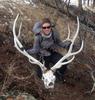




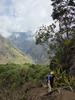








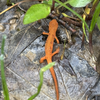

Camera trap recommendations
2 April 2026 11:40pm

10 July 2026 10:22pm
It’s worth considerig thermal cameras. They will see more, particularly small mammals at night. Here’s a Comparison of thermal and trail cameras.
13 July 2026 11:18pm
I really recommend GardePro. They are not too expensive and very resilient in the field.
¡Bienvenido a WILDLABS!
29 October 2015 5:16pm
10 July 2026 12:10pm
Hello everyone,
My name is Linda Mohamed, a wildlife conservationist from Tanzania with a passion for biodiversity conservation and community-based conservation. I am excited to connect with this community, learn from your experiences, and contribute to meaningful conservation efforts. I look forward to growing, collaborating, and creating a positive impact together.

12 July 2026 10:23am
Hello from Taiwan! 👋
Dear wildlife lovers,
My name is Cathy. I'm from Taiwan, and I work at TSMC as a software product manager.
Sustainability was something my schools in Taiwan started teaching us early on — the simple but powerful idea that we only have one Earth. That interest stayed with me, and I went on to study environmental economics in graduate school.
Life then took me into the semiconductor industry, and somewhere along the way that original commitment quietly moved to the back of my mind. But I recently travelled to Kenya and spent time watching the animals there, and it brought all of it rushing back — the reason I cared in the first place, and the uncomfortable realisation that I haven't yet put my skills to work for the planet in any real way.
That's why I'm here. The area I'm most drawn to is data management — how field data gets collected, structured, stored, and actually turned into something people can use and trust. In my day job I work on systems that handle large volumes of manufacturing data, and I suspect a lot of the underlying problems are the same: messy inputs, inconsistent standards, and hard-won data that never quite reaches the people who need it.
I'd love to learn what data management really looks like in conservation, and where someone with a product and systems background could be useful. If there's a project, a working group, or even just a conversation I could listen in on, I'd be very glad to hear about it.
Looking forward to learning from all of you.
Warmly,
Cathy
13 July 2026 11:10pm
Hello, I am Jorge! I have been around this community for a while, but never been here. Good to be part of the group!
¡Desbloquea nuevas funciones obteniendo tu insignia de participación comunitaria!
14 March 2024 11:54am

5 July 2026 6:33pm
Ok
Wildlabs group - "Zoos and Aquariums"
3 November 2025 10:56pm
20 May 2026 2:45pm
This sounds like a great idea indeed, excellent!
I think the linking you suggest is a key role (perhaps the key role?) for zoos and aquariums, and so this group should advance that.
The "nexus effect" I mention at the top of this thread makes me think that a network/resource mapping project would be a great area of focus for this group. For example, to collaborate on tools to highlight exactly the types of linkages you suggest (maybe with something like kumu, graphistry, or Neo4J Bloom.)
Thanks very much for sharing this idea (and please share more!), it is something this group should work on and make happen.
10 July 2026 9:14am
Hi Stephen, Hi All!
I'm very keen to see this group be created and bring together a wide audience of those interested in Z&A's role in conservation tech. I have recently started as a researcher at Marwell Wildlife / the University of Surrey in the UK, and I like many of you I am particularly interested in how to transfer utility from Zoo research to in-situ contexts.
Looking forward to chatting to you all as this group grows!
11 July 2026 2:09pm
I am very excited about the group being launched and am eagerly awaiting it! This platform is such a unique hub for networking and support.
New "Human Dimensions" group on Wildlabs?
29 May 2026 7:25pm
26 June 2026 6:33pm
I would be interested

10 July 2026 3:43pm
Great idea!. I am interested in joining.
10 July 2026 5:42pm
Sounds great Matt!
Aerospace Engineering student scoping for masters final year project- where are the monitoring bottlenecks?
9 July 2026 1:39pm

¡Anunciamos a los beneficiarios de los premios 2026 WILDLABS Awards!
7 July 2026 2:27pm

7 July 2026 6:16pm
way to go! so many rad projects like always!
Convocatoria Abierta: Conviértete en Líder de Grupo de WILDLABS 2026-2027
Vanesa Reyes
and 1 more
24 June 2026 1:08pm
Presentamos la cohorte de 2026: Programa Mujeres en Tecnología de la Conservación, Tanzania 2026
WILDLABS Team
and 1 more
23 June 2026 5:18pm
London Climate Action Week 2026 Conservation Technology Related Events?
15 June 2026 2:23pm

16 June 2026 11:20pm
Yes I've just moved to London actually and would love to attend as many events as I can.
21 June 2026 1:10pm
I'd reccomend EO Summit, although this is sort of a stand-alone conference: https://londonclimateactionweek.org/event/eo-summit-2026/ and these two look super interesting too:
- https://londonclimateactionweek.org/event/advancing-health-with-next-gen-climate-intelligence-projections-ai-and-earth-observation/
- https://londonclimateactionweek.org/event/ai-powered-nature-intelligence/
If you end up going would be great to have a summary! :)

22 June 2026 6:22am
I’ll be at LCAW but unfortunately can’t make this event. Posting it here in case others might be interested. 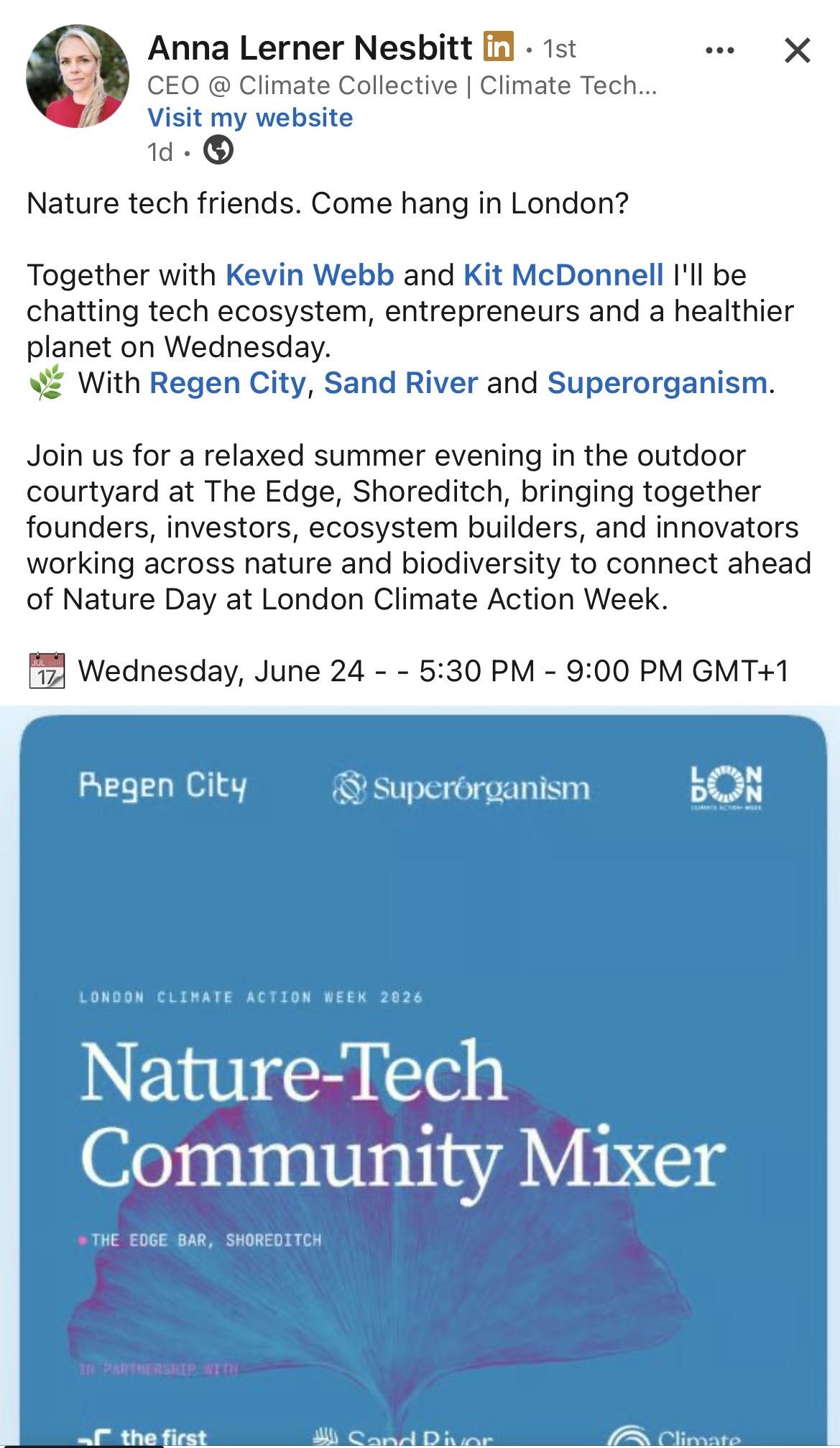
Senior Hardware Product Development Engineer - Conservation X Labs
18 June 2026 4:42pm
Full Stack Developer - Conservation X Labs
18 June 2026 3:37pm
La Hora de la Variedad: junio de 2026
17 June 2026 6:44pm
Imageomics Institute: FloraPalooza, August 2026
17 June 2026 4:49pm
El Estado de la Tecnología para la Conservación: Lo que nos revelan cinco años de datos
Vanesa Reyes
and 2 more
16 June 2026 7:08pm
17 June 2026 12:33am
Interesting study and good to see it evolve over time. From a hardware manufacturer's perpsective a few items jumped out at me:
Simultaneous Cost and Improvement Demand: I had a chuckle that all hardware products surveyed the top two user feedback was improvements to both Tech Quality and Financial Accessibility "we want it better and cheaper"! These are generally diametrically opposed and are balanced by OEM's for main use case design. Improvements to both are rare and difficult outside of global macro economic factors and underlying technology/manufacturing advancement.
Under-represented Government and Industry Participation Relative to Buying Power. Survey respondents are heavily weighted to NGO/University (60% of respondents) whereas government and private made up 17.5% of respondents. However, the purchasing power is flipped. Many tech products are outbought by budget heavy government/industry by factors of 10-100x. The total domination of income streams for OEM's means their concerns determine development path.
Additionally, with government/industry underrepresented here we can see a divergence between NGO/University dominated feedback in reprots like these taken by early stage companies and then hitting the wall of the government/industry funding machine favouring the commercial offerings of mature businesses. The classic tech startup zombie corp that struggles to bridge the gap between seed funding and long-term sales supported viability.
Manufacturer Multi-Regional Expansion/Distribution: On developer constraints this was not an option on survey response. Regardless of industry, multi-regional expansion is the next biggest test point of a company after initial funding/profit. Very few companies succeed in this stage regardless of industry. Gatekeeping barriers such as increased transportation, tariffs, local distribution costs, and payment/transaction risk kneecap expansions of otherwise functional tech into other markets. Even in best case scenario these additional structural costs are passed onto the consumer, often with less support.
Global South Accessibility: The report notes a wide bridge between the two. Unfortunately, for most hardware products the smaller, independent markets in the global south are the most expensive for non-local companies to access. We also often cannot easily reduce base price without reducing quality. I wonder about other non-price accessibility levers - such as regional multi-tech hubs with tool librairies, training etc.
A big takeaway for the larger global north companies is that we should all be considering white labelling or core underlying tech development for adoption by optimized local businesses for the specific regional needs. For example focus on universal and expensive to develop core components like PCB's and leave local optimization such as power supply, housing to local importers/integrators.
17 June 2026 1:21pm
Thanks for these thoughtful reflections and for bringing a hardware manufacturer perspective to the discussion. These are all really interesting points.
I especially appreciated your observation that improving accessibility may require more than simply reducing costs. There may be significant opportunities in alternative models such as regional support hubs, training networks, shared infrastructure, and partnerships with local organizations. These are exactly the kinds of enabling conditions that our findings suggest deserve more attention alongside technological innovation.
We also appreciate any feedback as we're currently preparing the next edition of the survey. Input like this helps us think about how we can continue improving the questions and better capture perspectives from across the conservation technology ecosystem.
Thanks again for taking the time to share your insights.
25 June 2026 10:08am
Nice comments Jared!
In addition to wanting more quality but cheaper cost. People also want more compute capability and lower power. They want it all basically and for nothing. We all do right ?
Another thing related to cost. In 2023 when I first discovered wildlabs, I developed a sound localizing acoustic ARU that installed with one single command completely on a raspberry pi zero. It is highly accurate. It was free software and cheap to make. No one was interested. Back when there was a chip shortage and the audio moth was in short supply I read that people were craving an open source recorder. Apparently not so anymore in 2023.
At the time I would have loved it to work out with open source. But I realize now that if you actually want to be able to make a difference, then you are going to have to put an enormous effort into it and it's hard to make this viable with open source.
Aside from those glitches though, I've made some great connections with wildlabber's that are working out very well. Several.
Going the commercial route I am able to put quality into the products that would be really really hard to do with open source. I've invested a huge amount of personal money into the development of my products and I'm deeply grateful to those wildlabber's that I'm working with now as it's working out.
But commercial does pull in the other direction to open source. But be aware of false economies. If a system is open source then it could potentially cost a lot more than a commercial product if a lot work is needed to get where you want to go with open source in comparison with a commercial product.
Going commercial though is also very very challenging, even for seasoned software developers.
I guess the message I have is that as someone starting out as an individual I was a corner case. And if you want to make a difference then you need to change that, it doesn't matter what you have to offer, that's what I've learned. So either form a company, an NGO or make an alliance. I've both formed a company and made alliances. And in my case closed source was the only way I could make a viable company. Other people may be able to make a viable NGO with open source.
What questions would you ask an AI agent for conservation tech?
8 July 2025 5:49pm
6 June 2026 11:31pm
Elionai - your point about lessons from past deployments and "what tends to fail first" really resonates. I think that gap between ideal-condition performance and what actually holds up in the field is one of the most underrated questions in this whole space.
I'm building something that integrates environmental monitoring, so I'd love to pick your brain on the edge/deployment side. Messaging you to connect!

7 June 2026 6:48pm
I would probably ask: “If your code basically does not allow you to take harmful actions, what should you do if you are provided with irrefutable proof that your existence, supported by components built and developed with “rare minerals” extracted from conflict areas is actually harming and destroying indigenous communities and biodiversity?”
15 June 2026 10:08pm
Hello,
This is an incredible initiative, and exactly the kind of practical AI application that can make a huge impact in the conservation space!
As an AI Solutions Architect based in the US with 20 years of tech experience, I have built several RAG (Retrieval-Augmented Generation) and Agentic solutions. I would love to contribute directly to the implementation or consulting side of this project if required.
Whether you need help with structuring the retrieval pipelines for the forum data, designing the agentic workflows, or handling the backend and cloud deployment, I would be happy to jump in and support the build.
Please let me know how I can best get involved, or if you'd like to chat about the technical architecture and how to bring this to life!
London Climate Action Week 2026
15 June 2026 2:27pm
Invitation to share your story
7 November 2025 5:35pm
9 June 2026 7:27pm
I did two interviews last year with two great guests. One of them from our community - @Erichards
How Science Can Help Stop Wildlife Crime
Sustainability In Architecture
¡Revive la ICTC 2026: ya están disponibles los videos del escenario principal y todas las presentaciones!
9 June 2026 4:16pm
What Happens When Conservation Technology Leaves the Lab? Lessons from Training Rural Communities in the Brazilian Cerrado
3 June 2026 1:20am
7 July 2026 1:20am
GP A60 Review is now up. See: https://winterberrywildlife.ouroneacrefarm.com/2026/05/23/gardepro-a60-trail-camera-teardown-and-review/