
WILDLABS
Wildlife Conservation Society (WCS)






Ayesha Zafar
- @AyeshaZafar
- | she/her
World Wide Fund for Nature/ World Wildlife Fund (WWF)



Talia Speaker
- @TaliaSpeaker
- | She/her
WILDLABS
World Wide Fund for Nature/ World Wildlife Fund (WWF)


Five years ago, WILDLABS set out to capture a baseline picture of the conservation technology landscape. What technologies were people using? What challenges were they facing? What support was needed to help technology deliver meaningful conservation outcomes?
Since then, we have run annual surveys of the community to keep tabs on progress. Today, with five years of data from 1,073 respondents across 101 countries, we have our clearest picture yet of how the field is evolving and where collective action is most needed.
The most striking finding from five years of data is not how much conservation technology has changed, but how much the sector’s core challenges have stayed the same.
While tools have advanced rapidly, practitioners and developers have continued to identify the same recurring barriers and priorities to address them. The challenge now is less about identifying what needs to happen, and more about making it happen.
Here’s what we found, in five key insights. Read on or dive into the full report.
Five Key Insights from the Report
1. Conservation technology is becoming increasingly embedded in practice
Technology is no longer a niche component of conservation work. Across the survey period, respondents consistently reported using multiple technologies rather than relying on a single tool, and in 2024, 94% of respondents reported regularly engaging with more than one tool. Camera traps and GIS/remote sensing remain foundational technologies, while engagement with acoustics and AI tools continues to grow.
Rather than replacing existing approaches, newer technologies are increasingly being integrated into broader workflows and decision-making processes.
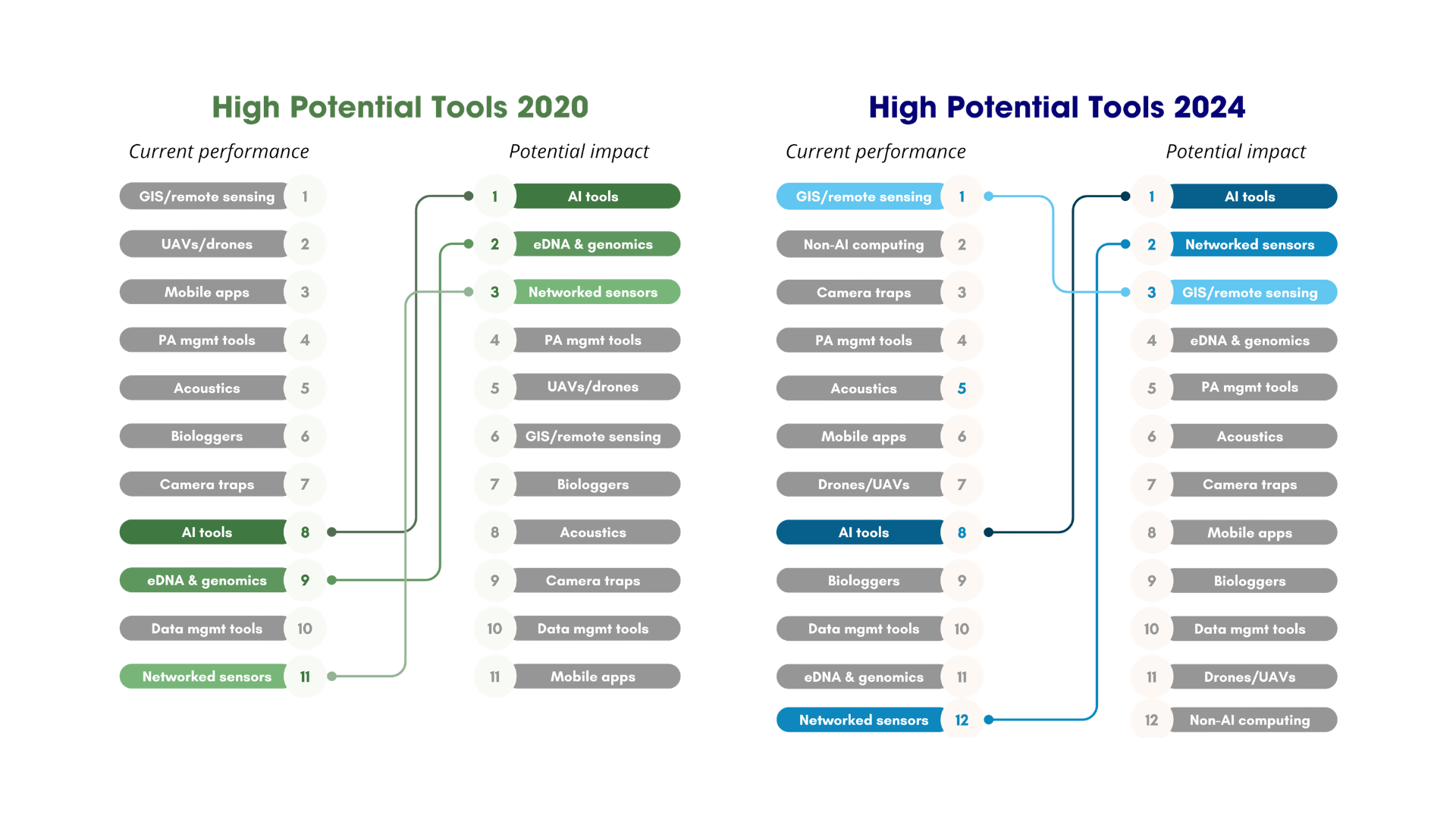
2. AI and networked sensors remain high-potential, but difficult to implement
Among all technology groups, AI tools and networked sensors were consistently viewed as having some of the greatest potential to advance conservation.
At the same time, they also ranked among the lowest-performing technologies in terms of current practical implementation.
This gap points to one of the report’s clearest messages: perceived value is not the same as real-world readiness. For high-potential tools to deliver conservation impact, the sector must also address the barriers that shape whether they can be adopted and sustained in practice, including accessibility, infrastructure, capacity, and operational deployment.
3. Inequities continue to shape who can access and benefit from conservation technology
As in prior years, the report found that barriers are not evenly distributed.
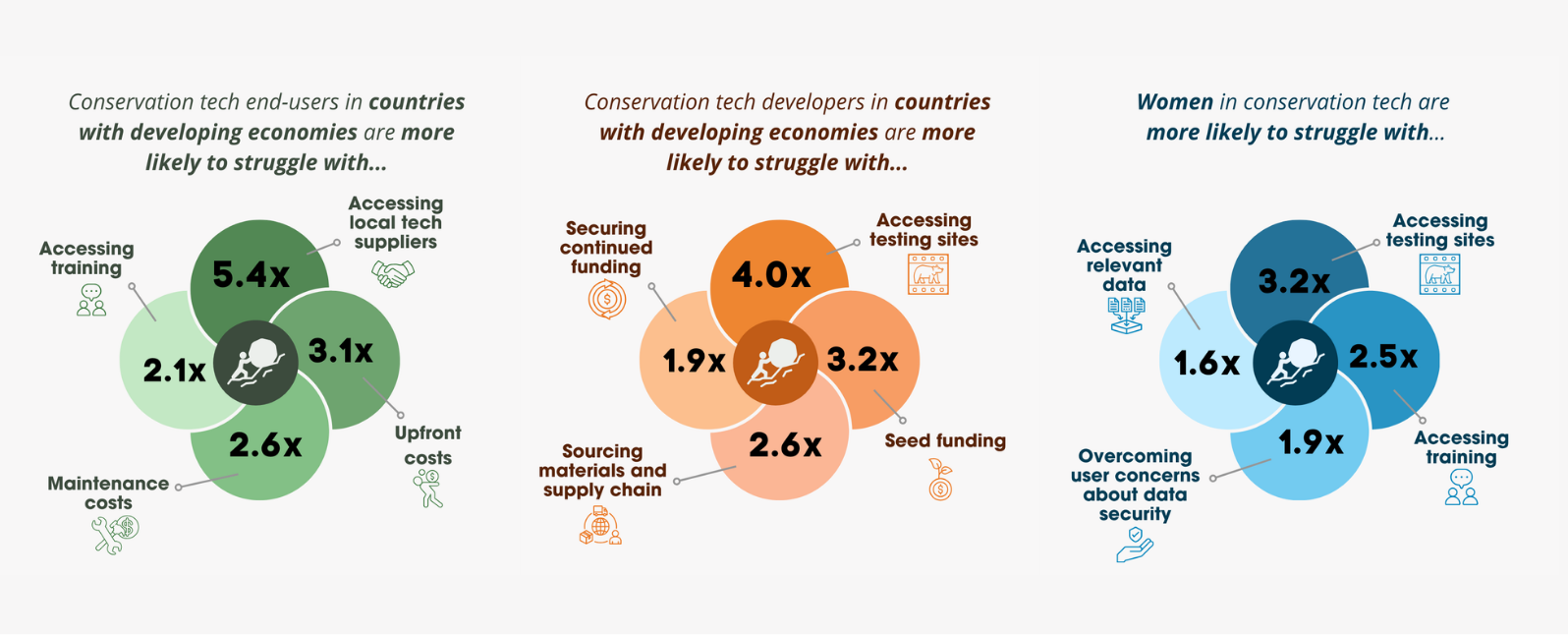
Practitioners in developing economies continue to face disproportionate challenges related to affordability, access to local suppliers, training opportunities, and technical support. Women working in conservation technology also reported higher rates of several key barriers, including access to training, testing opportunities, and relevant data.
For example, end-users in countries with developing economies were 5.4x more likely to report challenges accessing local technology suppliers, while women were 3.2x more likely to report challenges accessing testing sites.
These findings reinforce the importance of designing support systems, funding mechanisms, and capacity-building initiatives that are equitable and locally relevant.
4. The sector's biggest advancements may lie beyond new inventions
Across the five-year dataset, respondents consistently highlighted that many technologies are already generating valuable ecological and management insights. Yet the most commonly reported challenges were not about technological capability. Instead, respondents pointed to practical barriers such as cost, usability, connectivity, training, maintenance, and access to support.
The findings suggest that future progress may depend as much on strengthening the enabling conditions around conservation technology - including funding, training, support networks, and maintenance - as on developing entirely new tools.
5. The community agrees on what needs to happen next
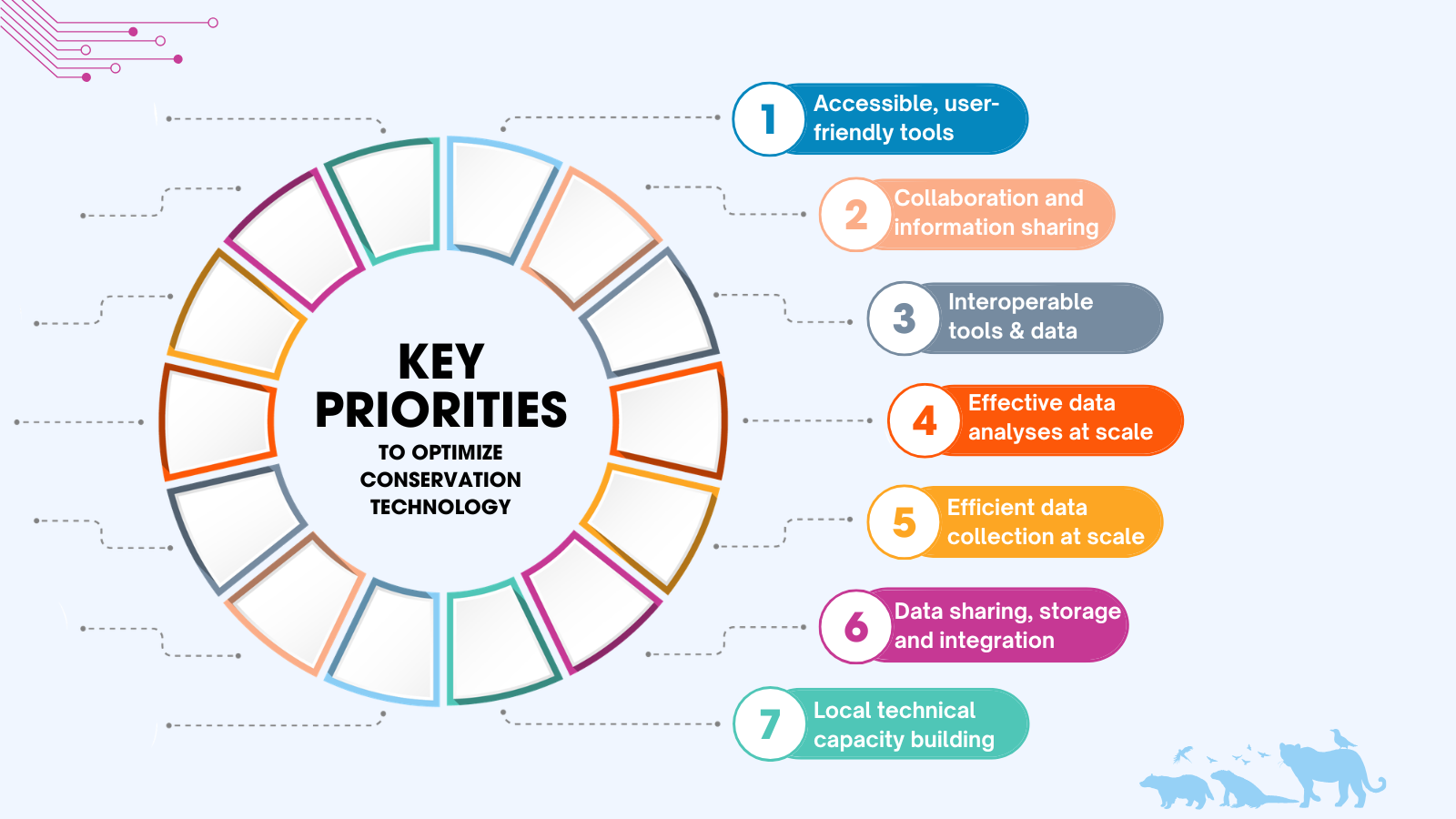
Across five years of survey data, respondents consistently emphasized the need to make conservation technologies more open, accessible, and user-friendly; strengthen collaboration and information sharing; improve interoperability between tools and data systems; and increase capacity to collect, manage, and analyze conservation data at scale.
Together, these priorities point to a clear message: future progress will depend not only on developing new tools, but on strengthening the conditions that help those tools translate into conservation impact.
Looking Ahead
Over the past five years, conservation technology has matured considerably. AI, automation, bioacoustics, remote sensing, and data-driven approaches are becoming increasingly important across conservation practice.
Yet perhaps the most important lesson from this research is that technology alone is not enough. To move from innovation to impact, the sector also needs sustained investment in the people, partnerships, institutions, and support systems that make tools usable, accessible, and effective in real-world conservation contexts.
As WILDLABS looks toward the next five years, these findings will continue to shape how we support the sector, from listening to the community and strengthening connections across silos to improving access to knowledge and tools and helping build the funding, capacity, and coordination needed for conservation technology to succeed.
Read the full report to explore the findings in detail, share your reflections with the WILDLABS community, and join the conversation about what comes next for the conservation technology sector. Also keep an eye out for the 2026 survey, coming soon!
Read the Report!
Header image credit: Alasdair Davies, Penguin Watch, Oxford Brookes University.
Related content
Article
OUT NOW: Our three-year trends report delivers the first global assessment tracking evolving perceptions and engagement in the tech for biodiversity and conservation space. Here are five things we found.
15 November 2023
17 June 2026 12:33am
Interesting study and good to see it evolve over time. From a hardware manufacturer's perpsective a few items jumped out at me:
Simultaneous Cost and Improvement Demand: I had a chuckle that all hardware products surveyed the top two user feedback was improvements to both Tech Quality and Financial Accessibility "we want it better and cheaper"! These are generally diametrically opposed and are balanced by OEM's for main use case design. Improvements to both are rare and difficult outside of global macro economic factors and underlying technology/manufacturing advancement.
Under-represented Government and Industry Participation Relative to Buying Power. Survey respondents are heavily weighted to NGO/University (60% of respondents) whereas government and private made up 17.5% of respondents. However, the purchasing power is flipped. Many tech products are outbought by budget heavy government/industry by factors of 10-100x. The total domination of income streams for OEM's means their concerns determine development path.
Additionally, with government/industry underrepresented here we can see a divergence between NGO/University dominated feedback in reprots like these taken by early stage companies and then hitting the wall of the government/industry funding machine favouring the commercial offerings of mature businesses. The classic tech startup zombie corp that struggles to bridge the gap between seed funding and long-term sales supported viability.
Manufacturer Multi-Regional Expansion/Distribution: On developer constraints this was not an option on survey response. Regardless of industry, multi-regional expansion is the next biggest test point of a company after initial funding/profit. Very few companies succeed in this stage regardless of industry. Gatekeeping barriers such as increased transportation, tariffs, local distribution costs, and payment/transaction risk kneecap expansions of otherwise functional tech into other markets. Even in best case scenario these additional structural costs are passed onto the consumer, often with less support.
Global South Accessibility: The report notes a wide bridge between the two. Unfortunately, for most hardware products the smaller, independent markets in the global south are the most expensive for non-local companies to access. We also often cannot easily reduce base price without reducing quality. I wonder about other non-price accessibility levers - such as regional multi-tech hubs with tool librairies, training etc.
A big takeaway for the larger global north companies is that we should all be considering white labelling or core underlying tech development for adoption by optimized local businesses for the specific regional needs. For example focus on universal and expensive to develop core components like PCB's and leave local optimization such as power supply, housing to local importers/integrators.

Vanesa Reyes
WILDLABS
Wildlife Conservation Society (WCS)
17 June 2026 1:21pm
In reply to jared
17 June 2026 12:33am
Interesting study and good to see it evolve over time. From a hardware manufacturer's perpsective a few items jumped out at me:
Simultaneous Cost and Improvement Demand: I had a chuckle that all hardware products surveyed the top two user feedback was improvements to both Tech Quality and Financial Accessibility "we want it better and cheaper"! These are generally diametrically opposed and are balanced by OEM's for main use case design. Improvements to both are rare and difficult outside of global macro economic factors and underlying technology/manufacturing advancement.
Under-represented Government and Industry Participation Relative to Buying Power. Survey respondents are heavily weighted to NGO/University (60% of respondents) whereas government and private made up 17.5% of respondents. However, the purchasing power is flipped. Many tech products are outbought by budget heavy government/industry by factors of 10-100x. The total domination of income streams for OEM's means their concerns determine development path.
Additionally, with government/industry underrepresented here we can see a divergence between NGO/University dominated feedback in reprots like these taken by early stage companies and then hitting the wall of the government/industry funding machine favouring the commercial offerings of mature businesses. The classic tech startup zombie corp that struggles to bridge the gap between seed funding and long-term sales supported viability.
Manufacturer Multi-Regional Expansion/Distribution: On developer constraints this was not an option on survey response. Regardless of industry, multi-regional expansion is the next biggest test point of a company after initial funding/profit. Very few companies succeed in this stage regardless of industry. Gatekeeping barriers such as increased transportation, tariffs, local distribution costs, and payment/transaction risk kneecap expansions of otherwise functional tech into other markets. Even in best case scenario these additional structural costs are passed onto the consumer, often with less support.
Global South Accessibility: The report notes a wide bridge between the two. Unfortunately, for most hardware products the smaller, independent markets in the global south are the most expensive for non-local companies to access. We also often cannot easily reduce base price without reducing quality. I wonder about other non-price accessibility levers - such as regional multi-tech hubs with tool librairies, training etc.
A big takeaway for the larger global north companies is that we should all be considering white labelling or core underlying tech development for adoption by optimized local businesses for the specific regional needs. For example focus on universal and expensive to develop core components like PCB's and leave local optimization such as power supply, housing to local importers/integrators.
Thanks for these thoughtful reflections and for bringing a hardware manufacturer perspective to the discussion. These are all really interesting points.
I especially appreciated your observation that improving accessibility may require more than simply reducing costs. There may be significant opportunities in alternative models such as regional support hubs, training networks, shared infrastructure, and partnerships with local organizations. These are exactly the kinds of enabling conditions that our findings suggest deserve more attention alongside technological innovation.
We also appreciate any feedback as we're currently preparing the next edition of the survey. Input like this helps us think about how we can continue improving the questions and better capture perspectives from across the conservation technology ecosystem.
Thanks again for taking the time to share your insights.



25 June 2026 10:08am
17 June 2026 12:33am
Interesting study and good to see it evolve over time. From a hardware manufacturer's perpsective a few items jumped out at me:
Simultaneous Cost and Improvement Demand: I had a chuckle that all hardware products surveyed the top two user feedback was improvements to both Tech Quality and Financial Accessibility "we want it better and cheaper"! These are generally diametrically opposed and are balanced by OEM's for main use case design. Improvements to both are rare and difficult outside of global macro economic factors and underlying technology/manufacturing advancement.
Under-represented Government and Industry Participation Relative to Buying Power. Survey respondents are heavily weighted to NGO/University (60% of respondents) whereas government and private made up 17.5% of respondents. However, the purchasing power is flipped. Many tech products are outbought by budget heavy government/industry by factors of 10-100x. The total domination of income streams for OEM's means their concerns determine development path.
Additionally, with government/industry underrepresented here we can see a divergence between NGO/University dominated feedback in reprots like these taken by early stage companies and then hitting the wall of the government/industry funding machine favouring the commercial offerings of mature businesses. The classic tech startup zombie corp that struggles to bridge the gap between seed funding and long-term sales supported viability.
Manufacturer Multi-Regional Expansion/Distribution: On developer constraints this was not an option on survey response. Regardless of industry, multi-regional expansion is the next biggest test point of a company after initial funding/profit. Very few companies succeed in this stage regardless of industry. Gatekeeping barriers such as increased transportation, tariffs, local distribution costs, and payment/transaction risk kneecap expansions of otherwise functional tech into other markets. Even in best case scenario these additional structural costs are passed onto the consumer, often with less support.
Global South Accessibility: The report notes a wide bridge between the two. Unfortunately, for most hardware products the smaller, independent markets in the global south are the most expensive for non-local companies to access. We also often cannot easily reduce base price without reducing quality. I wonder about other non-price accessibility levers - such as regional multi-tech hubs with tool librairies, training etc.
A big takeaway for the larger global north companies is that we should all be considering white labelling or core underlying tech development for adoption by optimized local businesses for the specific regional needs. For example focus on universal and expensive to develop core components like PCB's and leave local optimization such as power supply, housing to local importers/integrators.
Nice comments Jared!
In addition to wanting more quality but cheaper cost. People also want more compute capability and lower power. They want it all basically and for nothing. We all do right ?
Another thing related to cost. In 2023 when I first discovered wildlabs, I developed a sound localizing acoustic ARU that installed with one single command completely on a raspberry pi zero. It is highly accurate. It was free software and cheap to make. No one was interested. Back when there was a chip shortage and the audio moth was in short supply I read that people were craving an open source recorder. Apparently not so anymore in 2023.
At the time I would have loved it to work out with open source. But I realize now that if you actually want to be able to make a difference, then you are going to have to put an enormous effort into it and it's hard to make this viable with open source.
Aside from those glitches though, I've made some great connections with wildlabber's that are working out very well. Several.
Going the commercial route I am able to put quality into the products that would be really really hard to do with open source. I've invested a huge amount of personal money into the development of my products and I'm deeply grateful to those wildlabber's that I'm working with now as it's working out.
But commercial does pull in the other direction to open source. But be aware of false economies. If a system is open source then it could potentially cost a lot more than a commercial product if a lot work is needed to get where you want to go with open source in comparison with a commercial product.
Going commercial though is also very very challenging, even for seasoned software developers.
I guess the message I have is that as someone starting out as an individual I was a corner case. And if you want to make a difference then you need to change that, it doesn't matter what you have to offer, that's what I've learned. So either form a company, an NGO or make an alliance. I've both formed a company and made alliances. And in my case closed source was the only way I could make a viable company. Other people may be able to make a viable NGO with open source.
Jared Marley
Margo Supplies - Wildlife Technology