

Mesh camera trap network?

9 April 2017 1:29pm

25 July 2026 5:34am
Fantastic. We've been talking about this again lately. Will definitely check it out!
You're spot on regarding the line of sight antenna stuff. We run several 100+ mesh networks and have always found getting a minimum of 20+ devices deployed is pretty essential to start gaining the benefits of mesh which mitigates much of the LoS problem.
Also tons of interesting development occurring on LoRa satellite communications currently.

27 July 2026 11:31am
Brett, that 20-device threshold is a useful number and it matches the part of this I am most careful about. What you are describing is emergent mesh resilience: at that density the network finds its own way around an obstruction and you stop hand-engineering links. MeshCam deployments are usually 4 to 20 cameras, which is below that, so it does not get to rely on density. What it gets instead is a surveyed topology: gateway as high as the site allows, one or two solar relay nodes on the intermediate high spots, cameras hanging off whichever relay can actually hear them. That is an engineered tree with some redundancy, not a self-healing mesh, and I would rather say that plainly than imply four nodes behave like forty. It is also why there is a handheld range probe in the kit: at low node counts you cannot let density bail out a bad guess, so you walk the site and get GPS-stamped link checks before committing a layout. Where I expect your experience to bite is growth. If someone starts at six cameras and ends at sixty, the routing behaviour changes underneath them, and I would like to know what broke for you crossing that range.
What are your 100+ networks running, radio and stack? Reticulum was my choice because it gives a reliable arbitrary-size transfer primitive and end-to-end crypto, which is what moving image files needs, and LoRaWAN's duty-cycle and uplink-first model fights you the moment you want to pull a full-res file back down on demand. If you have hit the ceiling of that at scale I would rather hear it now.
On LoRa satellite, agreed, and it is the piece that would remove my last hard assumption. Right now the gateway needs some internet at the property, cabin WiFi or DSL or Starlink. Direct to satellite would make a site with no connectivity at all work, realistically alerts and thumbnails only, with full resolution pulled on a site visit or when a link exists. I have not built it and I am not claiming it, but it is the single change that would open up the sites people give up on.
If it is useful I am happy to go deeper on any of this, and glad to walk your team through the live demo. Whatever you are talking about internally, I would like to hear what the terrain and the node count look like.
Steve
Cellular and Lora camera traps
20 May 2021 10:51am

7 December 2021 4:51pm
Antoineede they are a mesh style of camera, one links to the other and then send pictures back to the home unit where you either send them via cellular or you check the sd card. The cover Lora and cuddielink cameras do this but they play hell on battieries.
I had a cuddelink system and got rid of it , the home unit was to hook up to a pc and then from there you could easily wept a scrip to send to txt message or email etc but they scrapped that idea
29 June 2026 8:57pm
I can share some practical perspective on the LoRa camera trap architecture for remote high-relief terrain with poor connectivity.
The core concept — cameras not connected to network, base station at a connectivity point relaying via LoRa — is sound and well-proven. A few things to consider for your specific conditions:
On LoRa range in strong relief — this is where the technology shines and where it disappoints unpredictably. In open terrain, 5-15km gateway range is achievable. In steep valleys or dense canopy, a node in a gully might only reach 200-300m. The solution is careful gateway placement on ridgelines or elevated points, and in complex terrain, one or two dedicated relay nodes at intermediate heights. Test before committing to a layout.
On reliability in heavy rain — LoRa itself is very robust in rain (the signal is largely unaffected by precipitation). The vulnerability is the hardware: connectors, antenna connections, and enclosures. For the gateway, use N-type or SMA connectors with proper weatherproofing, and position the enclosure under a simple rain shield. Cheap LoRa modules with U.FL connectors are more vulnerable — consider a fiberglass enclosed gateway with a proper outdoor antenna.
On the commercial options you mentioned — the Covert LoRa uses a proprietary LoRa implementation that requires their own base station, not standard LoRaWAN. This limits flexibility significantly. If you want to integrate with open platforms like The Things Network or ChirpStack and use standard sensors alongside the cameras, a system built on standard LoRaWAN is more future-proof even if it requires more initial setup.
Happy to discuss specific gateway options or architecture for your terrain.
26 July 2026 10:46pm
Antoine, this is close to the exact architecture I ended up building for, so let me answer the base-station question directly. I am Steve, a software engineer in Ohio; over the past year I built MeshCam, an open network of solar LoRa trail cameras, and the whole design assumes what you described: cameras that are not individually connected, relaying to one gateway that sits on the single point with connectivity.
The detailed June 2026 reply above is right on terrain and weather, and it matches what I see. LoRa itself shrugs off rain; the failures are hardware (connectors, enclosures, U.FL pigtails), and range in strong relief is unpredictable, so you place the gateway high and drop one or two relay nodes at intermediate heights rather than trusting one long link. MeshCam is built around that: solar relay nodes extend the mesh hop by hop, and there is a handheld range probe so you can walk a site and get GPS-stamped link checks before you commit a layout.
One deliberate difference from the LoRaWAN suggestion: MeshCam runs Reticulum over plain LoRa, not LoRaWAN. LoRaWAN is excellent for small uplink telemetry, but its duty-cycle and uplink-first model fight you the moment you want to pull a full-resolution image back down on demand. Reticulum gives a reliable arbitrary-size transfer primitive and end-to-end encryption, which is what moving images actually needs. To Rob and Kyler's earlier and fair point: you cannot stream photos over LoRa, so MeshCam does not. It sends a few-KB preview in seconds, keeps the full-res still on SD, and pulls it on request, store-and-forward, so an outage delays a photo but never drops one.
There is a live demo that does exactly that pull across a simulated mesh: demo.getmeshcam.com. Open firmware and API at github.com/meshcam, self-hostable gallery. If you did deploy something at Dzanga-Ndoki in the end, I would be interested in whether the base-station at the-connection-point model actually held up in that terrain, and I am glad to go deeper on the Reticulum side if it is useful.
Steve
Any experience with result-based financing or impact bonds?

26 July 2026 1:42pm
What questions would you ask an AI agent for conservation tech?

8 July 2025 5:49pm

6 June 2026 11:31pm
Elionai - your point about lessons from past deployments and "what tends to fail first" really resonates. I think that gap between ideal-condition performance and what actually holds up in the field is one of the most underrated questions in this whole space.
I'm building something that integrates environmental monitoring, so I'd love to pick your brain on the edge/deployment side. Messaging you to connect!

7 June 2026 6:48pm
I would probably ask: “If your code basically does not allow you to take harmful actions, what should you do if you are provided with irrefutable proof that your existence, supported by components built and developed with “rare minerals” extracted from conflict areas is actually harming and destroying indigenous communities and biodiversity?”
15 June 2026 10:08pm
Hello,
This is an incredible initiative, and exactly the kind of practical AI application that can make a huge impact in the conservation space!
As an AI Solutions Architect based in the US with 20 years of tech experience, I have built several RAG (Retrieval-Augmented Generation) and Agentic solutions. I would love to contribute directly to the implementation or consulting side of this project if required.
Whether you need help with structuring the retrieval pipelines for the forum data, designing the agentic workflows, or handling the backend and cloud deployment, I would be happy to jump in and support the build.
Please let me know how I can best get involved, or if you'd like to chat about the technical architecture and how to bring this to life!
Welcome to WILDLABS!

29 October 2015 5:16pm
24 July 2026 5:14am
Hi all, Steve here, a software engineer in Ohio. I have spent the past year building an open-source network of solar LoRa mesh trail cameras to monitor my family's land in northeast Ohio, which is how I fell down the conservation-tech rabbit hole and eventually found my way here. Long-time lurker, especially in the Camera Traps group. Glad to finally be joining in, and happy to talk LoRa mesh, low-power ESP32 camera nodes, or on-device detection with anyone chasing similar problems.

24 July 2026 1:46pm
Hi Jessica, welcome to WILDLABS!
It's great to have you here.
One resource I think you'd find valuable is the The Inventory, our community-curated directory of conservation technologies, R&D and organizations. It would be wonderful if you could add your tools there, such as WETSAPP and any of the other platforms you've developed. It helps practitioners around the world discover solutions, connect with developers, and learn from real-world implementations.
Looking forward to seeing you around the community and hearing more about your work!

25 July 2026 4:21pm
Hi all,
My name is David, based in Zurich, Switzerland. I run Techno-Merce, where we build satellite detection of illegal mining and land-cover change: radar fused with optical images, so activity shows up under all conditions. Validated so far against illegal gold mining sites in Ghana and Liberia, and we're working with government agencies across the continent of Africa.
I'm here to connect with professionals in the field and understand how our work could be useful to protected-area teams in the space of mapping, terrain classification, land degradation, and protection against encroachment.
Open to collaborations and pilot projects.
Project Showcase: "Global Birdsong Radio" - A distributed edge-to-cloud acoustic sensor network using live streams

27 February 2026 1:00am

18 May 2026 4:48pm
This is really impressive Avi! Would you mind sharing what kind of hardware the local ingestion + detection is running on?
It's a fun experiment to think if this could be expanded to any live stream happening on any platform (Instagram, TikTok)
21 May 2026 12:10am
Hi Luke,
The local hardware is just a laptop and a few SIM routers.
I guess the heart of it is the user experience, where the users can navigate their own choice of nature real time stream mosaic.
25 July 2026 2:28am
Hi everyone,
I have a major update: Global Birdsong Radio is officially Open Source! 🎉
A couple of months ago, I replied to @brian.maiyo mentioning that I wasn't quite
ready to share the code due to maintenance concerns and the sheer organic
messiness of the project. However, after thinking about the feedback from this
community, I decided doing a "scorched earth" cleanup, stripping out my personal
credentials, and packaging the system into a publishable state.
You can now view, fork, and dissect the entire v41.0 codebase here:
🔗https://github.com/Avi-wilddetect/global-birdsong-radio
Since my last post, the system has evolved significantly. Here is some
information on how it works under the hood and what is included in the
repository:
1. Hardware & Architecture Specs (To fully answer @luke.browne):
- The Edge Node (Local): Runs on a high-performance Windows PC/Laptop. This is
the workhorse. It runs the Python scripts, FFmpeg, yt-dlp, BirdNET, and
Google Gemini. It manages the "Hydra Network," dynamically routing listener
processes through multiple attached 4G/5G SIM dongles to evade YouTube API
bans, using a PID algorithm to monitor "Network Heat" (data usage) so I
don't blow through my monthly cellular caps.
- The Cloud Node (Web): A lightweight DigitalOcean VPS running Docker. It
hosts Nginx, a Flask API, and a PostgreSQL database. The Edge node simply
beams up tiny payloads of metadata and audio/image proofs.
2. Multimodal AI & "The Predator Reflex" The system is no longer just audio. It
now runs Google Gemini 2.5 Flash alongside BirdNET.
- It uses local pixel-variance motion detection to save API quotas, then
passes frames to Gemini to identify wildlife with strict 2D/3D size and
depth constraints.
- The Predator Reflex: If the Audio Engine hears a high-confidence acoustic
target (e.g., an Elephant rumble or a Lion's roar), it instantly bypasses
the Vision Engine's dormancy state, forcing an immediate visual scan of the
camera. If both confirm, it merges into a highly accurate "Multimodal"
detection.
3. The GUI Ecosystem To manage the "firehose" of data across ~400 curated
streams, the Edge Node includes a massive desktop application suite built in
PyQt6. The repo includes the code for the real-time Dashboard, the Intelligence
Hub (for AI prompting and taxonomy management), the Discovery Radar (which
auto-heals dead YouTube links), and a Curation Studio (where I manually audit
mistakes and export them into an ML dataset for future neural network
retraining).
A Quick Note on Transparency & Disclaimers: To be fully transparent with this
community: while the architectural vision, logic, and system design are mine, I
am not a software engineer by trade. 100% of the underlying Python, SQL, and
HTML/JS code in this repository was written by advanced LLMs acting under my
direction.
Additionally, because this project uses a custom "4-Tier Stream Resolver" to
bypass YouTube bot protections (falling back all the way to Headless Chrome
network sniffing if yt-dlp fails), I have to include a disclaimer: This is
published strictly as an educational research tool. Using automated scrapers can
violate platform Terms of Service, so if you fork it and deploy it, you do so at
your own risk!
Thank you all again for the encouragement. I'd love to hear your thoughts on the
codebase, the adaptive SNR math, or the multimodal logic!
And of course, for those who just want to experience the end result without digging
into the code, the live interactive map is always running at 🔗wilddetection.net.
Feel free to drop by and see (and hear!) what the global network is picking up right now.
Getting behavioral data out of datasets that weren't built for it
16 June 2026 3:49pm

15 July 2026 8:43am
Hi Maggie,
The videos are from motion-triggered camera traps, nearly all of then 20s long, a few 30s, with a 2-3 s gap between videos of continuous activity. They are certainly long enough for some behaviours (I already use them for scent-marking) and for activity cycles, some have already been used for activity by collaborators.
Species are rperesented in ratio to their abundance in northern Botswana, so huge numbers of elephants and impalas, but decent numbers since 2019 of all except the rarest species.
I will send you a message.
Peter

22 July 2026 7:46am
Here is some nice deer footage from Finland this morning.
Thermal deer video on YouTube
24 July 2026 6:41pm
Hi Maggie,
Us researchers at the Offal Wildlife Watching project are investigating scavenger behavior at hunter-provided gut piles. We're using Zooniverse to classify wildlife behavior. I suspect there are many other camera trap projects on Zooniverse asking behavior questions too. Check us out here: https://www.zooniverse.org/projects/embeller/offal-wildlife-watching

Listening to Biodiversity: The Theory and Practice of Passive Acoustic Monitoring

24 July 2026 6:30pm
eDNA & Genomics Group Reflection 2025-2026

20 July 2026 8:46am
24 July 2026 3:05pm
Thank you, Ahmed, and the whole eDNA & Genomics leadership team for all your hard work over the past year! We're looking forward to seeing the eDNA & Genomics community continue to grow and thrive!
Postdoctoral Fellowship in Computer Vision for Ecology

24 July 2026 3:01pm
Geospatial Group Reflections 2025-2026
22 July 2026 2:35pm
24 July 2026 2:52pm
Thank you all for your incredible work over the past year!! We truly appreciate the time, energy, and dedication you've invested in supporting and growing the Geospatial community. We're excited to see this amazing community continue to thrive :)
alp-data: unified access to 35+ bioacoustic datasets

22 July 2026 6:39pm
24 July 2026 2:35pm
Hi Diane, thanks for sharing this valuable resource. It'd be great if you could add it to The Inventory, a wiki-style database for conservation technology tools, R&D projects, and organizations. The Inventory is a place for individuals to explore what technology is available for their work, how it is being used by others around the world, and what the conservation tech community would recommend. Thanks in advance!
WiNoDa x DiSSCo Online Hackathon: Advancing Specimen Data

24 July 2026 1:53pm
New "Human Dimensions" group on Wildlabs?

29 May 2026 7:25pm

10 July 2026 3:43pm
Great idea!. I am interested in joining.
10 July 2026 5:42pm
Sounds great Matt!

24 July 2026 12:16pm
Hello everyone,
Great idea! I would also join and happily-actively contribute to a HD group on technology.
I am working for Callisto - Wildlife and Nature Conservation Society, an NGO, in Greece as part of its Human Dimensions group, and we are currently researching human-carnivore-related emerging technologies in the context of pastoralism-livestock.
So please, start this new group :)
Warm regards,
Dimitris
Lessons from building offline-first conservation apps on remote islands

17 July 2026 10:45am
22 July 2026 4:21pm
Ah got you, thanks for the answer - so you get as much live data as possible with the immediate uplinks, plus the occasional sync directed by the gateway, cool!
Whoops, just seeing on my message I wrote P2P instead of PtP, so for extending network connectivity to gateways in more remote areas. I'll let you know if we end up working with Starlink anywhere.
23 July 2026 10:19am
Hey Jimmy!
Thanks for your reply!
I checked your link and it's pretty impressive! One tool that can fit many workflows is a very interesting approach! So far I was approached to build custom tools from scratch, but the model is really not easily scalable !
My question is: Do you find that teams working in the field are generally tech-savvy enough to build their own forms and use your platform properly?
In my own experience, I found that field workers were not always all comfortable with technology, are usually more hands-on people and responded better to tools requiring minimum interactions. Would you say that's a challenge you've encountered for small teams as well?
For bigger teams, I would expect it would be the perfect tool in the hands of a tech-literate manager to handle properly and then distribute to the field teams.
Very curious about your own experience. Very cool project, thanks for sharing!
Always good to connect with people working on similar problems :)

24 July 2026 8:51am
My Problem is I'm a great builder but a terrible marketer and I haven't found any teams to use it yet.
I do have experience with creating simple tools and making it easy for non-tech users to get things up and running real quick.
We have different form builders ranging from setting up a basic tap to tally all the way up to a multi-step form in the advanced mode.
I'm busy working on a feature right now where you can describe the kind of form you want to an llm and get it made for you.
After that I'm planning on taking it one step further and just let the user take a photo of their paper forms or upload the final data from a previous session and have that made into the online form for you... Hoping that will make it easy for people to get up and running super fast.
Wildlife Acoustics Scientific Grant Program

23 July 2026 7:43pm
US-approved drones for conservation?

23 July 2026 7:37pm
The (Wildlabs) Year in Reflection for OSS Group

22 July 2026 7:52pm
ECHOSYSTEM 2027 – An International Symposium on Acoustic Ecology

22 July 2026 1:40pm
Rewilding the Web: $1,000 grants to pilot AudioMoth bioacoustics

22 July 2026 7:53am
Ecosystems Digital Twin Researcher II - Seasonal - San Diego Zoo Wildlife Alliance

21 July 2026 10:33pm
Mass Detection of Wildlife Snares Using Airborne Synthetic Radar
7 January 2024 6:50am

7 January 2026 2:07am
Hi @DaveGaynor and team. I am really keen to pursue this with some practical testing in Kenyan conservancies. What is the status of this effort, and could we meet to discuss how to take it forward as part of the Global Conservation Tech and Drone Forum in Nairobi, 2-6 March. I am chair of the Society for Conservation Biology Drone and Data Working Group and would like to discuss this at our inaugural meeting on 20th January. https://wildlabs.net/discussion/scb-drones-and-data-working-group-society-conservation-biology
8 January 2026 2:53am
Hi team, Can you please provide an update on where this effort sits now? The original post from January 2024 described three trials of airborne synthetic aperture radar for detecting snares and gin traps with foliage-penetrating radar scanning at 120 m AGL and generating geolocated alerts back into EarthRanger with identity and confidence metrics.
I want to add this as one of our competitions at the Global Conservation Tech & Drone Forum www.GCTDF.org in Kenya in early March, and include it in the new SCB Drones and Data WG as a discussion: https://wildlabs.net/discussion/scb-drones-and-data-working-group-society-conservation-biology
This would build on the recent launch of a hands-on Tech Innovation Challenge around of the ADS-B proximity alert , as a safety layer in real conservation field operations where pilots are often multitasking. Please let me know the current status, data availability, key contacts, and what next steps might look like if this is to be integrated into the Forum and the Working Group agenda.
Thanks.
[email protected]

21 July 2026 8:20pm
Airborne synthetic aperture radar for detection of snares sounds really effective! I would love to learn more about this. Dogs are also amazing a detecting snares but of course can't cover the same distance and constant survellience. Is it possible to share the benefits and barriers of this work after the 3 trials?
Open Source Solutions (OSS) Group Survey Results
13 February 2026 7:35pm
14 February 2026 6:28pm
As a newcomer to this platform/community, this was incredibly insightful. I look forward to exploring this network and building a better world together.
17 February 2026 5:33pm
Please feel free to fill out the survey (link in post, above), we appreciate any additional feedback!
21 July 2026 6:22pm
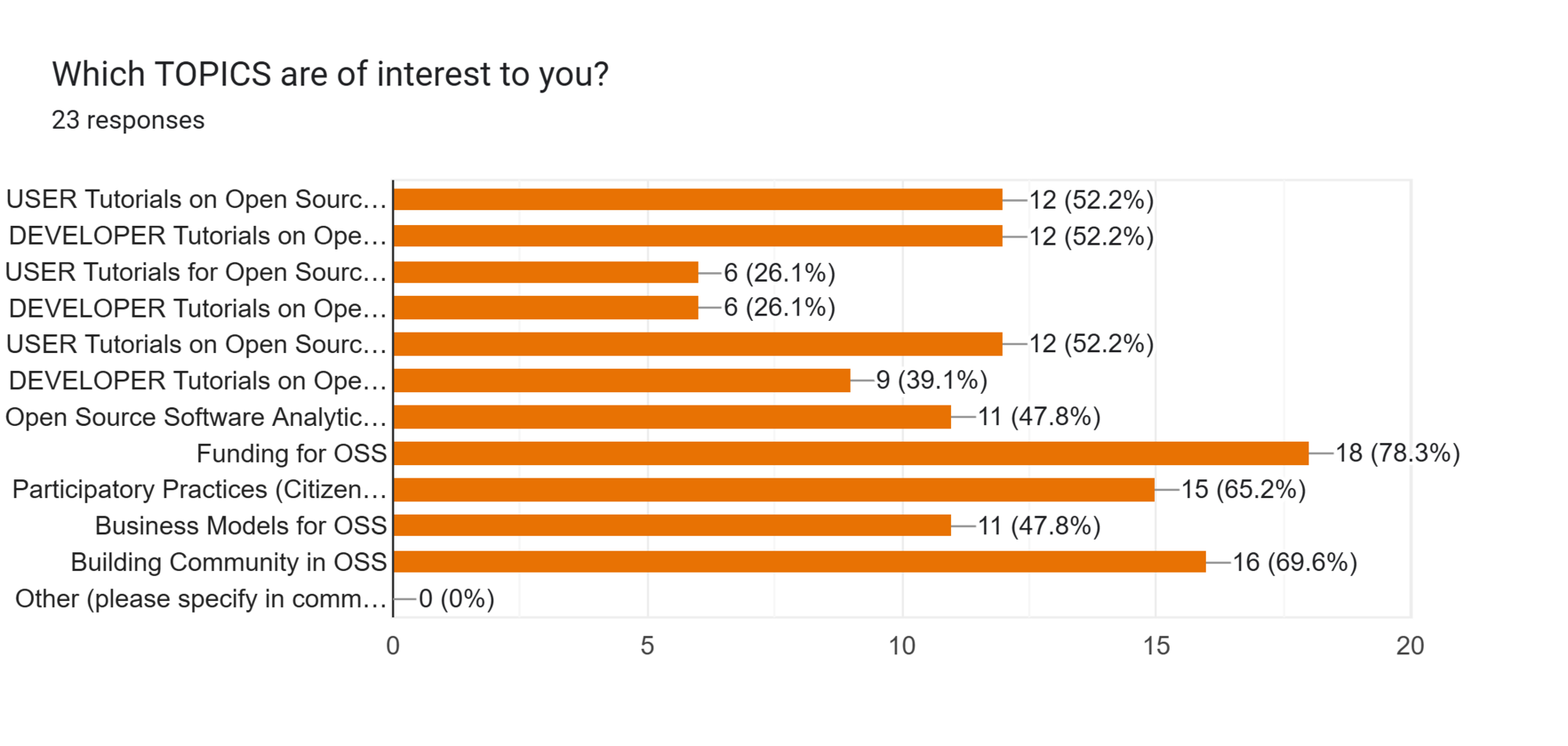
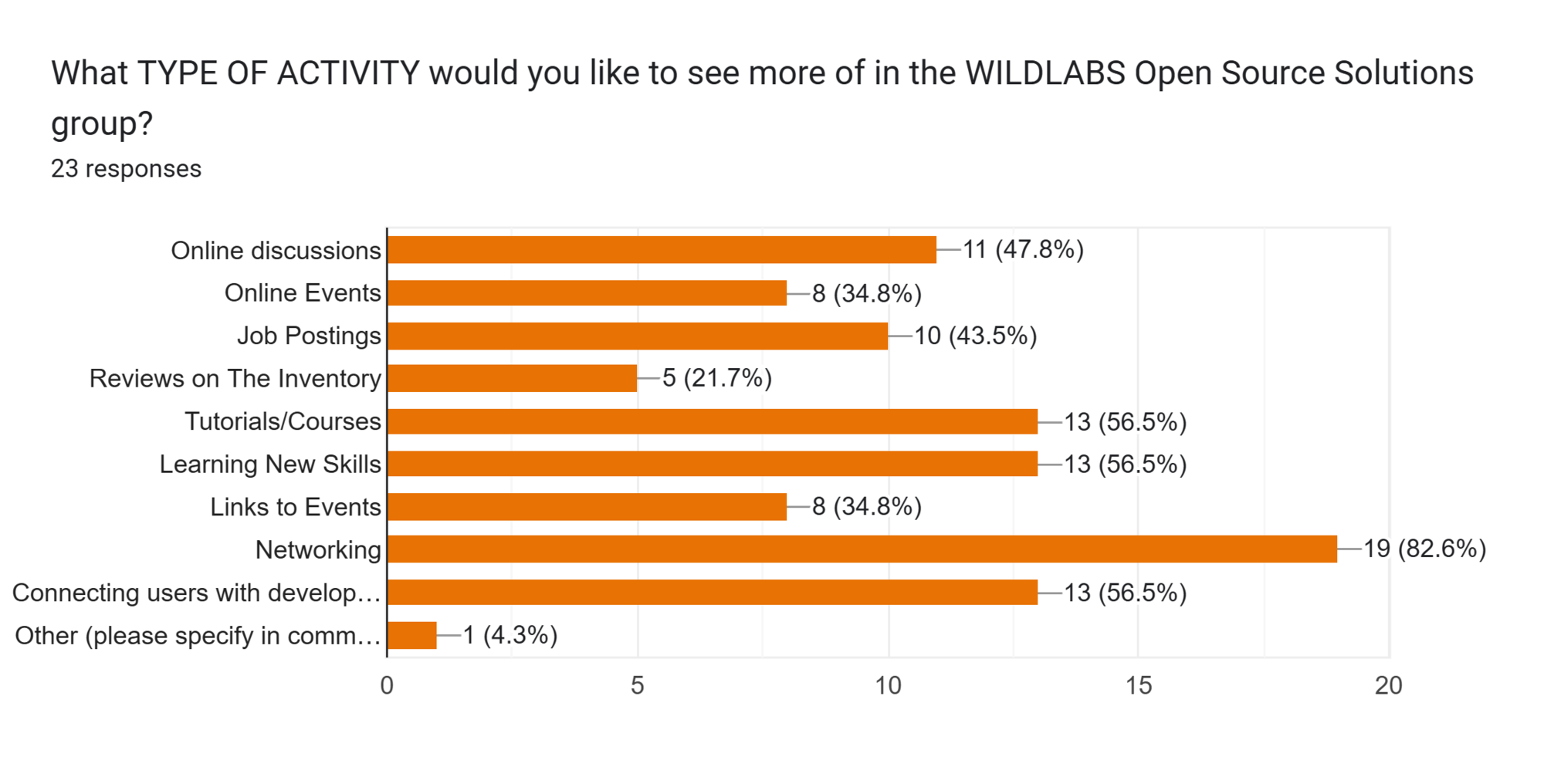
Somehow I forgot to add the most important graphs!?!?! Here are other results from our earlier survey!!!
World Bank report: "Advancing Amazonian Conservation through Digital Technologies."
15 July 2026 1:47pm
21 July 2026 12:03am
This Wednesday, 22, at 10 am EST, we are presenting the report "Advancing Amazon Conservation Through Digital Technologies" in a webminar.
Speakers include: Michel Kerf, World Bank Regional Director for Digital & AI for LAC and Europe and Central Asia will provide introductory remarks. Erwin De Nys, World Bank Enviroment Practice Manager for LAC, Niccolò Comini will moderate a discussion between Marion Adeney, Director of Amazon & Fire Programs at Conservation X Labs, Colleen M. Scanlan Lyons, Senior Director at Governors' Climate & Forests Task Force, and Gonzalo Llosa, Technical Coordinator at the Amazon Regional Observatory (ORA).
The webinar is open to the public. It will be in English but with simultaneous translation in Portuguese and Spanish. You can RSVP here:
https://worldbankgroup.zoom.us/meeting/register/bwjdqq5jSOq86Yiud_411Q#/registration
Trapper Keeper: Scaling Open-Source AI Infrastructure for Global Biodiversity Monitoring

20 July 2026 10:42pm
The Variety Hour: July 2026
20 July 2026 3:45pm
Interested in becoming an Edge Computing group co-leader?
20 July 2026 1:02pm
24 July 2026 9:42pm
I bought four Cuddeback cameras (the CuddeLink Black Flash LL-3A model). I tested them in a two camera configuration. A handful of things I learned:
While I had read (and AI research had said) that you didn't need the mobile plan or a mobile enabled unit, you really do.
The app only works in talking over the mobile network with the home base, otherwise management of the system is really difficult through the small LCD screen on the device. You cannot connect to manage devices via wifi or Bluetooth - must have a cell node and a cell plan and cell connectivity. You can have one of the non-cell cameras act as the home base and then that camera's SD card will have all the photos from all the cameras (so make that SD card bigger than others)
There is not a video viewer on the camera, i.e. you can’t see what the camera is seeing when you deploy it. You can remove the SD card and then if you have a mobile devices with an SD card reader, you can use it.
The image syncing worked fine - but Cuddeback does not support video.
The UX on the camera is clunky so not having the app makes everything painful.
The distance between cameras allowed varies with the terrain, but in a thickly wooded area with a rolling slope I could still space them 250 meters apart, which was fine for my use case, and for flatter, sparse terrain they might be able to go further. They have a signal measure on the camera so it's easy to know if where you are placing the camera has enough connectivity.
They take 4 D batteries each, and they can't be rechargeable, and they estimate they will last only 90 days. So you really need the solar panels otherwise you're still going out to the cameras frequently to change and dispose of batteries.
I've since bought some of the solar panels and will deploy all four on my property (because I already have them), and I'll deploy them in a serial configuration A -> B -> C -> D in some hard to reach places where I don't want to have to check the traps that often.
I will not purchase the additional 12 that I was considering because:
- No video support
- No app support in Australia (and I don't have mobile signal on my property)
I think Cuddeback has done a decent job given the constraints, but they just didn't fit my use case.