
Group curators

Frank van der Most
- @Frank_van_der_Most
- | He, him
RubberBootsData

Henry Rees
- @HRees
- | Him/His
WILDLABS
Fauna & Flora

Aurelie Pollak
- @Aurel
- | She/Her
About the Group
The number one problem in nature conservation is the need for more money or access to funding. This group aims to help all WILDLABS community members with funding and financing their projects by creating a space to learn about different funding opportunities, income models and business models, improve grant applications, discover venture capital investment projects, find collaborators for funding, finance and business opportunities, and more.
What the Group Offers
The group offers a space to:
- Ask questions and discuss finding and applying for Funding and Finance
- Brainstorm about Funding and Finance wishlists for types of instruments, eligibility criteria, thematic and geographic priorities
- Publish and be alerted to opportunities
- Publish support resources like grant-writing courses, grant-finding databases, consultant-influencers blogs/Medium/LinkedIn, business development, and project planning courses
- Review and comment on opportunities
- Ask for and provide peer feedback on draft applications
- Learn about funding and finance providers’ views and practices
- Learn about business models for companies and income models for NGOs
- Find collaborators or mentors
- Learn about and attend virtual series and events with live discussions relating to funding and finance information and training
- Identify and facilitate opportunities where WILDLABS community members can collaborate on project applications to increase likelihood of success and impact
- Share fundraising collaboration opportunities, events and resources
- Consultation meetings to discuss collaboration plans, aims or ideas, income and business models
Interested in funding opportunities? Check out the WILDLABS resources page and filter for “Funding Opportunity.”
Resources
- Databases for funding and finance
- Funding options for nature conservation
- Nature conservation grant writing courses
- Nature conservation crowdfunding platforms
Header image credit: Jitu Mondal
Group curators
- @Frank_van_der_Most
- | He, him
RubberBootsData
Field data app developer, with an interest in funding and finance





- 64 Resources
- 205 Discussions
- 9 Groups
- @HRees
- | Him/His
WILDLABS & Fauna & Flora
WILDLABS - Programme Development Manager, keen interest in bats, hyenas and tech!





- 22 Resources
- 39 Discussions
- 6 Groups
- @Aurel
- | She/Her
Looking to reconcile biodiversity conservation and finance.
- 2 Resources
- 1 Discussions
- 10 Groups
No showcases have been added to this group yet.

- @Dauson_M
- | Mr
Dauson Msumange is a social enterpreneur, founder and director of Tanzania Eco-Tech And Conservation Hub (TEACH).
- 0 Resources
- 1 Discussions
- 23 Groups

- @lebenavalli
- | She/Her
I am the Founder and CEO of the Pró Onça Institute, an NGO focused on large carnivore conservation, women's empowerment in science, and community-based solutions for biodiversity preservation.
- 1 Resources
- 4 Discussions
- 4 Groups

- @jgaryi
- | She/her
Ecosonus
Researcher and co-founder of Ecosonus, a startup incubated at Harvard Innovation Labs that develops AI-powered tools combining bioacoustics, remote sensing, and geospatial modeling to monitor biodiversity.

- 4 Resources
- 4 Discussions
- 6 Groups

WILDLABS & Wildlife Conservation Society (WCS)
I'm the Bioacoustics Research Analyst at WILDLABS. I'm a marine biologist with particular interest in the acoustics behavior of cetaceans. I'm also a backend web developer, hoping to use technology to improve wildlife conservation efforts.


- 45 Resources
- 40 Discussions
- 34 Groups

- @carlybatist
- | she/her
ecoacoustics, biodiversity monitoring, nature tech


- 133 Resources
- 373 Discussions
- 19 Groups
- @HRees
- | Him/His
WILDLABS & Fauna & Flora
WILDLABS - Programme Development Manager, keen interest in bats, hyenas and tech!
- 22 Resources
- 39 Discussions
- 6 Groups

- @StephODonnell
- | She / Her
Tech, Sustainable Finance at World Bank & CFA (prev. Founder WILDLABS)


- 197 Resources
- 670 Discussions
- 31 Groups

My research focuses on using Next-Generation Sequencing (NGS) to study endangered species, including carnivores, chiropterans (bats), and lizards, as well as their microbiomes.

- 7 Resources
- 9 Discussions
- 20 Groups

- @Pema
- | He/Him/His
Naturalist/Wildlife Biologist
- 1 Resources
- 1 Discussions
- 6 Groups

I'm a software developer that has pivotted to starting a company, Wildlife Security Innovations, to help people and wildlife live together safely.
- 0 Resources
- 500 Discussions
- 8 Groups

- @Lysa001
- | she/her
Ecologist & Conservationist | Sabah, Malaysia #sundapangolin #movementecology #communityengagement #publicoutreach #conservationpolicy
- 0 Resources
- 0 Discussions
- 15 Groups
- @Frank_van_der_Most
- | He, him
RubberBootsData
Field data app developer, with an interest in funding and finance
- 64 Resources
- 205 Discussions
- 9 Groups
Article
WILDLABS Awards 2026: Meet the Judges
Henry Rees
While the WILDLABS Awards 2026 submissions are in the final round of judging, meet the panel that is currently reviewing the shortlist of applications.
22 May 2026
Article

🌍 Conservation technology is transforming how we protect wildlife, but are we thinking carefully enough about the risks? Drones, camera traps, GPS trackers, acoustic sensors, AI, and remote sensing have become...
22 May 2026
Funding

3 scholarships for aspiring ecopreneurs from the Global South Now. Do you know anyone who would benefit? (In 8 weeks, we help people to go from a wild idea to launching their nature NGO/company)
30 April 2026
Article
How to find collaborators for research or business
Frank van der Most
A relatively new member asked me this question. Since my answer was quite generic, and since others may have a similar question, I have rewritten it as an article. If you have additions or different experiences, please...
9 March 2026
Funding
Funding Opportunity - Ebbe Nielsen Challenge 2026

Maristela Martins de Camargo
The GBIF Ebbe Nielsen Challenge is an annual competition that seeks to inspire innovative applications of open-access biodiversity data. In 2026, the Challenge will award a total of €20 thousand for advancements in open...
26 February 2026
Funding
WILDLABS Awards 2026: Express Your Interest Now!

WILDLABS Team and 1 more
Applications are now open for up to 15 projects to receive grants of $50,000 and $10,000, engineering and technology support from Arm, and access to the world's largest conservation technology community. Submit your...
18 February 2026
Funding
Renewables Environmental Research Initiative (RERI)
Harriet Pinder
Notification of Intent to Apply Launched
13 January 2026
Careers
Interim Co-Chair Position with Move BON

Lacey Hughey
Move BON is seeking a new Interim Co-Chair to help shape the future of biodiversity observation and movement ecology.
6 January 2026
Article

The University of Hawai‘i - Ocean & Resources Engineering program is seeking project ideas from community groups, marine/ocean scientists, government agencies, companies, and non-governmental organizations for their...
16 November 2025
Funding

Allen Family Philanthropies has issued a call to non-profit organizations across the U.S. that are working in the Natural Climate Solutions (NCS) space to break implementation barriers using science and technology.
13 November 2025
Link
CFA's Conservation Finance Guide
Frank van der Most
Everything I, and hopefully you too, always wanted to know about conservation finance, from introduction to basic concepts to detailed descriptions of particular finance instruments, to business plans and planning.
11 November 2025
Funding
Conservation Finance Alliance Incubator round 4
Frank van der Most
CFA Incubator is searching for "innovators to turn bold ideas into practical, scalable conservation finance solutions" ( USD 25 K grant )
11 November 2025
June 2026
event

Rebekka Stutz
March 2026
event
Diana Mastracci
| Description | Activity | Replies | Groups | Updated |
|---|---|---|---|---|
| With the judging process for the 2026 WILDLABS Awards now underway, we are excited to share a look at the statistics behind this year’s... |
|
Funding and Finance, Community Base | 2 weeks 6 days ago | |
| Hi, would the direct costs be included in the awarded amount, or be in addition to it (i.e., $10,000 + overheads if accepted)?Thank you |
+18
|
Funding and Finance, Community Base | 1 month 1 week ago | |
| Hey LeonardoI might have something. Lets chat, reach out to me at [email protected] |
|
Acoustics, AI for Conservation, Community Base, Drones, Funding and Finance, Open Source Solutions, Software Development | 1 month ago | |
| Greetings, I'm based in Gibsonia, PA and looking to help anyway I can part time either local or remote.My skillsets are the following:.NET... |
|
Acoustics, AI for Conservation, Animal Movement, Autonomous Camera Traps for Insects, Build Your Own Data Logger Community, Camera Traps, Citizen Science, Climate Change, Community Base, Connectivity, Conservation Dogs, Conservation Tech Training and Education, Data Management & Mobilisation, Drones, Earth Observation 101 Community, East Africa Community, Edge Computing, eDNA & Genomics, Emerging Tech, Ethics of Conservation Tech, Funding and Finance, Geospatial, Human-Wildlife Coexistence, Latin America Community, Marine Conservation, Protected Area Management Tools, Sensors, Sustainable Fishing Challenges | 2 months 2 weeks ago | |
| Hi Susan, Thank you for your message. I apologise, but as we are a non-profit and mostly volunteer-run, we are presently unable to provide funding support to people to... |
|
AI for Conservation, Citizen Science, Climate Change, Community Base, Connectivity, Conservation Tech Training and Education, Drones, Early Career, East Africa Community, eDNA & Genomics, Emerging Tech, Ethics of Conservation Tech, Funding and Finance, Human-Wildlife Coexistence, Marine Conservation, Open Source Solutions, Protected Area Management Tools, Women in Conservation Tech Programme (WiCT) | 4 months ago | |
| Are you focussing on investment in the strict sense (i.e. put money in with the expectation of getting more money out) or are you also interested in donor funding (put money in... |
|
Funding and Finance | 6 months ago | |
| Hi Maria,Thanks for your comment and patience. The winners will be announced this week.All the best,Henry |
+46
|
Funding and Finance, Community Base | 7 months 2 weeks ago | |
| Not a bad idea to join the BCA calls, will look into it.I agree it is more difficult to come up with a standardize unit of measurement for biodiversity, and this will probably... |
|
Funding and Finance | 8 months ago | |
| Hi there Elsa, oh thanks so much for that site!! So helpful I really appreciate it! |
|
Geospatial, Software Development, Climate Change, Funding and Finance, Marine Conservation, Open Source Solutions | 8 months 1 week ago | |
| Hi Manuel,Perhaps at this one Neotropical Birding and Conservation FundAlso, the About page of the Funding and Finance Group has a list of resources that may help you find funding... |
|
Funding and Finance, Acoustics, Latin America Community | 8 months 2 weeks ago | |
| Hi Shannon, thanks for sharing this.I've given your account the ability to post funding opportunities, if you also wanted to share this as one of those too. It could be helpful... |
|
Funding and Finance, Open Source Solutions | 8 months 4 weeks ago | |
| Hi Both!Thanks for the feedback, I agree it would be nice to have the option for users to subscribe to some form of direct on-site/email notifications for new posts of specific... |
+4
|
Funding and Finance, Community Base | 9 months ago |























WILDLABS Awards 2026: Meet the Judges
22 May 2026 2:49pm
Help shape best-practice guidance on conservation technology - input to survey
22 May 2026 10:20am

WILDLABS Awards 2026: Statistics
14 May 2026 5:17pm
WILDLABS Awards 2026: Ask Your Questions!
18 February 2026 8:44pm
30 March 2026 9:04pm
Hi! I was wondering if all applicants for the WILDLABS 2026 Awards EoI will receive a status notification, or only those invited to submit a full application?
1 April 2026 9:59am
Hi Ana,
Thank you for your question. Everyone who applied will receive a notification of the status of their application. You should hear back within the next two weeks.
Many thanks,
Henry
23 April 2026 4:52am
Hi, would the direct costs be included in the awarded amount, or be in addition to it (i.e., $10,000 + overheads if accepted)?
Thank you
Nature Credit Markets Webinar with Sensing Clues: Trustworthy Data for Validation and Verification Purposes
11 May 2026 6:51am
Looking for opportunities in AI for Bioacoustics and Environmental Monitoring
6 April 2026 10:37am
8 April 2026 7:26pm
Hi I am also looking for collaborators
Looking for Collaborators: AI-Powered Backyard Bee Monitor for Citizen Science | WILDLABS
if interested in the project let me know
we can add acoustic monotoring for bees
17 April 2026 1:19pm
Hi Leonardo,
Let’s chat! I potentially have some opportunities, collaborations or even short-term employment. Send me a message.
1 May 2026 3:51pm
Hey Leonardo
I might have something. Lets chat, reach out to me at [email protected]
3 Scholarships for aspiring Ecopreneurs from Global South
30 April 2026 6:01pm
Looking To Utilize My Skillsets To Help
19 March 2026 10:26pm
How to find collaborators for research or business
9 March 2026 11:03am
11 March 2026 9:22am
Great summary, Frank. I agree with and have experienced many of the points. I have asked and get asked for collaborations, but many people don't realize how big of a commitment it actually is. There are so many things that complicate it, ie:
All this isn't to discourage people from collaborations. A good collaboration can lead to great things and a lot of innovation. Each collaboration is an opportunity to create something innovative and impact the world. For us, collaborations are great and have led to amazing projects that we could have never pulled off alone. But it's always best to be aware of and head off the potential messy issues that may come up.
Hope this helps anyone that wants to start a collaboration. I think it's best to balance casual-ness with awareness of the realities of where things may go.
Akiba
12 March 2026 6:10pm
Hej Akiba!
What a great follow up on the article! Good to know that you share my insights and experiences. And more importantly, as becomes abundantly clear from your long addition, inviting someone, getting invited and accepting the invite is really still just the beginning, even after all the work done to become part of a community.
Lots of pitfalls, but warning and solving these issue is in part what WildLabs is for!
When Wildlife Becomes Data: Ethical AI in Biodiversity Monitoring- Join the GEO Indigenous Alliance Summit 2026 March 16-19
5 March 2026 3:53pm
Funding Opportunity - Ebbe Nielsen Challenge 2026
26 February 2026 1:54pm
WILDLABS Awards 2026: Express Your Interest Now!
18 February 2026 8:14pm
Women in Conservation Forum (WiCF) 2nd March in Nairobi: GoFundMe platform
30 January 2026 5:14am
30 January 2026 10:52am
Hello Macayle
It is of great pleasure that there is this opportunity coming to East Africa. I would like to attend this. Do you have any recommendation for funding a student to attend such a forum? I will share this opportunity with our East Africa WhatsApp group too.
2 February 2026 2:33am
Hi Susan,
Thank you for your message.
I apologise, but as we are a non-profit and mostly volunteer-run, we are presently unable to provide funding support to people to travel to Nairobi for the forum.
Thank you for sharing WiCF with the whatsapp community; that’s lovely of you!
I can write up an official letter of invitation if that would help with a university bursary application, and WiCF attendees will receive a certificate of attendance for the day.
I have a small invitation flyer; feel free to share this with others who may be interested.
Kind regards,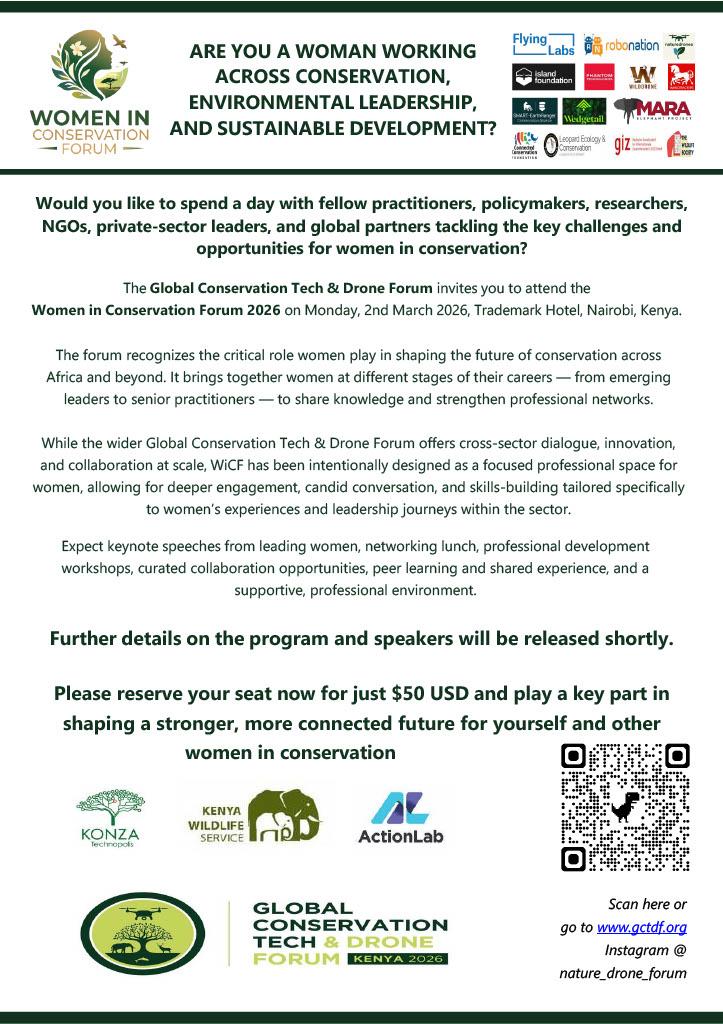
Macayle
Renewables Environmental Research Initiative (RERI)
13 January 2026 1:51pm
Interim Co-Chair Position with Move BON
6 January 2026 6:58pm
Interview request: conservation investment
21 October 2025 10:20am
4 November 2025 9:58am
Actually, I'd like to add, not only early stage startups, but some particular subset of early stage startups :)
None the less, a business model like Margo supplies is a more sustainable approach and that Marley has managed to do it for so long make's it an excellent candidate for an interview :-)
15 November 2025 8:05am
Hi Eden,
Perhaps you should also post your question in the 'Community base' group. It may give you a wider audience within WILDLABS. Just click on 'Edit' to edit your post and add the group in the box where you've picked Funding and Finance.
I am curious, for which medium are you writing your article?
'Too small' is one of the big roadblocks for investment in nature conservation. Do you see solutions for that problem, or do people that you're interviewing see them?
29 November 2025 9:26am
Are you focussing on investment in the strict sense (i.e. put money in with the expectation of getting more money out) or are you also interested in donor funding (put money in with no expectation of getting any of it back again)?
🚨 🔔 Call for Project Ideas: Partner with Graduate Ocean Instrumentation and Technology Course!
16 November 2025 7:22am
RFP for $10 Million to Accelerate Natural Climate Solutions
13 November 2025 5:01pm
CFA's Conservation Finance Guide
11 November 2025 10:05am
Conservation Finance Guide
" /> <link rel=
Conservation Finance Alliance Incubator round 4
11 November 2025 9:10am
Become a Partner for the International Conservation Technology Conference
6 November 2025 5:42pm
Announcing the Boring Fund 2025 Grantees
21 October 2025 2:20pm
22 October 2025 5:26pm
So cool!
22 October 2025 6:47pm
Congratulations to all grantees
24 October 2025 7:07pm
Congratulations 🥳 👏 to the leaders.
📈☘️🏞️♻️💚
The Boring Fund 2025: Ask your questions!
2 July 2025 5:10pm
29 September 2025 9:36am
Hi all,
Thank you for your questions and for your patience, we are preparing to contact applicants for The Boring Fund this week, we look forward to updating you soon.
Many thanks,
Henry
15 October 2025 1:28am
Hello! I hope you are well.
I’m writing to you because I would like to know if the winners of Boring fund grant were announced.
Regards,
20 October 2025 2:00pm
Hi Maria,
Thanks for your comment and patience. The winners will be announced this week.
All the best,
Henry
Nature Intelligence for Business Grand Challenge
19 October 2025 5:53pm
NEW! eDNA Collaborative 2025 Microgrant
15 October 2025 9:49pm
What do you think about Nature-Credits?
19 September 2025 9:05am
26 September 2025 4:11am
I believe there are a few issues that are being grappled with in the nature/biodiversity credit initiatives that are being undertaken. One of them is the issue of fungibility, ie: for carbon markets, 1 ton of CO2 in the US is the same as 1 ton of CO2 in Bermuda. So the market can trade based on the principle of equivalency.
To offset biodiversity loss, you would have to deal with this equivalency. For example, would 1 hectare of tropical forest in Indonesia being lost to palm plantations be equivalent to restoring 1 river in the Mekong and saving 5 tigers?
There are currently a few biodiversity credit initiatives going on right now and I recommend you talk or attend the calls for them. The BCA (Biodiversity Credit Alliance) has regular calls and is quite open to new members. I was discussing some of the biodiversity credit issues with the head of BCA at a conference in Bangkok and he is very interested in getting orgs and people that are active and enthusiastic about pushing the market forward. It's a bit slow to take off at the moment as I understand it.
Hope that helps.
Akiba
29 September 2025 7:09am
Spending more time exploring this topic, I've learned how the full "value chain" looks like:
So I can count at least 5 "hands" the credits need to pass to be born in to existance.
29 September 2025 7:18am
Not a bad idea to join the BCA calls, will look into it.
I agree it is more difficult to come up with a standardize unit of measurement for biodiversity, and this will probably slowdown the whole process. There are a few nature-credit certifiers who come with their own methodology for measuring it, and according to their claims - they strive to make it more generic (meaning: one report should ± fit all certification methodologies). Lets see how it will turn out.
Anyone using InVEST?
10 July 2025 1:31pm
23 September 2025 6:21pm
There's a great online forum where you can ask questions in case you get stuck :) Hope it all goes smoothly though!
23 September 2025 6:23pm
Thanks John! We'd love to try out different models for scenario planning in the future so may reach out.
24 September 2025 9:19pm
Hi there Elsa, oh thanks so much for that site!! So helpful I really appreciate it!
Suggestions for research funds
10 August 2025 5:56pm
19 September 2025 8:15am
Hi Manuel,
Perhaps at this one Neotropical Birding and Conservation Fund
Also, the About page of the Funding and Finance Group has a list of resources that may help you find funding.
Perhaps you've found the page in the meantime. Sorry for my late reply. I was on holidays when you wrote and had overlooked your post after my return
cheers
Frank
The Boring Fund 2025 Statistics
17 September 2025 6:57pm
18 September 2025 8:51am
Thanks for the stats' @HRees ! I'm curious what kind of data management and mobilisation platforms applicants are using? And what boring stuff they need the money for? Like, hosting, license costs or development?
19 September 2025 8:20pm
Brilliant stats
23 September 2025 9:26pm
I consider data work more boring than any other conservation technology and we have a substantial number of project in taht category. This statistics is really useful and impressive
Carbon Accelerator Programme for the Environment (CAPE)
15 September 2025 4:05pm