


Michael Kowalski
- @mbkowalski11
- | he/him
University of California Santa Cruz
Related Inventory Content
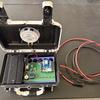
The Ambiance team has had a productive year with the support of WILDLABS and Arm. The Ambiance Project was sparked four years ago at the beginning of my PhD when I needed a device that could broadcast playback treatments in remote field settings to evaluate the impacts of human presence on ecosystems. I couldn’t find any preexisting technology that would fit the bill and so I collaborated with several teams of engineering undergrads and iterated through three generations of Ambiance prototypes until we arrived at the device we have deployed through our 2025 WILDLABS Award. During our first field test in 2024, we conducted a landscape-scale playback experiment at Mpala Research Centre in which we exposed free-living wildlife to human voices or a control treatment. We observed strong behavioral responses to human presence across the entire mammal guild that resulted in trophic cascades – but we were particularly focused on the responses of elephants to human voices: reductions in detection frequency by 54%, foraging by 80%, and tree damage by 64%. This massive reduction in foraging effort due to perceived anthropogenic mortality risk inspired us to leverage Ambiance not only as a means to understand basic ecological relationships, but as a tool that could be applied in community settings to reduce elephant crop raiding and large carnivore livestock depredation (e.g., lions, leopards, spotted hyenas, wild dogs).
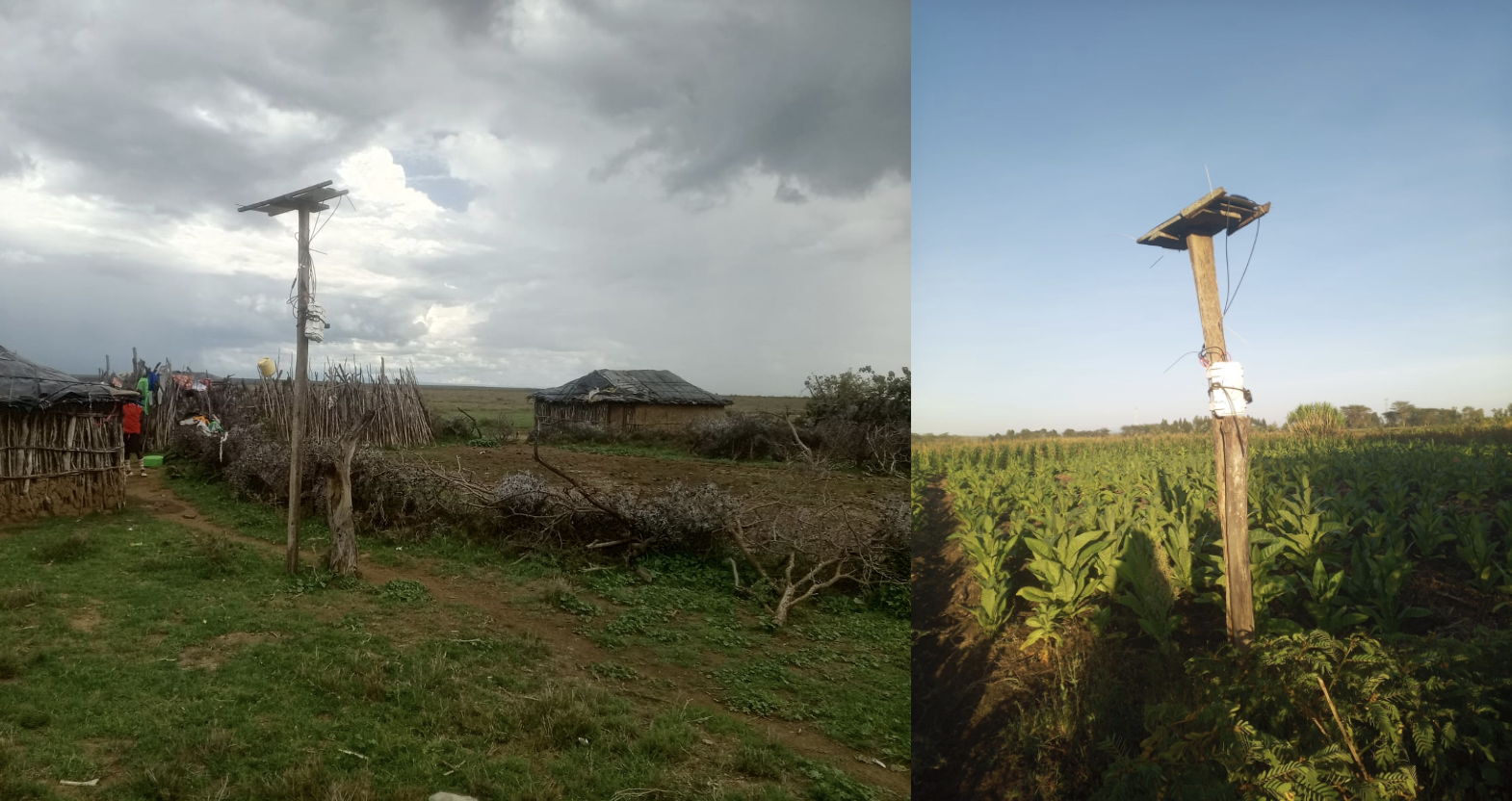
Human-wildlife conflict (HWC) is an acute and pressing conservation issue in Laikipia County, Kenya. Laikipia hosts the second largest concentration of wildlife in Kenya, and due to extensive subdivision, under resourced agropastoral communities directly abut wildlife conservancies and are inadequately equipped to repel foraging large mammals. To address this resource gap, we sought to establish landscapes of fear on community farms and livestock corrals using Ambiance units to broadcast human voices and elevate perceived risk around vital community resources. To evaluate the effectiveness of Ambiance as a HWC deterrent, we manufactured 60 Ambiance units in Kenya and deployed 20 on subsistence farms and 20 on livestock corrals called bomas. We then alternated on a monthly treatment schedule between human voices and cricket choruses (control) to compare the prevalence and intensity of crop raiding and livestock depredations between treatments.
What We Found
Over the course of the first four months of playback exposures (two human and two control treatment periods), elephants reduced presence on farms by 75% (7.3 to 1.9 detections/month), increased their distance from Ambiance units by 6.6x (14 to 93m), reduced their likelihood of raiding given they present on a farm from 75% to 22%, and area of crops damaged by 86% (5079 to 699 m2/year) during human playbacks in comparison to control treatments. Meanwhile large carnivores reduced their presence around bomas by 48% (5.1 to 2.7 detections/month), increased their distance from Ambiance units by 5.6x (23 to 129m), and reduced livestock attacks by 89% (1.8 to .2 attacks/year) during human playbacks in comparison to control treatments. Notably, these measures have remained through those 4 months and we have not detected any signs of habituation. At this juncture, we feel confident that proactive human playbacks can effectively reduce HWC intensity and frequency in multiuse landscapes where wildlife have negative interactions with humans via short term deployments around a harvest or calving season when conflict is particularly acute.
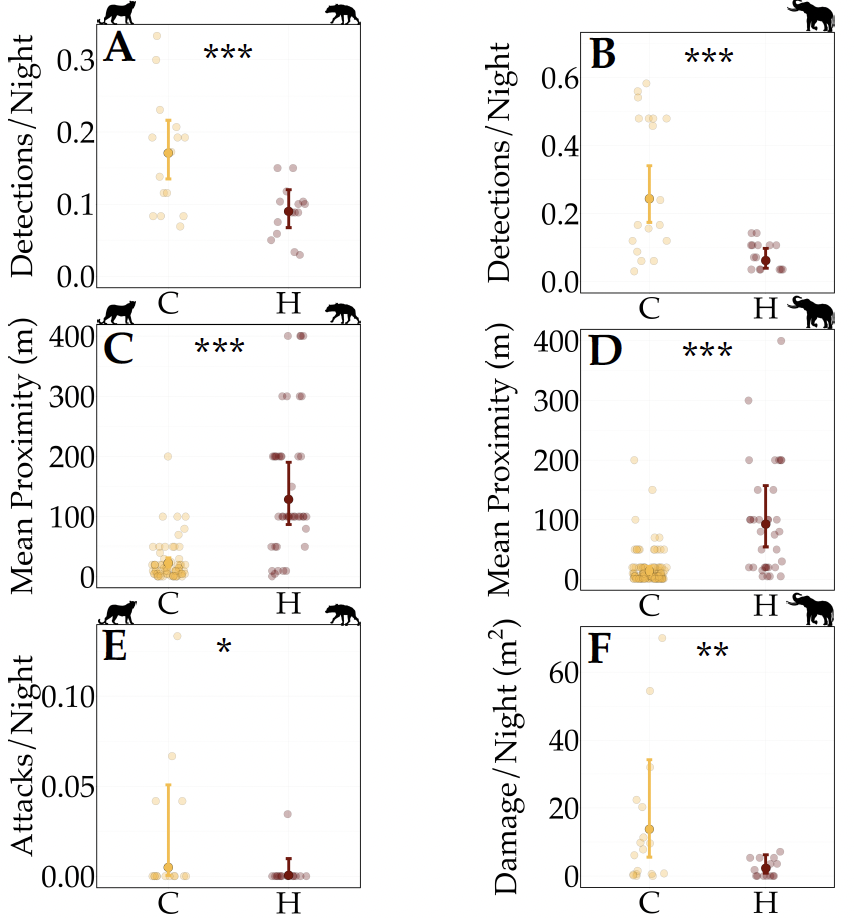
Although we initially intended to repeat our monthly treatment design over the course of a year to accrue a sufficient sample size, we achieved our intended statistical power to differentiate treatment effects after 4 months and have thus proceeded with a new experimental design intended to evaluate the long-term stability of human playbacks for mitigating HWC. For the remaining 8 months (through September 2026) of our intended experimental period, we will deploy continuous human playbacks to evaluate long-term habituation rates to human playbacks.
Ambiance Specifications
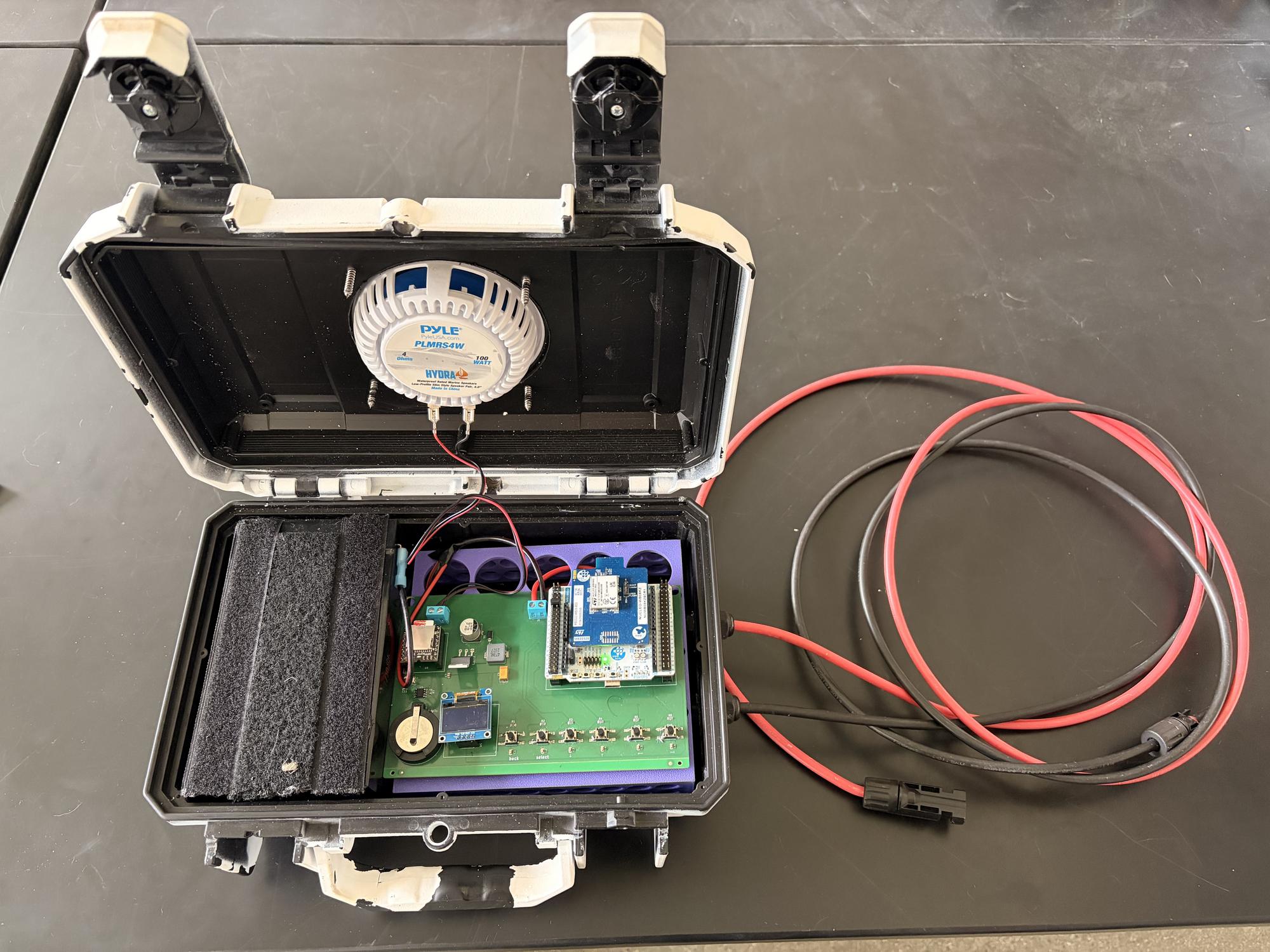
Third third-generation Ambiance playback speakers are weatherproof, solar-powered devices that have been designed for long-term, off-grid field deployments in harsh conditions. They have been programmed to broadcast playback treatments via audio tracks organized into treatment folders on a microSD card. Multiple treatments can be schedule over the course of a day and these treatments will repeat daily for the specified duration of days. In our most recent Ambiance prototype, we focused on usability and ease of manufacturing. To this end, we created a custom GUI that allows users to change playback parameters (e.g., volume, duty cycle, treatment, etc.) over Bluetooth without removing Ambiance units from the field and optimized our printed circuit board with surface mount components to speed up assembly with reflow ovens. Playbacks can also be fully parametrized through the units OLED display. For more information on Ambiance specifications, please consult The Inventory or the Ambiance GitHub Repository.
Unforeseen Challenges
While we executed the field component of our research very effectively, we did run into several unforeseen snags prior that delayed our fieldwork. The first was delays and expenses associated with changes in tariff policies, as well as import controls on equipment related to the solar industry. We were able to find work around through third parties to get the equipment we needed to our field site, but it did increase costs and cause use to get started later than we anticipated. The other challenge we encountered was persistant automation bug in the DFPlayer Mini MP3 module — a cheap, widely used component whose internal logic, we learned the hard way, is poorly documented and behaves unpredictably under certain conditions. After extensive troubleshooting, we were able to isolate and circumvent the issue by forcing the DFPlayer Mini to skip a particular audio track position. However, if we were to go through another round of prototyping, we would utilize a more reliable MP3 microcontroller.
Continuing Plans
At the conclusion of our year-long experiment, Ambiance units deployed in the field will be managed by local project partners as part of a nimble community loaner program which will deploy units on a short-term basis to areas of acute conflict across Laikipia. While we do plan on publishing this work in an open-access, peer-reviewed journal, we have uploaded all of our hardware, software, and assembly manuals to a GitHub Repository linked to Ambiance’s page on The Inventory. We hope this facilitates at-cost DIY manufacturing within academic labs, conservation NGOs, and government environmental agencies and are happy to provide support to those interested in assembling their own units. Ambiance units are broadly applicable across continents, biomes, focal taxa (any species that perceives and responds to acoustic cues), and audio playback treatments. Likewise, we are looking for collaborators to further field test Ambiance for both basic ecological research and HWC mitigation in new and exciting ways. Lastly, DIY assembly is not suitable for all parties interested in Ambiance deployments. @Martin Shungoh is available to manufacture Ambiance units for members of the East African community, however, we are looking for manufacturers in other parts of the globe as well. Please reach out on WILDLABS or email me ([email protected]) if you are interested in collaborating with us or manufacturing Ambiance units.
This project was supported by the 2025 WILDLABS Awards, funded by Arm. Huge thanks to the WILDLABS team and Arm for backing this work, our UCSC engineering undergrad capstone teams for developing Ambiance prototypes, @mattShungoh for importing materials and manufacturing our Ambiance units, local conservation partners for facilitating fieldwork in local communities, Anderson Larpei for coordinating research operations, and to the participating community households across Laikipia for their generous time and consideration.