


Hannes Fischer
- @grandonia
- | he
Hello everyone,
I’m reaching out to discuss a challenge we’re tackling here in Brazil related to pest monitoring in agriculture. Thrips (Frankliniella spp., Thrips spp., and Caliothrips spp.) are a significant threat to crops like tomatoes, potatoes, peppers, and onions, causing up to 80% yield losses through direct damage and virus transmission. Beyond thrips, larger pests such as whiteflies, aphids, or beetles also pose significant challenges. Detecting these pests, ranging widely in size, on the same sticky traps is a key hurdle we’re aiming to overcome.
Putting Pest Sizes in Perspective
- Thrips: Tiny pests, typically 1–2 mm in length, requiring imaging systems with fine detail to differentiate them from debris or background noise.
- Whiteflies: Around 1–2 mm in length, similar to thrips but more visually distinct due to their color and shape.
- Aphids: Typically 2–5 mm, larger but still small enough to demand precision in imaging.
- Beetles and Moths: Larger pests, ranging from 5–20 mm, requiring detection systems that can handle broader scales.
This size variation complicates image capture, as it demands both high resolution (to capture small pests like thrips) and broader coverage for larger pests—all while maintaining cost efficiency.
Current Approach
We currently use yellow sticky traps combined with 16MP digital microscopes (I used a cheap one from amazon.com, so I don't really think the resolution is that high, probably more in the 2-4MP range), see a picture below:
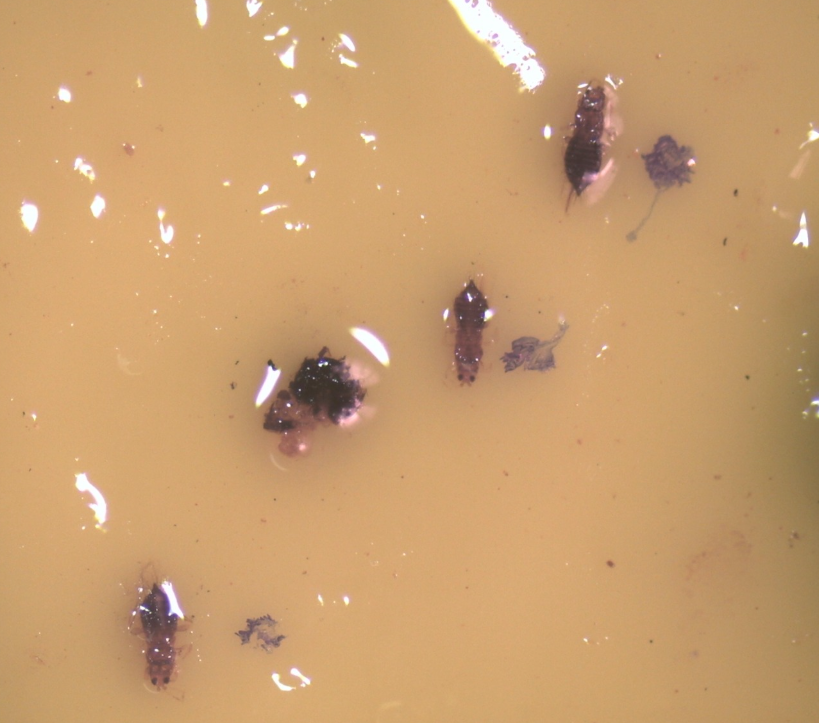
to capture images for analysis using an AI-powered detection system. This method is effective, reducing manual inspection time by 70% and achieving high detection accuracy ([email protected]: 0.869). However, it is costly and still labor-intensive, we wanted to reduce the identification process by at least 90% in time, from 10h per double sided sheet to maybe 10min max. With this microscope, each session requires capturing around 60 images, making it challenging to scale for broader use. (I’ve attached a banner we recently presented at a scientific conference for additional context.)
Exploring Better Solutions
We are now looking for cost-effective alternatives that can capture high-quality images of sticky traps while detecting both thrips and larger pests. Some ideas we’re exploring include:
- Flatbed Scanners: These could scan entire sticky traps in one go, reducing imaging time and ensuring consistent quality. We’re testing a setup with a needle-like support frame to keep the sticky glue from dirtying the scanner glass.
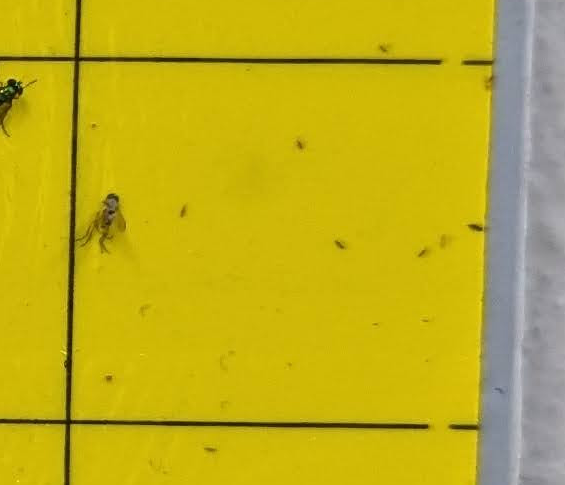
- High-Resolution Cameras or Smartphones: While promising, even high-end models like the iPhone 15 or Google Pixel 6 Pro didn’t provide sufficient resolution for capturing the whole trap while meeting our requirement of at least 30 pixels per mm. Below is the resolution I got from the Google Pixel 6 Pro, fine, but not enough. I got over 10 pixels / mm but the model didn't work out that good with this resolution.
- Other Ideas?: Are there other imaging technologies or systems that could balance cost, scalability, and quality?
Why It Matters
Our ultimate goal is to develop a scalable solution that meets the resolution needs for accurate detection of both small pests like thrips and larger pests like beetles while supporting sustainable agricultural practices like Integrated Pest Management (IPM). Sticky traps are inexpensive in Brazil, so field-deployed automated camera systems aren’t practical for most farmers. Instead, if farmers can capture high-resolution images (minimum 30 pixels per mm) with affordable tools, we can process them using our YOLO-based AI system to provide rapid, accurate results.
How You Can Contribute
We’d love to hear your ideas on:
- Experiences with imaging technologies for detecting pests of varying sizes.
- Methods for validating new imaging solutions (e.g., scanner vs. microscope comparisons).
- Collaborations to prototype and test low-cost solutions.
Let’s brainstorm a scalable, efficient pest monitoring system that empowers farmers to respond quickly and accurately to pest threats. Your input could be pivotal in creating a system that detects both tiny thrips and larger insects simultaneously!
For context, we’re a university-based group hosted by the Precision Agriculture Faculty at FATEC Shunji Nishimura, located in the interior of São Paulo state, about 500 km west of São Paulo City.
Looking forward to your ideas and suggestions!
Banner AgroSense CEMASU - inglês (4).pdf16 December 2024 1:28pm
What about the following approach. An 8MP camera is pretty high res. One image on that sort of camera I see here has a resolution of:
3840x2160 pixels
So to reach your pixel density you just need to divide it by 10. So 38cm needs to fill the full frame. The best camera images that you can play with yourself are likely to be security cameras I'm thinking. But you would need to replace the lens in order to focus that close. But that can't be that difficult. Then you take a snapshot and divide it up into smaller images that fit within the resolution of the matching model and process them in turn. Job done I reckon.


Kim Hendrikse