






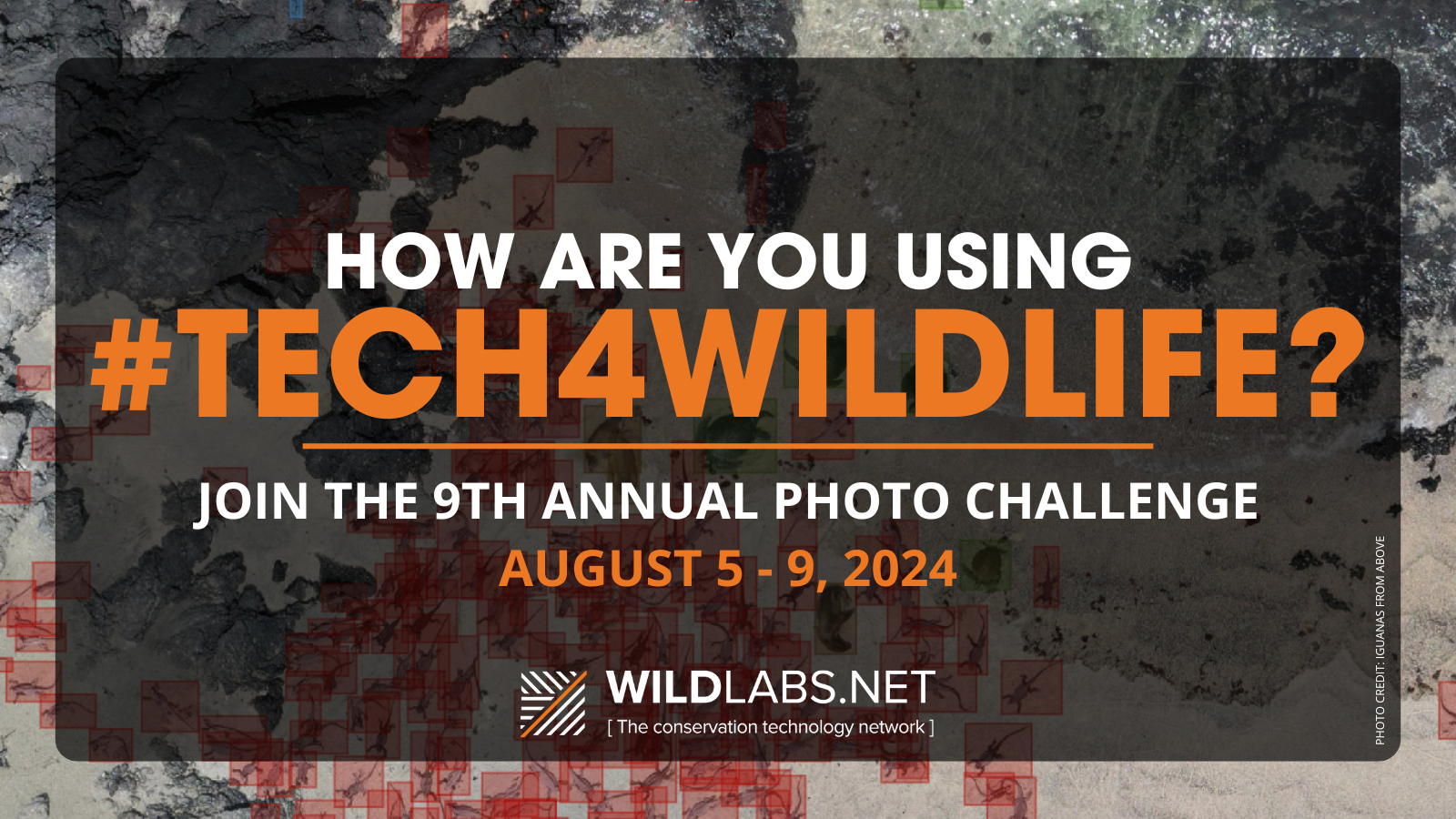
AI is changing the way we view and interact with the world in every aspect of our lives. It’s no surprise that it’s making waves in conservation, too. In past challenges, we’ve seen researchers use machine learning to identify animals by their unique thermal shape and utilize AI to identify and count iguanas from drone images. As AI continues to advance, there’s no limit to the possibilities when it comes to using AI in conservation tech.
Are you using AI in wildlife conservation efforts? Share your photos, videos, and stories with the hashtag #Tech4Wildlife!
See how current and past submissions show demonstrate how AI is shaping conservation:
2024
[2/9] The initial goal was to develop individual identification for Andean bears, but the scope of our visit quickly grew! pic.twitter.com/UO55W9quyB
— Ed Miller 🐻 (@bluevalhalla) August 6, 2024
#tech4wildlife | Addax Data Science | 28 comments
🌳 🐺 Mitigating human-wolf conflicts with AI 📸 🌲 After 150 years of extirpation, wolves have returned to the Netherlands as a protected species. However, the fragmented Dutch landscape and densely populated countryside present challenges. The high number of roads increases the risk of collisions, and wolves pose a threat to the abundant livestock. Addax Data Science, in collaboration with Smart Parks, has developed a 24-hour monitoring system to continuously check for the presence of wolves. This real-time detection system aims to reduce human-wolf conflicts by sending notifications via Whatsapp, Email, or EarthRanger events. By addressing potential encounters and protecting both wolves and livestock, this initiative can contribute to the sustainable coexistence of humans and wolves. Powered by the open-source Deepfaune v1.1 model developed by the Deepfaune initiative (https://lnkd.in/eJRUrAFj), our system not only detects wolves but also recognizes 26 European species, making it a versatile tool for general wildlife monitoring. #Tech4Wildlife WILDLABS Community @WILDLABSNET More info: https://lnkd.in/e3ZTSpdu | 28 comments on LinkedIn

Checking out camera trap images just got so much more colourful. 🐗🌈Meta just released its Segment Anything Model 2 (SAM 2) and it plays nicely with our wild boar piglets.@WILDLABSNET @AIatMeta #Tech4Wildlife #cameratrap pic.twitter.com/XN3xOU2kSm
— Robin Sandfort (@RobinSandfort) August 5, 2024
2023
#Tech4Wildlife Towards screening MegaDetected camera trap datasets for wildlife behaviours of interest with @DeepLabCut AI Residency 2022 crew using SuperAnimals. Camera trap images collected in Kruger National Park during AFSCTS2023 @WildEcoLabNMU Sex Div https://t.co/J6nPXlCVN2 pic.twitter.com/6gUHJGUvbp
— vscc 🏳️🌈 (they/them) (@vsccvscc) July 24, 2023
#Tech4Wildlife We are using Birdsy AI to connect to IP cameras, allowing users to have their cams monitored by the system, recording only clips of wildlife, IDing them and saving them to the cloud. Species are logged and the cam can be live streamed on https://t.co/2P5Wrs5eAc 😀 pic.twitter.com/BdzUMfE2xj
— BirdsyTV (@BirdsyTV) July 26, 2023
We are testing #AI as an accurate approach to identify and count #marineiguanas from #aerialimages. Our main objective is to estimate the population size of this species in a short time and help improving conservation efforts in the Galapagos Archipelago 🦎#Tech4Wildlife pic.twitter.com/jnH7FmfQXp
— Iguanas from Above (@IguanasAbove) July 28, 2023
We are using #GoPro cameras and #AI to estimate tropical fish populations at Las Estacas Spring in Central Mexico, as part of a #ReWilding project #Tech4Wildlife Usamos cámaras GoPro y una herramienta de inteligencia artificial para estimar poblaciones de peces en Las Estacas pic.twitter.com/KVkwHDJCac
— Topiltzin Contreras (@TopiltzinCM) July 24, 2023
Most bear species, like other mammals, lack distinguishing markings that can be used to identify individual animals. So studying them over time and space using cameras poses problems (see same bear below). Luckily, #FaceRecognition #AI and humans can help! 2/n pic.twitter.com/MQeoWHGP4T
— BearID Project (@bearid_project) September 14, 2022
2021
We use #Tech4Wildlife for our project developing automated methods of individual ID for brown bears and other wildlife. We use a combination of #cameratrapping, visual observations, and #machinelearning with collaborative partnerships to make this happen. @WILDLABSNET 1/ pic.twitter.com/Ro3C5r3nd7
— BearID Project (@bearid_project) March 1, 2021
We are using #Tech4Wildlife @Audiomoth to record dolphin vocalizations, #citizenscience @the_zooniverse #DeepLearning to classify recording and decode dolphin communication. #DolphinChat #citizenscience #CetalinguaProject pic.twitter.com/GpyidcWkD8
— Cetalingua Project (@Cetalingua) February 28, 2021
2020
It's @WorldRhinoDay & there is no better way to celebrate than to show how tech is key to the prevention of the eradication of species. See how WildEyes™ AI is being used to protect & monitor rhinos. https://t.co/rA6dRLrGko #resolvengo #TrailGuardAI #Tech4Good #Tech4Wildlife pic.twitter.com/4n0sMmuNCJ
— Zambezi Impact Foundation (@ZambeziImpact) September 23, 2020

2019
We're using machine learning, thermal cameras and drones to find and monitor endangered animals automatically. Animals glow brightly in thermal images making them really easy to spot, and the ML can tell species apart from their unique thermal shapes #tech4wildlife @WILDLABSNET pic.twitter.com/AFqgvFrNjA
— Dr Claire Burke (@CBurkeSci) February 26, 2019
2018
Thermal & infrared Park security system in Kenya – using AI to detect intrusions 24-7 @WILDLABSNET #Tech4Wildlife @World_Wildlife pic.twitter.com/eJ60cPSSEz
— Rachel Kramer (@RachelKramerWWF) March 1, 2018
Counting birds! Researchers are using drones to accurately count and monitor wildlife from above https://t.co/x0qThy0zWd.#AI #Tech4Wildlife
— InternetOfElephants (@ioelephants) February 26, 2018
Fantastic to see @Google @GoogleCloud engaging in #Tech4wildlife. Working with @OfficialZSL to develop a new platform to make AI accessible to all conservationists and speed up image recognition for wildlife monitoring. @WILDLABSNEThttps://t.co/Q5ha5PuYKA pic.twitter.com/dBEh7pCzoK
— sophiemaxwell (@sophiemaxwell) March 1, 2018
Related content
Article
Participate in the 2024 #Tech4Wildlife Photo Challenge!

Natalie Peoples
Participate in our annual #Tech4Wildlife Photo Challenge from August 5 to 9 by sharing photos and videos of how you use technology in your conservation work.
22 July 2024
Article
Get to know the judges for the 9th Annual #Tech4Wildlife Photo Challenge!
1 August 2024
Article
To celebrate our 9th Annual #Tech4Wildlife Photo Challenge starting yesterday, we’re taking a look at past and current submissions that feature the fastest growing areas of conservation tech: movement ecology, AI,...
5 August 2024
Add the first post in this thread.