






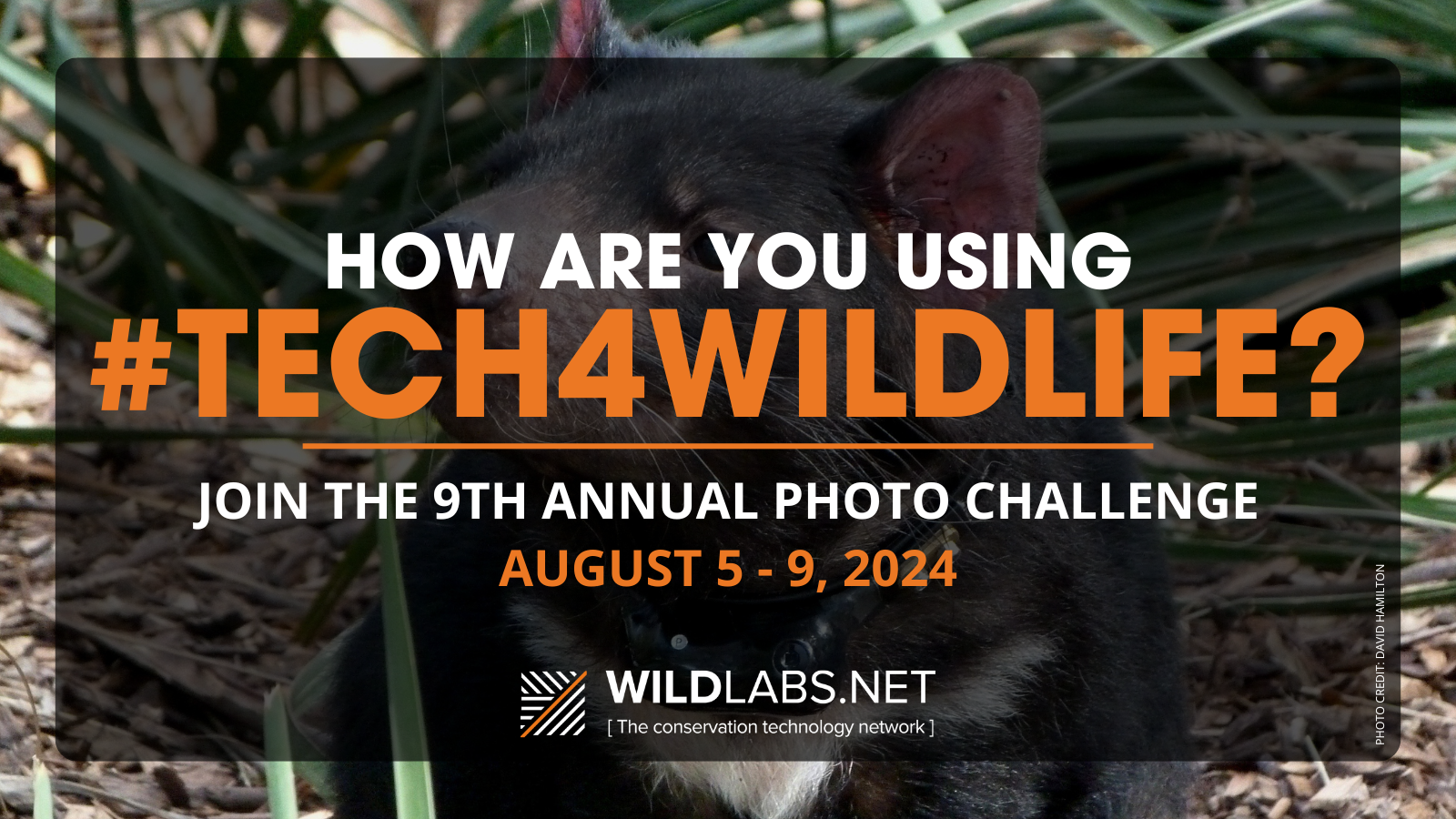
Since the challenge began in 2016, we’ve watched movement ecology make leaps and bounds as technologies advanced rapidly. From GPS collars that track Caribou in Ontario to satellite-tags that help study the feeding behaviors of nesting loggerhead sea turtles, new biologging technologies have revolutionised how we study wildlife and their interactions within the environment. We can’t wait to see how movement ecology has embraced innovative tech in just the past year as more photo, video, and story submissions roll in this week.
How are you using biologgers, GPS tracking, and satellites for conservation? Share your photos and videos with the hashtag #Tech4Wildlife!
2024
Studying platypuses in Brisbane's urban environments. This hefty 2kg male is released back with a radio transmitter so we can prioritise the conservation of freshwater and riparian habitats. @brisbanecityqld @UNSWScience @CES_UNSW pic.twitter.com/6cU9469u1U
— Platypus Conservation Initiative (@Platypus_CI) August 5, 2024
#tech4wildlife #sustainability #reusableagtech #newanimalmonitoring #australianagriculture #smarteartagforlivestock #aginnovation #pasturefeedintake #supplychaintracebility | CERES TAG
Adam is our Koala model for the WILDLABS Community 9th Annual Photo competition #tech4wildlife. When he is not modelling he is gathering data on his daily habits and wellbeing. 🐨 What’s your favourite wildlife animal? We would love to hear or see! #sustainability #reusableagtech #newanimalmonitoring #australianagriculture #smarteartagforlivestock #aginnovation #PastureFeedIntake #supplychaintracebility

Proud to support the @MaraElephant in protecting elephants and neighboring communities! 🐘
— Savannah Tracking Ltd (@STL_tracking) August 6, 2024
Our GPS collars are helping track the challenging bull preventing human-wildlife conflict
Together, we're building a future where humans and elephants can coexist peacefully.#Tech4Wildlife https://t.co/ZLow1nbq0d
287 likes, 5 comments - maralliance on August 5, 2024: "Why Monitoring Matters: A Crucial Step for Male Sea Turtle Conservation Did you know that most of our knowledge about sea turtles comes from studying females? This is because females return to land to nest, allowing researchers to observe, tag, and collect data. In contrast, males remain at sea for life, making them much harder to locate and study. Our research is focused on: 🌍 Spatial Ecology of Males: Rising sand temperatures due to climate change are leading to more female hatchlings, as the sex of sea turtles is determined by sand temperature. This shift in sex ratios could severely impact reproduction and long-term species survival. 🧭 Migration Mysteries: While female sea turtles are known for long-distance migrations, the movement patterns of males are still largely unknown. Do they migrate as far or as often as females? Understanding these behaviors is key to developing effective conservation strategies. How are we studying them? 📡 Satellite Tags: These tools are essential for tracking, providing detailed data on male sea turtle behavior and ecology. 📊 New Insights: After two years of tracking male loggerhead turtles in the MesoAmerican region, we are uncovering new movement patterns. These findings are critical for the conservation and management of sea turtle populations. 🌐 Curious about the sea turtles we tag? Check out our tracking page on the MarAlliance website for open access to real-time data and movements of tagged sea turtles. @wildlabsnet #Tech4Wildlife #SeaTurtles #MarineConservation #ClimateChange #OceanResearch #WildlifeConservation #MaleSeaTurtles #LoggerheadTurtles #SaveOurOceans #MarAlliance #MesoAmericanReef #Biodiversity #Ecology #EndangeredSpecies #MarineBiology #OceanLife #ProtectOurPlanet".

#Tech4Wildlife
— Lewa Wildlife Conservancy (@LewaConservancy) August 6, 2024
In 2023, we installed LoRa (Long Range) transmitters on 7 rhinos across the Lewa-Borana landscape. The LoRa-enabled sensors, implanted into the rhinos’ horns, allow us to track their movements in real-time via @EarthRangerTech software.
Thread: pic.twitter.com/Mr07vhx37C
CERES TAG has always had a passion for the conservation and welfare of animals and especially wildlife.
— CERES TAG (@ceres_tag) August 5, 2024
Working alongside @Giraffe Conservation Foundation and @EarthRanger we have been able to help identify, track and conserve families of giraffes.@WILDLABSNET #Tech4Wildlife pic.twitter.com/2PXeLvi1Kr
2023
Using collar data and Google Earth, we can visualize movements! Orange is a female human-habituated bear and blue is a male non-habituated bear. The valley she spends her time in is full of campgrounds, day-use areas, and hiking trails. The Highwood Pass is less developed... 🧵 pic.twitter.com/0BllTJeROi
— Alyssa Bohart (@AMBohart) July 28, 2023
2021
We love collaborating with @EizaguirreLab to support the study of movement ecology and feeding behaviors of nesting #loggerhead #seaturtles in #CaboVerde. Here's a photo of a newly satellite-tagged #loggerhead on her way back to the sea! #Tech4wildlife #WorldWildlifeDay https://t.co/e5SqLKl8DI pic.twitter.com/ZY72vfhyoZ
— Project Biodiversity (@ProjetoBioSal) March 3, 2021
Or good-ol' binoculars, when your bird is wearing tiny geolocators that record light-levels and do not send any signals! @MeyerBritta @kedelmore #Tech4Wildlife Remember #fieldwork? pic.twitter.com/okMFLhOHvD
— Lisa Kettemer 🦣 (@liserbeth) February 25, 2021

2020
We @whapavt are using #Tech4Wildlife by putting camera collars on #blackbears to study foraging ecology in the Appalachian Mountains. We now are watching thousands of videos of cool behaviors like this rock flipping. It's awesome to get a bear's eye view! pic.twitter.com/YqVGTpI8IE
— Marcella J. Kelly (@marcellajkelly) February 27, 2020
We're tagging in @sblakewcs who heads the Galapagos Tortoise Programme, using invaluable tracking data to aid in their conservation! #Tech4Wildlife https://t.co/jnjCzOJFvI pic.twitter.com/1OvNXkODAl
— Movebank (@MovebankTeam) February 27, 2020
2019
We're using #tech4wildlife in the form of acoustic bio-loggers with 3D printed casings. These devices can be easily attached to existing GPS collars and provide valuable information on animal behaviour. @WILDLABSNET pic.twitter.com/mXKbawWy2x
— OpenWild (@OpenWildOrg) February 27, 2019
2018
This is me in the field using #Tech4Wildlife to download data straight from a Tasmanian devil! We use proximity loggers to understand how devils interact with one another, & how that influences the spread of devil facial-tumour disease (DFTD) @WILDLABSNET pic.twitter.com/cKtrZNqJKk
— Dr David Hamilton (@davidghamilton1) February 27, 2018
2016
Lots of wild dog GPS collars involved in my research #tech4wildlife pic.twitter.com/1ZbyzSP312
— Dr Dani Rabaiotti (@DaniRabaiotti) March 1, 2016
Related content
Article
Participate in the 2024 #Tech4Wildlife Photo Challenge!

Natalie Peoples
Participate in our annual #Tech4Wildlife Photo Challenge from August 5 to 9 by sharing photos and videos of how you use technology in your conservation work.
22 July 2024
Article
Get to know the judges for the 9th Annual #Tech4Wildlife Photo Challenge!
1 August 2024
Add the first post in this thread.