
Curadores del grupo

Talia Speaker
- @TaliaSpeaker
- | She/her
WILDLABS
World Wide Fund for Nature/ World Wildlife Fund (WWF)

Lacey Hughey
- @lhughey
- | she/her
Smithsonian Conservation Biology Institute

Marianna Chimienti
Bangor University

Muhammad Rais
- @sahil
- | He/ His
Las tecnologías de movimiento animal han mejorado significativamente nuestra comprensión del mundo natural, desde el descubrimiento de patrones migratorios y corredores de movimiento clave hasta la demostración del impacto de las presiones antropogénicas y el cambio climático. Los continuos avances en el desarrollo de tecnologías para la recopilación y transmisión de datos de biorregistro, junto con la mayor disponibilidad de datos ambientales de alta resolución y los avances analíticos en la modelización del movimiento, abren las puertas a nuevas aplicaciones. Sin embargo, aún existen importantes lagunas en este campo, como la movilización de datos de movimiento para convertir los datos de los dispositivos de rastreo en información para su aplicación en políticas y prácticas. Este grupo es un espacio para que la comunidad del movimiento animal se conecte y debata sobre nuestros esfuerzos para impulsar este campo.
Entre 2025 y 2026, el grupo Animal Movement se desarrollará en colaboración con la International Bio-Logging Society.
Recursos para principiantes
Conozca los proyectos de WILDLABS sobre Movimiento Animal
- Anuncio de la iniciativa MoveBON
- Discusión de seguimiento de MoveBON
- Reunión virtual Temporada 4: Seguimiento del progreso (Proyecto de investigación WILDLABS sobre ecología del movimiento)
- Reunión 1: Sensores en red para seguridad y prevención de HWC
- Reunión 2: Seguimiento de la fauna silvestre de última generación
- Reunión 3: Big Data en la conservación
- Reunión 4: Preguntas y herramientas futuras en la ecología del movimiento
- Behind the Buzz Temporada 1: De los datos a las decisiones
Imagen de encabezado: Equilibrio Azul/www.equilibrioazul.org
Curadores del grupo
- @TaliaSpeaker
- | She/her
WILDLABS & World Wide Fund for Nature/ World Wildlife Fund (WWF)
I'm the Executive Manager of WILDLABS at WWF



- 28 Recursos
- 64 Discusiones
- 33 Grupos
- @lhughey
- | she/her
Smithsonian Conservation Biology Institute
I am an ecologist and program manager with experience leading collaborative research projects in international settings. I specialize in the application of animal tracking data to conserve migratory species on a changing planet.



- 9 Recursos
- 10 Discusiones
- 3 Grupos
Bangor University
I am a quantitative ecologist and lecturer at Bangor University researching how species respond to environmental changes using bio-logging technology and modelling techniques.
- 2 Recursos
- 0 Discusiones
- 3 Grupos
- @sahil
- | He/ His
- 3 Recursos
- 0 Discusiones
- 0 Grupos
Aún no se han agregado destacados a este grupo.
- @LucyD
- | She/They
Backend engineer and data scientist with an ecology and conservation twist



- 0 Recursos
- 3 Discusiones
- 10 Grupos

- @carlybatist
- | she/her
ecoacoustics, biodiversity monitoring, nature tech


- 133 Recursos
- 373 Discusiones
- 19 Grupos

- @StephODonnell
- | She / Her
Tech, Sustainable Finance at World Bank & CFA (prev. Founder WILDLABS)


- 197 Recursos
- 670 Discusiones
- 31 Grupos
Aerospace Engineering student with a passion for conservation and ecology. Here to learn more about the field and get inspiration for personal projects.
- 0 Recursos
- 2 Discusiones
- 6 Grupos

World Wide Fund for Nature/ World Wildlife Fund (WWF)
I work to deploy and scale conservation technologies, including AI-enabled camera traps and eDNA tools, to help practitioners monitor and protect biodiversity more effectively.
- 2 Recursos
- 3 Discusiones
- 7 Grupos
- @laurakb
- | she/her
I work on Hawaiian forest bird conservation.
- 0 Recursos
- 3 Discusiones
- 7 Grupos

Founder | Entrepreneur | Head of Product | Engineer
- 0 Recursos
- 3 Discusiones
- 4 Grupos

- @Cris
- | he / him
Octophin Digital
Senior Developer at Octophin Digital and constant maker.

- 0 Recursos
- 5 Discusiones
- 5 Grupos
Conservationist | Ecologist| Geospatial Scientist
- 0 Recursos
- 1 Discusiones
- 12 Grupos

- @Antonvdp
- | he/him
Marine biologist Anton Van de Putte is a strong proponent of open data in marine conservation.As the OBIS and GBIF Antarctic regional node manager, he supports ecosystem-based management of the Southern Ocean's fragile habitats by converting open science into conservation policy.
- 0 Recursos
- 0 Discusiones
- 4 Grupos
Building perimeter monitoring technology for protected areas with Safora
- 0 Recursos
- 1 Discusiones
- 10 Grupos
- @TaliaSpeaker
- | She/her
WILDLABS & World Wide Fund for Nature/ World Wildlife Fund (WWF)
I'm the Executive Manager of WILDLABS at WWF
- 28 Recursos
- 64 Discusiones
- 33 Grupos
Enlace
Major milestone for Move BON! The network's first paper is out, making the case for animal movement data to play a bigger role in biodiversity indicators and policy. A huge collective effort from the whole community and...
8 July 2026
Artículo
Wild Moves and Wild Album: New GBIF Data Portals for Animal Tracking and Camera Trap Data

WILDLABS Team and 1 more
New data portals are making it easier to discover and explore wildlife tracking and camera trap datasets from around the world.
4 Junio 2026
Carreras
Ecologist (Postdoctoral Research Fellow), IS-0408-09
Lacey Hughey
The Smithsonian’s National Zoo & Conservation Biology Institute (in collaboration with Duke Farms, a center of the Doris Duke Foundation) is seeking a postdoctoral researcher to lead the development of next-gen...
1 Junio 2026
Artículo

🌍 Conservation technology is transforming how we protect wildlife, but are we thinking carefully enough about the risks? Drones, camera traps, GPS trackers, acoustic sensors, AI, and remote sensing have become...
22 Mayo 2026
Carreras
We are currently recruiting for multiple positions in the Ecological and Collective Cognition Lab (Kano Lab) at Kyushu University (Institute for Advanced Study, Japan)
9 Mayo 2026
Carreras
A 3-year, fully-funded PhD studentship at the interface of ecological theory, AI and global biodiversity mapping
28 April 2026
Carreras
Ecological Data Scientist
Lacey Hughey
The Smithsonian Institution is the world’s largest museum, education, and research complex, with 21 museums and the National Zoo. This position is located in the Smithsonian's National Zoo and Conservation Biology...
21 April 2026
Carreras
Remote Geospatial Software Developer with TerrAdapt
Leah Stahmann
Architect and scale the digital infrastructure that transforms global datasets into actionable, real-time tools for conservation practitioners worldwide.
2 April 2026
Carreras
Remote Senior Scientist with TerrAdapt
Leah Stahmann
Lead the design of complex applied science projects, using remote sensing and ecological modeling to provide partners with the evidence-based insights needed to prioritize conservation action.
2 April 2026
Carreras

Support the conservation of birds in Canada and beyond.
20 Marzo 2026
Julio 2026
evento

Renilde
evento

Ginevra Bellini
Noviembre 2026
evento
Claudia Meneses Moreno
Mayo 2026
evento
Ginevra Bellini
Abril 2026
evento
Marianna Chimienti
evento
Rebekka Stutz
107 Products
Recently updated products
| Descripción | Actividad | Respuestas | Grupos | Actualizado |
|---|---|---|---|---|
| GP A60 Review is now up. See: https://winterberrywildlife.ouroneacrefarm.com/2026/05/23/gardepro-a60-trail-camera-teardown-and-review/ |
+6
|
Cámaras Trampa, Movimiento Animal, Base Comunitaria, Carrera Temprana, Comunidad de África Oriental, Tecnologías Emergentes, Human-Wildlife Coexistence | 2 días 16 horas ago | |
| Here's a recent video of a Racoon dog and her young filmed at Lammi Biological Station recently. I'd be interested to hear your review. How helpful is this for your... |
|
IA para la Conservación, Movimiento Animal, Cámaras Trampa, Data Management & Mobilisation, Geoespacial, Herramientas para la Gestión de Áreas Protegidas, Sensores, Desarrollo de Software | 5 días ago | |
| Hi Kristof!It's been quite some time since you made this post, and I hope you're doing well.I'm an environmental scientist currently working on a project to teach children living... |
|
Carrera Temprana, Movimiento Animal, Geoespacial, Desarrollo de Software | 1 semana ago | |
| Hi everyone,I'm hoping to tap into the community's experience with GPS tracking technologies for birds in particularly challenging... |
|
Movimiento Animal | 1 semana 1 día ago | |
| Have you received any feedback on this? I am also looking for similar advice for a crow species. |
|
Movimiento Animal | 1 semana 1 día ago | |
| Great discussion — the trade-offs you're navigating with Loko are exactly the right ones for open-source wildlife tracking.A few thoughts on the points raised, particularly for... |
+6
|
Sensores, Movimiento Animal, Soluciones de Código Abierto | 1 semana 2 días ago | |
| Hi Travis — good question, and one where the practical answer is often different from what the theory suggests.The fundamental challenge with solar on GPS collars is that the... |
|
Movimiento Animal | 1 semana 2 días ago | |
| Hi RaviIf you’re still looking for VHF receivers to track wildlife you could check out multi-frequency receivers. These can track 500 frequencies simultaneously (with no need for... |
|
Movimiento Animal | 1 semana 3 días ago | |
| This initiative was such a great motivation to finally tackle some of our tech debt, so thanks indeed Arm and Wildlabs. The boring stuff is really what underpins the exciting one... |
|
Data Management & Mobilisation, Movimiento Animal, Ciencia Ciudadana, Desarrollo de Software | 2 semanas 6 días ago | |
| Hi Lea,Apologies for the late reply, I did not see the notification! I think our system would work well for your use-case. We're designing fittings for multiple drones, one of... |
|
Drones, Movimiento Animal | 3 semanas 1 día ago | |
| Looks very beautiful. Well done.Poor Rob Appleby. He's just a youngun. |
|
Movimiento Animal, Soluciones de Código Abierto | 3 semanas 2 días ago | |
| HI Chittakon, Have you tested the dB gain as that is a measurement of how sensitive the receiver is to pick up a VHF signal. Most commercial grade VHF receiver from... |
+12
|
Movimiento Animal | 1 mes 1 semana ago |




























New paper calls for animal movement indicators in biodiversity policy – GEO BON
8 July 2026 1:48pm


Camera trap recommendations
2 April 2026 11:40pm
18 May 2026 6:18pm
Hi, are you looking to import these? Do you have any import tax considerations? This could impact which models you buy. I have been using Acorn models, very reliable and provide photo and 4K video with sound options.
Best wishes
Susan
6 June 2026 3:44am
Thank you everyone for your recommendations! We were awarded the grant, so I will share this information with our team, taking all your advice into consideration with our budget.
7 July 2026 1:20am
GP A60 Review is now up. See: https://winterberrywildlife.ouroneacrefarm.com/2026/05/23/gardepro-a60-trail-camera-teardown-and-review/
Getting behavioral data out of datasets that weren't built for it
16 Junio 2026 3:49pm
22 June 2026 9:33am
HI
This what I am trying currently todo
https://wildlabs.net/en/discussion/looking-collaborators-ai-powered-backyard-bee-monitor-citizen-science?language_content_entity=en
I have already some algorithms and some monitoring set up in development
feel free to reach me maybe we could join forces
28 June 2026 10:12pm
This thread is exactly the conversation I was hoping to start - thank you all.
Janelle, your point about context is the crux of it. A crocodile with its mouth open could be thermoregulating, resting, or hunting, and the still frame alone won't tell you which - it's the surrounding signals (eyes, posture, what else is in the scene) that disambiguate. That's the whole problem in miniature: behavior isn't legible without context, and most datasets strip the context out. I love your reframe of observer bias as signal, too - the order in which individuals approach and explore a new camera is behavioral data, not just noise to wait out. And it points at exactly where I think this goes: no single stream is enough. Thermal, acoustic, eDNA, movement - layered together, you start to reconstruct a scene rather than just catalog detections.
Kim, the continuous thermal deployment you're describing is the kind of capture I'd love to understand better - sustained, passive, weatherproof is where the rare and off-frame behaviors actually live. Would be curious how much behavioral signal you're seeing in that data vs. presence/absence.
Henri, your bee work is striking - we're clearly circling the same core idea from different systems. I'd be glad to compare notes; I'll follow up directly.
More soon - this is the good stuff.
Maggie
4 July 2026 5:32pm
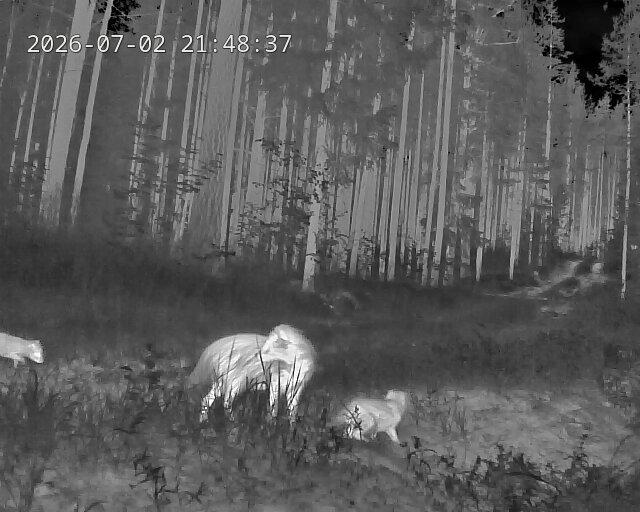
Here's a recent video of a Racoon dog and her young filmed at Lammi Biological Station recently.
I'd be interested to hear your review. How helpful is this for your behavioral use cases ?
Below is the video link
https://youtu.be/G-pSfN1jqdc
Looking To Connect: Game Developer to Conservation Tech (Built Animal Movement App)
3 Diciembre 2025 1:10am
20 April 2026 4:05am
I am glad to see more programmers coming into the conservation field. The first big project I did that really got me involved with conservation work, was taking the path finding algorithms I used from learning game programming, and using them to detect and measure the distance of routes that turtles traveled up and down streams in a river drainage.
20 April 2026 7:39am
Wolves, cool!
Will this then need collared wolves ?
1 July 2026 11:25pm
Hi Kristof!
It's been quite some time since you made this post, and I hope you're doing well.
I'm an environmental scientist currently working on a project to teach children living near a national park the basics of game development through conservation science focused on the biodiversity of the atlantic forest. I came across your post and thought it would be wonderful to chat with you, if you're still available and interested.
Let me know—I’d love to hear from you!
July15: “Wildlife Tracking for Connection” online learning session
1 July 2026 4:20pm
Looking for recommendations: GPS tags that perform well in remote rainforests on birds
30 Junio 2026 10:02pm
GPS tags for medium-sized parrots
15 Septiembre 2025 4:40pm
30 June 2026 9:38pm
Have you received any feedback on this? I am also looking for similar advice for a crow species.
GPS Tracker For Wildlife
27 February 2025 12:13pm
8 October 2025 12:52pm
Hi Akio,
Yes we can have a chat about this at some stage.
Best wishes
Nigel
15 October 2025 9:49pm
Hi Akio!
Is there any more extensive documentation for Loko than what I see on the website in the link you sent? I'm curious to learn more, such as what the mean and median positional errors are, and how long the battery would last at various fix intervals (such as 5 minutes fixes vs 15 minute fixes), whether the device is capable of taking more than 6,500 consecutive fixes if it is able to regularly connect to the ground device, how it handles failed fixes (i.e. there are no satellites detected), etc.
I'm working on a project in which we are deploying GPS receivers on gopher tortoises. As with many devices, one of our biggest challenges is finding a device that can store a lot of fixes so that we can leave it out for long deployments (we have been looking at devices with pure receivers, and no transmission option), and as someone else mentioned, ruggedness is very important as well- the turtles can be very hard on trackers. These animals present some unique tracking challenges because they spend much of their time underground, meaning that the device will be unable to detect satellites and/or get a good fix most of the time. We also value customizability- someone else pointed out that we biologists have been known to open up devices and DIY them for our own uses- and we are wont to do the same with software as well, if able. For example, for my study we are interested in options where we can choose an adaptive fix interval, for example, every 5 minutes but only during daylight hours, to save on battery as well as memory space. I know triggered firmware is a common request as well- various groups will use different sensors, such as light, temperature, moisture, float, accelerometer, etc. to tell a device when it's appropriate to take a fix (when the animal moves, when it surfaces, etc.).
Best,
Jocelyn
29 June 2026 8:52pm
Great discussion — the trade-offs you're navigating with Loko are exactly the right ones for open-source wildlife tracking.
A few thoughts on the points raised, particularly for large animal tracking in Africa with limited budget:
On waterproofing the LoRaWAN antenna — the antenna does need to protrude or be positioned at the surface of the enclosure, but this doesn't have to compromise IP rating. A simple approach is to use a helical or meandered trace antenna on the PCB itself (no external stub needed) and cast the entire PCB in epoxy or use a conformal coating, with the enclosure providing the mechanical protection. For collar deployments on large mammals, the antenna is often routed along the collar belt itself as a flexible element, which also improves radiation pattern.
On geofencing for large animals with infrequent fixes — I'd agree with the caution raised earlier. For animals with large home ranges like elephants or lions in Africa, a 1-4 hour fix interval means an animal can travel 10-30km between fixes. Geofencing only works reliably when you can predict where the base station receiver will be relative to the animal's trajectory. For open savannah, a LoRaWAN gateway on a fixed elevated point (a termite mound, a tree, a ranger station) with 10-20km range is more practical than trying to download when the animal passes close.
On memory — 6,500 records at hourly fixes gives about 270 days of logging, which is enough for most large mammal deployments. The limiting factor in practice is usually battery rather than storage.
I work with LoRaWAN-based tracking systems and have field experience in southern Africa — happy to discuss specific deployment scenarios.
Questions regarding the use of solar panels to extend battery life of GPS collars
6 Enero 2024 8:44pm
28 January 2024 10:27pm
Lars,
As always, your insights are great! The GPS Plus X battery life calculator is great! I've downloaded it and have been toying around with it, very convenient when thinking about sampling schedules. Curious as to why more tech developers don't incorporate something similar into their own programming/analysis software. Very useful.
I've got a few meetings set up with a couple different tech developers, but may reach to Vectronic here. At first glance, their collars seem great! I appreciate the recommendations.
I must admit, I am not well versed in Python, but I am looking into something that wold be the R equivalent. If I don't have much luck, I may try and take a look at how that package was made in Python and attempt to recreate it in R.
You're the best Lars! Thanks!
Cheers,
Travis
28 January 2024 10:42pm
Hi Bill,
I don't believe I will need them to be extremely accurate, but will need a good degree of accuracy for some behavioral classification and habitat use analyses. In regards to the solar, tracking the solar cycle is a great suggestion. I have also considered having some thresholds programmed in the accelerometer to power off both sensors during periods of sleep/rest in order to conserve battery life. I did this same thing in my last study for the GPS only, so there wouldn't be instances where the trackers continued to try and unsuccessfully acquire GPS fixes while the bats where inside their caves resting. After the bat's surge axis dropped into the -1 and there was 10 unsuccessful GPS fix attempts in a row, the GPS powered down.
Thanks for the suggestions and insights Bill!
Best,
Travis
29 June 2026 8:44pm
Hi Travis — good question, and one where the practical answer is often different from what the theory suggests.
The fundamental challenge with solar on GPS collars is that the power budget is dominated by the GPS fix, not the idle current. A modern GNSS module during a fix pulls 15-30mA for anywhere from 5 seconds (hot fix) to 60+ seconds (cold start or poor sky view under canopy). A typical small solar cell on a collar — say 2-3cm² — generates perhaps 1-5mA in full sun in Africa. So solar is not replacing GPS power; it's offsetting the baseline quiescent current and helping during long inter-fix intervals.
In practice, solar works well when: your fix interval is long (hourly or less), the animal spends significant time in open sun, and you're optimizing for months-long deployments rather than high-frequency tracking. For large savannah species — elephants, lions, giraffes — where the animal is often exposed and fix intervals of 1-4 hours are acceptable, solar can meaningfully extend collar life, sometimes doubling it.
Where it tends to disappoint: dense canopy species, nocturnal animals with low daytime activity, or applications requiring fixes every few minutes. In these cases the extra weight, cost, and mechanical complexity often outweighs the benefit.
A few practical notes: lithium primary cells (LiSOCl2) have higher energy density than rechargeable lithium-ion and don't need solar management circuitry — worth comparing before assuming solar is the right route. If you do go solar, a small MPPT circuit like the BQ25504 from Texas Instruments handles the variable input from small panels very efficiently at minimal quiescent cost.
What species and fix interval are you targeting? That would help narrow the recommendation.
Looking for advise on a suitable VHF receiver
25 November 2024 7:52pm
3 December 2024 5:35am
Hello @robbiemp
My method may not be the best at the moment, but I’ll share the results from my previous tests. Here’s what I’ve tested: “DIY using SDR connected to a smartphone as a radio telemetry receiver.”
I have a VHF receiver that works with SDR and an Android smartphone. I’ve tested it with a VHF tag that I built myself, "My VHF Telemetry Tag Building Project From Scratch."
It depends on whether you need data or just audio. If you need data, SDR may not perform very well. But if you’re just after audio signals, it can work similarly to a regular VHF receiver. By using a Yagi antenna and connecting the SDR to the smartphone, it can work for any frequency range you want. I used 148-151 MHz, but you can use more than that.
Please understand that it works similarly to a commercial VHF receiver, but it may not be as good as the ones available in the market due to various limitations. However, it can still be used. I tested it with a Yagi antenna that I made myself (but if you already have an antenna, you can use it too), and I was able to detect my VHF tag from a distance of about 1.2 kilometers and 800 meters for the VHF tag I received from @Rob_Appleby . This is just a rough test.
If you need a receiver that can operate across a wide range of frequencies, I think the RTL-SDR would be a good option as well.
This may not be the best method, but it works just fine. Thank you, and if you have any questions, don’t hesitate to ask me.
10 December 2024 10:07am
Thanks so much Chittakon. I have ordered the parts, and will be trying the phone method.
29 June 2026 12:01am
Hi Ravi
If you’re still looking for VHF receivers to track wildlife you could check out multi-frequency receivers. These can track 500 frequencies simultaneously (with no need for frequency scanning), and provide automated geo-location (with no need for triangulation).
They are ideal for aerial (drone or aircraft) and ground tracking.
For more info please see our website:
https://altitudeconservation.com/
Good luck with your fieldwork!
Kind regards
Chris
Project Report: Upgrading Software for The Motus Wildlife Tracking System and NatureCounts
15 Junio 2026 11:52pm
18 June 2026 10:41pm
Developing an accessible, multi-channel drone telemetry system (Seeking feedback and use-cases)
18 Mayo 2026 8:42am
29 May 2026 4:04am
Hi Robin. Thanks for getting in touch with me and thanks for your information. I also received your contact submission on our website, so I'll chat to you there in more detail.
Simon.
29 May 2026 1:34pm
Hi Simon, this sounds so interesting and is something I've been thinking about for my work in the past.
My team tracks Temminck's pangolins in Malawi using VHF and satellite tags. These animals have been rehabbed and released so we conduct welfare checks on them following release.
Our biggest challenge is that sometimes the satellite tag dies prematurely and then we struggle to pick up VHF signal without knowing an approx sat location. If the terrain is especially hilly then the distance we can pick up VHF signal from is really reduced, especially if the animal is in a burrow. I've previously wondered if a VHF monitoring system is possible with our drone (DJI Mavic 3T).
Your system sounds great and I'm definitely interested in learning more. A 50-100m real-time estimate would work well for us.
17 June 2026 5:05pm
Hi Lea,
Apologies for the late reply, I did not see the notification! I think our system would work well for your use-case. We're designing fittings for multiple drones, one of which is the Mavic 3T.
You're welcome to jump on to our mailing list by heading over to our website. We'll keep you posted with release dates, etc.
10 years later, achievement unlocked! A breakthrough for sea turtle satellite tracking
7 Junio 2026 1:05am
16 June 2026 12:48am
This post makes me so freaking happy! Glad to have met you through conservation technology discussions all the way over here in Australia back in the early days :) I am also super excited to see your innovations continue.
16 June 2026 2:13pm
Looks very beautiful. Well done.
Poor Rob Appleby. He's just a youngun.
Wild Moves and Wild Album: New GBIF Data Portals for Animal Tracking and Camera Trap Data
4 Junio 2026 6:36pm
Ecologist (Postdoctoral Research Fellow), IS-0408-09
1 Junio 2026 4:02pm
DIY using SDR connected to a smartphone as a radio telemetry receiver
2 Octubre 2024 5:53am
20 April 2026 3:51am
I wrote a really simple app for Android phones that acts as a telemetry receiver using the RTL-SDL dongles. First version was 5 years ago, and I will admit I didn't really understand what I was doing with the signal processing at the time. I have improved it some, but haven't added all the features I have wanted quite yet. A big change I made was integrating the RTL-SDR android driver directly into my code so a separate package doesn't have to be installed. Some concerns have been brought up, that making a cheap receiver could lead to bad actors using it to find animals, and I have had to sit and debate that. Still, the code for the projects is here:
https://github.com/donfbecker/Telemetry-Receiver
I saw mention of tracking BPM with AI, and I have to say, you don't need AI. Code for this one will not be released until after we finished up a project or two using it (publishing is competative, sometimes you have to keep your advantage). The hardware has a cellular modem in it, so we get updates on BPM (which translates to Body Temperature), every 20 minutes. I had it at 5 minutes, but the solar panels don't keep up as well then. Like I said, no code, but I can give you a teaser of what I have been watching the last few days as our snakes emerge from over wintering.
The main issue with the RTL-SDR is that with the 8bit sampling, you have a noise floor around around -50dB, so you have to have a signal stronger than that to detect it. The built in amplifier amplifies it's own noise as well, so isn't always great. The wideband LNAs that are sold for software radios amplifies EVERYTHING, which sounds great, but isn't. Tracking frequencies often aren't too far off from local FM radio stations in my area, so the LNA amplifies them too. If they get too strong, they saturation the amplifier, and the RF front end on the SDR, basically erasing your signal. The solution is to put a good bandpass filter in front of the LNA, but I've never been able to find one for the frequencies we use, so had to resort to building my own. I only recently figured out the black magic that goes into LC filters, and dealing with all the extra capacitance added by PCBs. I finally have a filter working in the range I need, and will be testing it out on my hardware soon to see how it helps with range.
Overall there is a lot of utility in using the RTL-SDR dongles, but the more I get into it, the more I am trying to design my own SDR hardware. I don't need it to be as capable as the commercially available hardware. I've made a few basic ones already just feeding the output of mixers in to the ADCs on an STM32 microcontroller, using an SI5351 to generate an LO signal for direct converstion. I am going to start playing with using a TLV320ADC audio codec chip to sample signals. It does 32bit sampling, which lowers the noise floor down to -130dB or so, assuming I don't introduce a bunch of noise from my hardware. The sampling rate wouldn't be as fast, but still plenty for picking up the CW pulses from wildlife transmitters.
--Don
P.S. I am recovering from the flu, please ignore typos
18 May 2026 7:11am
How far did you end up taking this project?
29 May 2026 5:22pm
HI Chittakon,
Have you tested the dB gain as that is a measurement of how sensitive the receiver is to pick up a VHF signal. Most commercial grade VHF receiver from telemetry manufacturers are in the -150dbm with a maximum noise figure of 3 dB.
What was the type of VHF transmitters you were using and what was the length of the antenna of the transmitter? Was the transmitter on the ground or position above the ground and if so what height and polarization plane?
There are a lot of variables which determine field range.
Chris Kochanny
www.vectronic-aerospace.com
Help shape best-practice guidance on conservation technology - input to survey
22 Mayo 2026 10:20am
Engineer Searching for Biologists
20 Mayo 2026 3:18pm
Call for Collaboration: Share your voice at ICTC next week!
11 February 2026 3:29am
19 February 2026 3:35am
Hi Anna!
Is there anything that sparks your curiosity, which I can address for you? Take a look at the upcoming day 2 and day 3 sessions, and if you see anything that intrigues you, please let me know! I'll happily join the session that aligns, and share your thoughts! ☺️
Kind regards,
Mandy
13 May 2026 2:18pm
That's a great idea @MandyEyrich ! Similar to your idea, I wrote up an article with geospatial highlights from ICTC 2026: https://wildlabs.net/en/article/wildlabs-geospatial-group-ictc-2026.
Is the Human-Wildlife Coexistence article available yet? Would love to read it and share it with colleagues at Fauna & Flora.
13 May 2026 2:21pm
@annavallery here's the article with geospatial-ish highlights in case you're interested: https://wildlabs.net/en/article/wildlabs-geospatial-group-ictc-2026. Let me know if you have any questions or specific interests. Happy to share further details!
Open Positions – Postdoc, Technical Staff, and Students (Kyushu University, Japan) Ecological and Cognition Lab (Kano Lab)
9 Mayo 2026 12:23am
Ecology Field Training: Data Collection and Analysis at Lower Oder Valley
6 Mayo 2026 9:50am
Low-cost GPS tracking of giant tortoises
27 April 2025 7:35am
24 April 2026 2:01pm
See the solution below. If the island is within Globalstar’s coverage area, this is definitely the cheapest option: https://interrex-tracking.com/flex-globalstar
30 April 2026 8:13am
Thank you for getting in touch, Marcin. In the meantime I have already found a solution.
2 May 2026 7:01pm
Greetings Lisa, it is interesting to see to the project you are working on. If there's anything I can do to help with my skillset let me know.
Thanks, Mike
Tiger coexistence challenges
20 April 2026 3:20am
2 May 2026 6:32am
Hi Mandy, writing from Indonesia where we manage the Sumatra Merang Peatland Project (SMPP) which is in a landscape supporting some of the last Sumatran tigers. Our project is part of a corridor including two national parks and a few scattered conservation areas within active oil palm and Acacia plantations. There's not a lot of room for tigers and they do range through human communities or come into contact with plantation workers.
Fatal attacks are rare but two occurred in 2022. We hold annual HWC trainings with communities but also celebrate International Tiger Day with them, having a light-hearted event with games, face paint, and education of the importance of biodiversity, even when scary. We emphasize common sense personal safety measures to reduce the potential for conflict. Luckily livestock aren't very common in this area so that conflict trigger is not a major issue. Mostly it's about restricting activity at dusk/night/dawn, travelling in groups, not running, etc. We haven't found any feasible tech options (tagging is beyond our scope/budget) but we do use camera traps to see if/when tigers are present in/around our project area. This can only do so much for HWC as it's not a rapid response tool but does indicate presence.
Regarding your question "Who/what parties should be held responsible for the loss of life, both human and tiger? Can they be held responsible?" there isn't an easy answer! Indonesian law technically gives tigers the same right-to-life as humans but in practice reprisals of course happen. In our region the military did respond to the 2022 events with patrols and presence, but they were not allowed to shoot. Obviously there is no proactive recourse against the tiger itself as a responsible party. It's an opportunity to redouble efforts on community education to explain why the attacks occurred (both fatalities were at forest frontiers, crouching with back to the forest, etc) and how to avoid re-occurrence!
Biodiversity Lab Manager
29 April 2026 1:31pm
Open PhD project: Decoding and mapping Earth's species interactions with ecological AI
28 April 2026 4:51pm
Animal Movement Group Meetup: R packages, data and code integration in animal movement ecology
23 April 2026 6:21pm
Ecological Data Scientist
21 April 2026 9:22pm
Anyone here in Jaipur??
18 April 2026 3:58pm
The Hidden World of Sensitive Species Data
10 April 2026 4:03pm
Remote Geospatial Software Developer with TerrAdapt
2 April 2026 1:51pm