

Aerospace Engineering student scoping for masters final year project- where are the monitoring bottlenecks?

9 July 2026 1:39pm
¡Bienvenido a WILDLABS!

29 Octubre 2015 5:16pm

8 July 2026 7:26pm
Hi everyone, I'm Alex, founder of ASD Technologies. I've spent years developing miniature, ultra-low-power sensors and biologging devices for medical robotics as well as wildlife and movement-ecology research — GPS and acoustic loggers, physiological sensors, and modular animal-borne tags.
We've recently merged with a global edge-AIoT company, which is letting us push more on-device intelligence — onboard ML and better connectivity — into field hardware. I'm excited about what that opens up for bioacoustics and remote monitoring.
I'm here mainly to learn from this community and to give back where I can. Happy to talk shop on tag miniaturization, ultra-low-power design, on-animal acoustics, or edge ML — feel free to reach out if any of that is useful to your work.
(For context, our work lives at https://asd-tech.com, but I'm here first and foremost to connect and contribute.)
9 July 2026 1:07pm
Hey everyone, my name is Aaron and I am an aerospace engineering student from the UK. I am passionate about wildlife and conservation, and am determined to use my degree to help! I look forward to learning more about the work being done and getting to know the community!
Mini AI Wildlife Monitor

25 Junio 2025 12:27pm

8 June 2026 9:15pm
In case someone. Find this totally out of place commemt… this is how I solved it, I've decided to use a IMX477 HQ Camera, building a *manual, heavy-duty optical rig* utilizing C/CS-mount lenses and physical macro extension tubes.

5 July 2026 5:19pm
Wow, what a great project.
8 July 2026 8:36pm
This is a great project! Some comments:
RaspberryPI though accessible is not the best fit for video pipelines and AI workloads or off grid deployments:
- it lacks onboard ISP which means either software implemented ISP, distorted data or on camera non energy optimized ISP.
- it lacks any power management techniques, low power modes, etc.
- it runs from SDCard using the same one for OS, swap and data, any corruption can lead to full loss.
- it runs any AI/ML workload on CPU which is extremely non efficient and any addon accelerators such as Hailo8 add a lot to power consumption and heat dissipation representing more challenges.
The advantages are of course plenty of documentation, community and all kind of makers addons, hats, etc.
For something more realistic, real life suitable I would suggest using something based on SoC with integrated NPU such as Hailo 15, Renesas RZ/V, Synaptics SL1680, MediaTek Genio or even the I.MX8M Plus for very light AI/ML workload. All of these have variety of SBCs, kits or even standalone smart camera oriented designs available from different vendors.
real‑time drone‑based telemetry tracking on forest‑dwelling bats in Europe

27 Mayo 2026 3:33pm
16 June 2026 7:36pm
Hey Garin, how are you?
you should contact https://wildlifedrones.net/ they have rented the equipment (payload and drones) in the past to track pangolins, bats and many other species. But I've heard the they are closing bussiness since Trump's budget cut in the USA since this country was their first client. But I think that they may help you out getting in touch with you with the researchers.
My tech advices are, what's the species? weight? attachment method? how long do you want to track? you should use the higher LOS of the transmitter, 40 Km LOS (Line of Sight) is the higher and since you are interested in tracking fossorial species, the LOS will be affected by the obstacles (ground density, forest density, topography etc), so the LOS will be like 5% up to 10% in the field, its about 200 mt up to 4 Km
Also try contact
If you are trying building up your payload and drone here's a link that may help you out
https://besjournals.onlinelibrary.wiley.com/doi/10.1111/2041-210X.13261

6 July 2026 11:34pm
Hi Jérémy,
I'm the developer of the UAV-RT system. We haven't updated our website in a long time and have made some significant progress. I've got a student making updates right now.
We've recently deployed the system in the UK on pine martens, with painted dogs in Zimbabwe, and tracking kiwi in New Zealand. Our recent deployments are showing detections far beyond ground telemetry. I'm actively looking for some more fieldwork opportunities for the coming year and have travel money left on my grant. Feel free to shoot me an email at [email protected].
Have drone. Will travel.
-Michael
8 July 2026 7:19pm
For reliable bat tracking in France and Western EU, look into SigFox enabled tags. For example these are today's smallest and lightest SigFox tags with Atlas Native support so you'll get a location in addition to basic telemetry: https://asd-tech.com/product/fx05-uwasp/

Conservation Genetics Post Doctoral Associate - San Diego Zoo Wildlife Alliance

8 July 2026 5:28pm
Post Doctoral Associate, Elephant Communication - San Diego Zoo Wildlife Alliance
8 July 2026 5:23pm

New paper calls for animal movement indicators in biodiversity policy – GEO BON

8 July 2026 1:48pm

Raspberry Pi Alternatives for Edge AI!
6 July 2026 7:10am

8 July 2026 12:01pm
Hi Luke,
Really enjoyed another one of your videos, you've definitely got me experimenting more with edge compute and AI in my garden. I was wondering whether you’ve done much with NVIDIA Jetson boards? I think you mentioned having an older version in a previous video.
I got an Orin nano super developer kit since the higher-memory RPis doubling in the past year, while the Orin Nano/Orin Nano Super now seem surprisingly fairly static in price over that time period. What interests me is the possibility of using them for wildlife monitoring: running detection or ID models locally, collecting new field data, self labelling and training then using that data to periodically improve the model all on the edge.
I’m not sure whether full on-device training would be practical, but perhaps a more realistic workflow would be active learning or a teacher–student/pseudo-labelling setup: the device flags uncertain or interesting detections, those get reviewed or labelled, and the model is retrained or fine-tuned periodically self redeploying via scripts or a local model and agentic harness.
There also seems to be a good ecosystem of cameras and sensors around Jetson. I assume you find limitations in the Jetson boards for ecology/wildlife-monitoring projects?
TrailCam - Browser tool for preparing trail camera observations
8 July 2026 12:44am
Mothbox - Upcoming Features

7 Marzo 2025 8:03pm

10 March 2025 3:45pm
@hikinghack that's a complete update!
A lot of compassion regarding the budget situation, especially knowing how great @briannaljohns is.
It’s great to see a clear plan for the hardware development! I hope you'll have nice outcomes from it!

29 June 2026 8:53pm
On the microcontroller approach for power gating the Pi — this is a well-proven pattern and worth doing even if the idle power is already low, because it also gives you a hardware watchdog for free.
The typical architecture is a small ultra-low-power MCU (STM32L0, SAMD21, or even an ATtiny) that stays awake in stop mode drawing a few microamps, handles the RTC wake-up schedule, and drives a P-channel MOSFET or load switch to cut power to the Pi entirely. When the Pi is done with its task, it signals the MCU via a GPIO line and the MCU cuts power and goes back to sleep. The key advantage over software sleep is that even a hung Pi gets cut off at the next scheduled cycle — no manual intervention needed in the field.
For the Mothbox use case where the Pi might sit idle for weeks, even 10mA idle current adds up to about 168mAh per week — enough to matter for a solar-charged system during a cloudy period. A properly gated system can get standby down to under 1mA including the MCU and RTC.
One practical note on the integrated PCB direction — if you're planning to integrate the MCU on the same board as the Pi interface, make sure to include a dedicated programming header (SWD for STM32, UPDI for modern ATtiny) so the MCU firmware can be updated in the field without disassembly. It's a small thing that saves a lot of frustration during deployment.
Happy to share more detail on the power switching circuit if useful.
7 July 2026 6:16pm
THanks for this!!!
¡Anunciamos a los beneficiarios de los premios 2026 WILDLABS Awards!
7 July 2026 2:27pm
7 July 2026 6:16pm
way to go! so many rad projects like always!
eDNA in Wildlife Research and Conservation

7 July 2026 6:51am
Camera trap recommendations

2 April 2026 11:40pm

18 May 2026 6:18pm
Hi, are you looking to import these? Do you have any import tax considerations? This could impact which models you buy. I have been using Acorn models, very reliable and provide photo and 4K video with sound options.
Best wishes
Susan
6 June 2026 3:44am
Thank you everyone for your recommendations! We were awarded the grant, so I will share this information with our team, taking all your advice into consideration with our budget.
7 July 2026 1:20am
GP A60 Review is now up. See: https://winterberrywildlife.ouroneacrefarm.com/2026/05/23/gardepro-a60-trail-camera-teardown-and-review/
Anyone using Microsoft Sparrow?

18 Junio 2026 12:39am
22 June 2026 3:52pm
@rahul.dodhia wow I would love to work on that! It sounds like Sparrow Studio is not open source yet? But, in the meantime, I think if this was going to be a successful fork or plugin anyways I would need to be more familiar with the codebase and it's best practices.
If you think of a smaller task that could help me learn how best to work with the community and software I would be excited to to contribute!

6 July 2026 9:48am
looking forward to this discussions too. Exploring the use of sparrow and in case our use case succeeds, we'll share feedback too.

6 July 2026 10:24am
Super to hear your numbers. Thanks!
Loaning Bioacoustics Recorders

6 July 2026 2:16am
iNaturalist trail camera report tool — feedback welcome
5 July 2026 7:06pm
¡Desbloquea nuevas funciones obteniendo tu insignia de participación comunitaria!

14 Marzo 2024 11:54am
12 June 2026 1:57pm
Hi Sandro,
Thanks for raising this and what could be a barrier to certain users.
The Sprout badge was originally introduced to recognize engagement and, more recently, to help protect the platform from large waves of spam and fake accounts that manage to get around our other protections. However, your comment highlights an important trade-off, and we appreciate you bringing it to our attention.
I have updated these guidelines to include an extra line clarifying that if someone runs into issues completing the required tasks to obtain the Sprout Badge for any reason, they can privately email me / the team and we can circumvent the badge and unlock all the abilities for anyone that needs them. I can see you have already obtained your Sprout Badge, but hopefully this will help others in future.
We are also working on potentially easing restrictions for non-verified users to be able to post a limited number of times per day instead of not at all, which would allow for valuable contributions from any community member without the need to jump through these hoops, but also retain a level of protection against mass spam posts from bots that manage to circumvent our other anti-spam/bot security at the point of registration. We also plan to make it easier for members to track what requirements for the badge they have completed and what they need to do next in order to minimise the time it takes to earn this badge.
We welcome any other suggestions to make things more accessible to more community members too!
Building the perfect camera trap (Guide)

17 February 2025 8:06am
23 February 2025 8:11am
Hey Bob, thanks for the kind words! Your articles on Winterberry Wildlife have really been a big inspiration for me! There are extremely limited numbers of articles on trial cameras, and you have some nice in-depth hardware level which I have been reading 😊
You are completely right about the battery life and trigger speed tradeoff. If I remember right, there are a few cameras which offered “real time” images but in return the battery was drained in a few days and people started to complain on forums. In early stages of development there is also much about limiting the services at boot, as you mention putting the camera function as early in the boot sequence as possible, creating your own camera configs and so on.
29 June 2026 9:01pm
Great guide — this is exactly the kind of resource the community needs. A few additions from a hardware embedded perspective that might be worth including:
On PIR sensors — the standard Fresnel lens + PIR combination has a fundamental limitation in hot environments: when ambient temperature approaches body temperature (~35°C in African savannah), the thermal contrast between the animal and the background drops dramatically and trigger reliability degrades. This is worth calling out explicitly for tropical and arid deployments, where the standard PIR may miss animals during the hottest part of the day. Some teams have moved to passive radar (Doppler microwave) as an alternative trigger for hot environments — less species-selective but more temperature-independent.
On power architecture — one thing I'd add to the component deep-dive is the power switching circuit. Most commercial cameras use a simple battery holder with no protection. For DIY builds, a proper battery management IC with overcurrent protection, low-voltage cutoff, and reverse polarity protection adds almost no cost but prevents a lot of field failures, especially when using lithium primaries in extreme temperatures.
On IR illumination — the choice between 850nm (faint red glow, better image quality) and 940nm (truly invisible, lower image quality, shorter range) is well covered in most guides, but what's often missed is thermal management of the IR LEDs themselves. High-power IR LEDs run hot and can significantly raise the enclosure temperature in a sealed housing — worth mentioning as a factor in enclosure thermal design, particularly for cameras that run night-long video.
On the shift away from hardware — curious what drove that decision. Was it the enclosure/thermal challenges, the PIR reliability issue, or something else entirely?
5 July 2026 5:17pm
Thank you for sharing.
NBM update: 13359 annotated birds calls now accessible
1 July 2026 12:54pm

5 July 2026 4:47pm
That is a great dataset!
Deep Voice - A Free Online Platform for AI-Based Marine Mammal Sound Detection and Classification

5 July 2026 4:03pm
Getting behavioral data out of datasets that weren't built for it

16 Junio 2026 3:49pm

22 June 2026 9:33am
HI
This what I am trying currently todo
I have already some algorithms and some monitoring set up in development
feel free to reach me maybe we could join forces
28 June 2026 10:12pm
This thread is exactly the conversation I was hoping to start - thank you all.
Janelle, your point about context is the crux of it. A crocodile with its mouth open could be thermoregulating, resting, or hunting, and the still frame alone won't tell you which - it's the surrounding signals (eyes, posture, what else is in the scene) that disambiguate. That's the whole problem in miniature: behavior isn't legible without context, and most datasets strip the context out. I love your reframe of observer bias as signal, too - the order in which individuals approach and explore a new camera is behavioral data, not just noise to wait out. And it points at exactly where I think this goes: no single stream is enough. Thermal, acoustic, eDNA, movement - layered together, you start to reconstruct a scene rather than just catalog detections.
Kim, the continuous thermal deployment you're describing is the kind of capture I'd love to understand better - sustained, passive, weatherproof is where the rare and off-frame behaviors actually live. Would be curious how much behavioral signal you're seeing in that data vs. presence/absence.
Henri, your bee work is striking - we're clearly circling the same core idea from different systems. I'd be glad to compare notes; I'll follow up directly.
More soon - this is the good stuff.
Maggie
4 July 2026 5:32pm
Here's a recent video of a Racoon dog and her young filmed at Lammi Biological Station recently.
I'd be interested to hear your review. How helpful is this for your behavioral use cases ?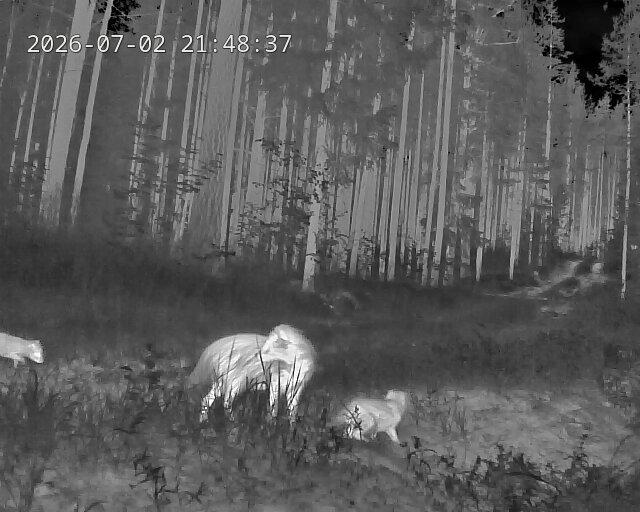
Below is the video link
https://youtu.be/G-pSfN1jqdc
RFauna Rover Fundraiser

3 July 2026 7:38pm
AudioMoths in Arctic conditions?
2 July 2026 12:17am

3 July 2026 4:50am
Hi Barbara.
If you are able to power the Audiomoth externally from a lithium-ion source, the lithium-ion batteries can be used down to -20 deg C. They can't be charged below 0 deg C though so if you were thinking of a solar charging setup as well, then you'd need to look at the temperature range you're planning to use them in.
In regards to the battery life for continuous recording, I found this information from here:
The recording lifespan of the AudioMoth on one set of batteries has previously been measured only for a subset of the possible configuration settings. Hill et al. reported the battery life of the AudioMoth using 3000 mAh lithium batteries for some common configurations [15], reporting that an AudioMoth could record for 115 days recording at 8 kHz, the lowest sample rate, for 30 s every 5 min. The developers also reported the AudioMoth lasted 9 days recording nonstop at a 48 kHz sample rate. While the AudioMoth configuration app provides estimates of battery life for any chosen configuration settings, these estimates have not to our knowledge been validated empirically.
Even derating the battery life by a factor of 2 due to cold temperature conditions would seem to get you over the finish line. One experiment you can try is to record continuously in a refrigerator and look at the recording duration. Typical refrigerators are around 2 deg C which could approximate conditions you mentioned.
If you will be using stock Audiomoths with no modification for rechargeable batteries, then I'd recommend using Energizer Lithium AA batteries which have some of the highest battery capacities for disposable batteries. Those are airplane safe if they go in your carry-on luggage.
Hope that helps.
Akiba
3 July 2026 3:53pm
Hi Maxi, thanks so much for this! That's really helpful to know. We were planning on using just a basic plastic windshield. Do you have any advice for what has worked for you against wind? Could I ask also, how long did your AudioMoths last on just regular alkaline batteries?
3 July 2026 3:56pm
Hi Akiba,
Thanks for this - that's very helpful! We're looking to borrow quite a few of our AudioMoths, so they wouldn't be modified or modifiable by us in any way. I will definitely try your idea to record in a fridge! Probably will have to be lithium AAs - thanks for the Energizer recommendation.
8 July 2026 5:10pm
Hi! Welcome to WILDLABS. I'm Hazel, a Data Scientist from Costa Rica, working on PantheraID, an individual jaguar identification system built on a CNN ensemble. I'm actually in the middle of a modelling challenge right now: balancing dataset cleaning (removing near-duplicate frames to avoid data leakage) against the resulting smaller dataset size, and its effect on generalization. Would love to hear your perspective if you have experience with small/imbalanced datasets, might reach out if that's alright!