


Akio
- @tomipiriyev
- | mr
Hello everyone! I'm Akio, and I'm new to this group.
I'd love to start a discussion about GPS trackers for wildlife. As the developer of Loko—an open-source, offline GPS tracker—I’m eager to learn from your experiences in the field. What types of devices do you use? What are their advantages and disadvantages? What challenges do you face?
Your feedback and insights would be incredibly valuable in helping me improve Loko. Looking forward to your thoughts!
Cheers,)
1 March 2025 12:09am
As discussion points, the following are some ideas I've been investigating and hoping to find solutions for for my specific scenario - tracking large animals in large areas in Africa with very limiting funding and resource:
For wildlife, durability and reliability is key - it must be able to endure anything nature can throw at it for years - preferably 2 years+ in my scenarios... For large rollouts, cost is most often the deciding factor - most conservation entities don't have much money and budgets are stretched...
Communications must be reliable but secure - especially for tracking TOPS (Threatened Or Proctected Species) animals. Location info should only be accessible to authorized devices/users. Encryption should not be optional...
Location update frequency depends on tracking needs - e.g. for security tracking more frequent updates are needed (think seconds or minutes) than for simple "where are they" studies (once or twice a day at most). LoRa or Bluetooth Low Energy needs to be standardized. Batch update functionality (i.e. where location info is tracked more frequently and stored locally until a secure connection is made and several records are then sent) would expand possiblilities - e.g. only install "readers" in key locations (e.g. at waterholes) and when animals get in range data is downloaded and distributed - making rollout cheaper since the whole area doesnt have to be covered by "readers".
Not specific to the tracking device, but the device receiving the communication should be robust, and not require any connectivity since in most conservation areas in Africa mobile/cell reception or wifi is absent, or cost prohibitive. Offline maps are key - especially ability to use geotiff or other local maps, and not just offline Google or OSM maps. Researchers often use unpublished maps with proprietary data that cannot be exposed to Google or OSM.
The Loko device seems good, but for wildlife tracking size and durability might have to be approved. And if the app can display custom geotiff or similar maps, and show multiple devices at the same time it could be really useful for a much larger audience.

Herdhanu Jayanto
KONKLUSI (Kolaborasi Inklusi Konservasi - Yayasan)



1 March 2025 4:42am
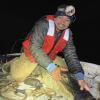
Hi Akio! I wanted to share our experience.
We are tracking crocodiles in peat swamp forest, so far we tracked 8 crocodiles. We use product from ATS - GPS/VHF with iridium transmitter. We put the tag on the nuchal of crocs. Challenge for tracking the crocodiles and make it sustainable:
- For now they don't have release mechanism (so we need to catch them again)
- one GPS cost at least $25 per month for Iridium subscription (for Indonesia this is quite expensive!). Oh but ATS provide 1-year free subscription
- Initial cost is expensive of course, the durability of this product is quite good itself. The battery might last 1-2 years depending on the setting.
- The GPS point and satellite transmission sometimes not consistent
- more sensors like accelerometer and data logger would be great, but keep it affordable
I feel like this is asking everything at once, but that is what we faced, especially when resource are super limited in Indonesia compared to global north. Hope this help!


Yvan Satgé
Clemson University


3 September 2025 4:24pm
Hi Akio,
The Loko system looks like it could be great for short- to medium-term deployments on wildlife.
I saw somewhere that you were working on a bird-size option. Could you provide some details?
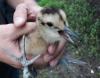
Also we, seabird researchers, successfully waterproof trackers like MobileAction's iGotU (previously discussed here https://wildlabs.net/discussion/igotu) or the very similar Mr. Lee CatTraQ (https://www.mr-lee.com/cattraq.htm) with heatshrink tubing (after removing the tag's plastic packaging and upgrading the battery if needed). This could also work with the Loko but do you know if the LoRaWAW antenna could be rolled around the PCB? I'm afraid that, if it has to stick out of the heatshrink tubing, it will affect the waterproofing.
Finally, seabirds can go on long foraging trips (up to 10-15 days in some species) between visits to their nest/nesting colony (where the received would be placed). What's the memory size in the Loko? How many GPS locations can be stored?
Thanks,
Yvan




15 October 2025 9:49pm
Hi Akio!
Is there any more extensive documentation for Loko than what I see on the website in the link you sent? I'm curious to learn more, such as what the mean and median positional errors are, and how long the battery would last at various fix intervals (such as 5 minutes fixes vs 15 minute fixes), whether the device is capable of taking more than 6,500 consecutive fixes if it is able to regularly connect to the ground device, how it handles failed fixes (i.e. there are no satellites detected), etc.
I'm working on a project in which we are deploying GPS receivers on gopher tortoises. As with many devices, one of our biggest challenges is finding a device that can store a lot of fixes so that we can leave it out for long deployments (we have been looking at devices with pure receivers, and no transmission option), and as someone else mentioned, ruggedness is very important as well- the turtles can be very hard on trackers. These animals present some unique tracking challenges because they spend much of their time underground, meaning that the device will be unable to detect satellites and/or get a good fix most of the time. We also value customizability- someone else pointed out that we biologists have been known to open up devices and DIY them for our own uses- and we are wont to do the same with software as well, if able. For example, for my study we are interested in options where we can choose an adaptive fix interval, for example, every 5 minutes but only during daylight hours, to save on battery as well as memory space. I know triggered firmware is a common request as well- various groups will use different sensors, such as light, temperature, moisture, float, accelerometer, etc. to tell a device when it's appropriate to take a fix (when the animal moves, when it surfaces, etc.).
Best,
Jocelyn
HeinrichS