


Carter Andrew
- @carterjandrew
- | He/Him

Related Inventory Content

I've just been learning a little bit about Microsofts Sparrow Project and it seems awesome. But it also promises a lot. I'm hoping there might be some people who have worked with it willing to share their experiences.
In particular I'm curious about:
- Costs of setup and maintainence
- Reliability of data delivery
- Reliability of models
- Experience with surrounding tooling
- Genuine thoughts on if the technology is ready and useful (or at what level of dedication it becomes so)
Excited to hear what people have to say :)
18 June 2026 5:45am
I haven’t worked with it, but it looks like is targeted at a specific niche. Its quite powerful but requires space and infrastructure (ie 100W solar panels, starlink, etc) along with all the sensors and electronics gear. That said, if you can handle that equipment on site, it’s an interesting tool.
There’s more info regarding what it takes to set it up here:






18 June 2026 12:20pm
Just curious, does your use case justify the starlink and friends ? In other words, if all the software stack met your standards, would then then be okay with the power and starlink requirements ?


18 June 2026 5:28pm
Hello Carter,
The Sparrow team from the AI for Good Lab here. Thank you so much for your interest in Project Sparrow.
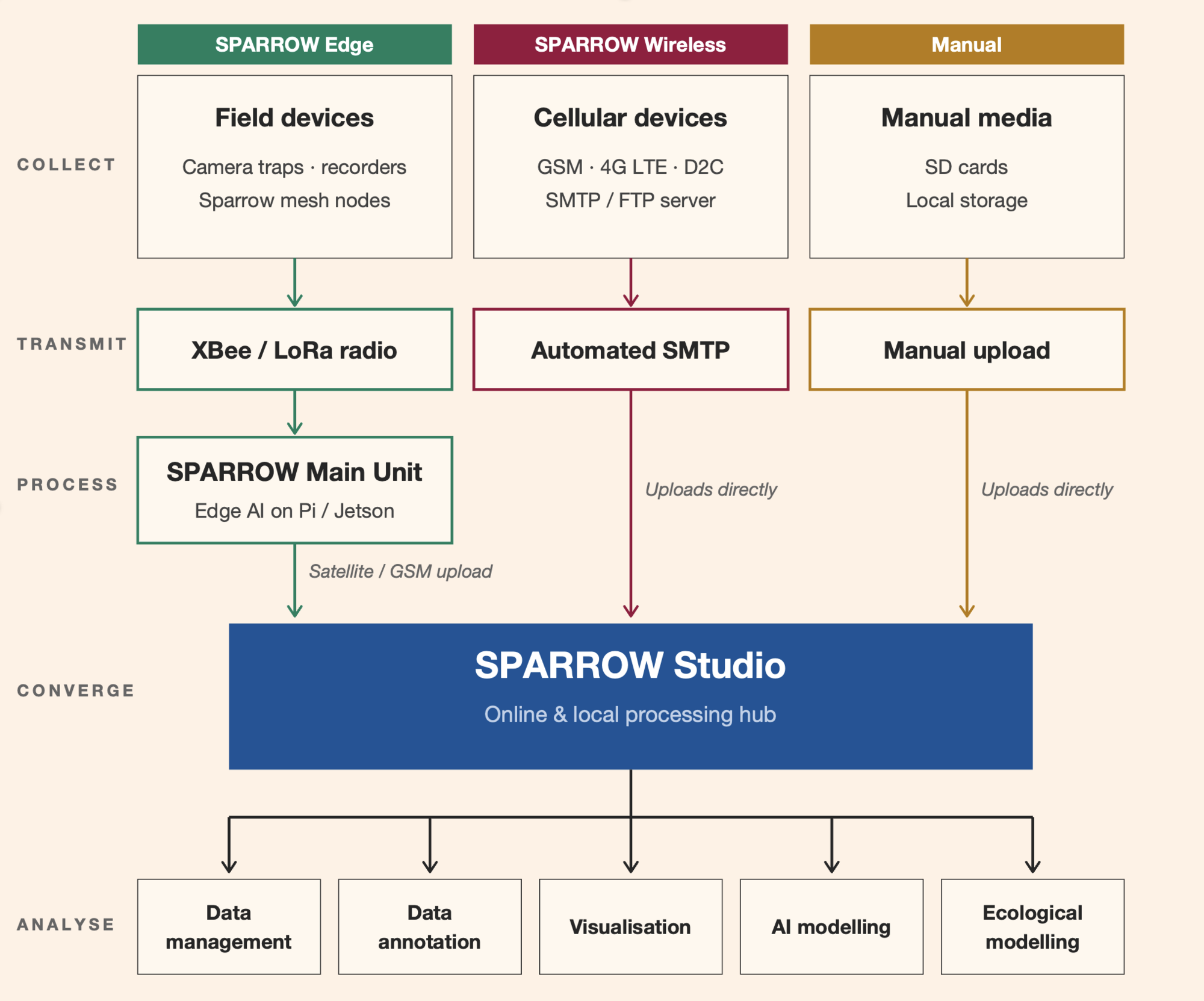
Since the initial announcement, Sparrow has evolved significantly. It now supports not only Edge AI but also direct connections from 4G devices (e.g., Reconyx 4G cameras) wherever GSM coverage is available.
Here are our responses to your questions:
- Costs of setup and maintenance
- For the main gateway edge device, we currently use a Raspberry Pi 5. A Starlink build costs approximately $2,000 (all off-the-shelf components). If GSM coverage is available, the cost drops to just the Raspberry Pi 5 (~$100–$200, depending on market pricing) plus smaller solar panels and controllers, for a total under $1,000.
- We also now offer mini Sparrows that can connect directly to existing cameras or other devices via USB. These use a Raspberry Pi Zero 2W and can run MegaDetector onboard along with at least two ResNet-18 models concurrently. (We recently deployed a dual ResNet-18 audio classification model on a remote ocean buoy.) The mini Sparrow supports 4G connectivity and costs approximately $200 total, including the Pi Zero (~$20), solar panel (~$50), and power bank (~$100).
- If you are not running Edge AI, the main cost is simply the 4G camera itself (a Reconyx 4G camera is around $500).
- Reliability of data delivery
- Data delivery has been very reliable. We have received continuous data from all our deployments—both Starlink edge pipelines and pure 4G pipelines. Our oldest unit has been operating in the Amazon rainforest (without 4G) for over 400 days and continues to send automatic captures as well as edge-processed images and audio.
- Reliability of models
- Hardware reliability depends on build quality. One of our jungle units was struck by lightning and went offline for four months. It has since fully recovered and resumed transmitting all the data it collected during that period.
- AI model reliability depends on the specific models used. Sparrow is powered by PyTorchWildlife and our production inference engine, Sparrow-Engine. This engine is model-agnostic and loads any model available in our expanding model zoo. It currently supports first-party detection models such as MegaDetector, second-stage animal classification models, as well as SpeciesNet, Perch2, and Deepfauna. We will add BioClip support very soon.
- Experience with surrounding tooling
- Could you please elaborate on what you mean by “surrounding tooling”?
- Is the technology ready and useful?
- Project Sparrow is a cornerstone project in the AI for Biodiversity section of our lab. This section currently focuses on two interconnected lines of work: Sparrow and MegaDetector. Our goal is to keep everything as open as possible and free of charge, with users owning their devices and data.
I have attached an ecosystem figure for Project Sparrow. All Sparrow data streams are consolidated into a user dashboard called Sparrow Studio. In Sparrow Studio, users can manage their database, process data with AI, visualize and edit annotations and predictions, and fine-tune models (feature currently in development).
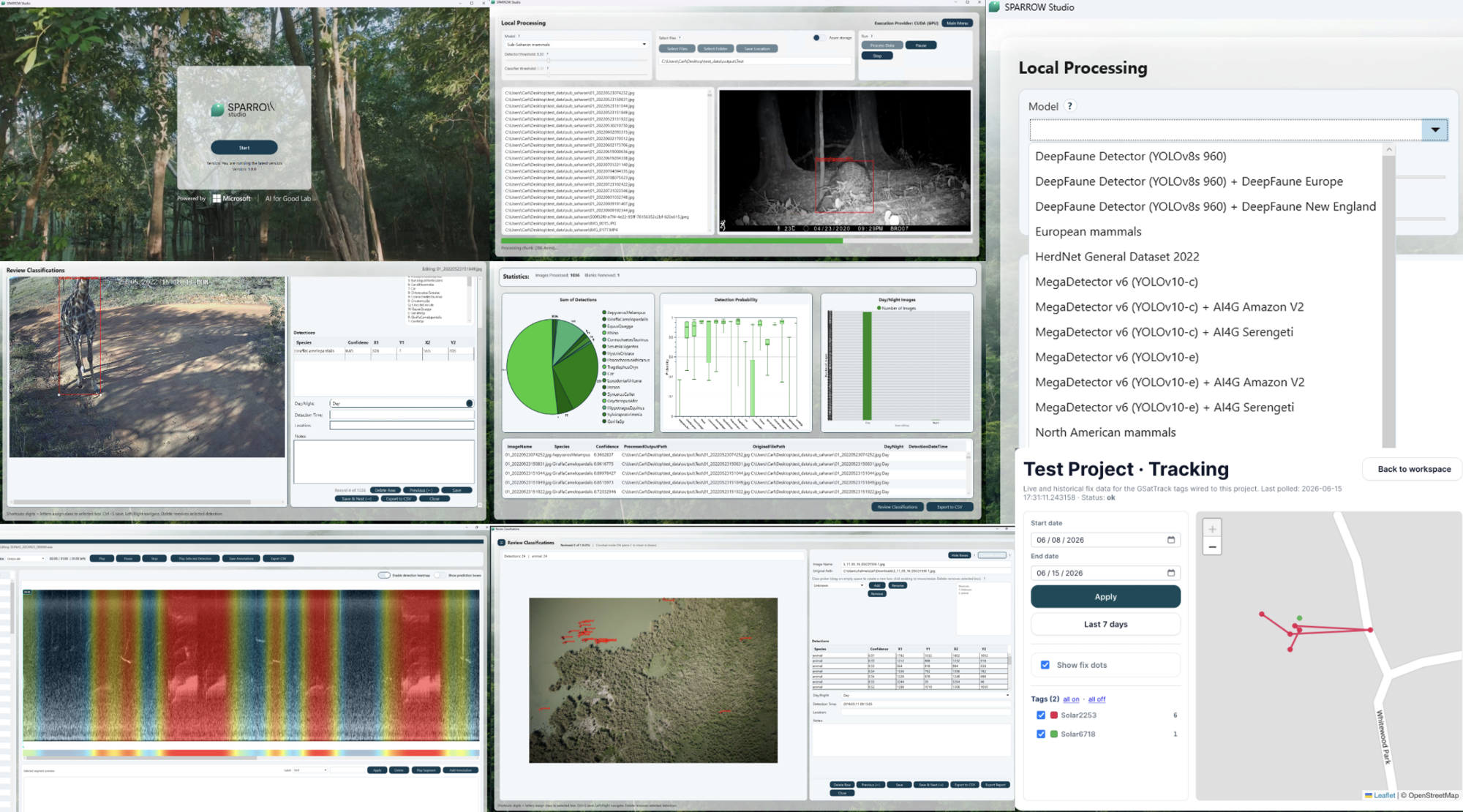
We are currently updating our public Sparrow repository and the AI for Biodiversity repository to reflect recent progress.
Please follow us on LinkedIn for the latest updates!



6 July 2026 9:48am
looking forward to this discussions too. Exploring the use of sparrow and in case our use case succeeds, we'll share feedback too.
Akiba
Freaklabs