Groups
Related Inventory Content
I'd like to share some of the first video content filmed with our new 1280x1024 thermal module. We are proud to announce that Wildlife Security Innovations has a new partnership with a fabulous Zoo, located just 3km from our offices.
Kasteel Park Born has recently become the proud custodians of two new born baby camels.
Here is a video of a selection of their animals. The clarity of this module is really amazing, I think you'll agree.
7 April 2026 8:55am
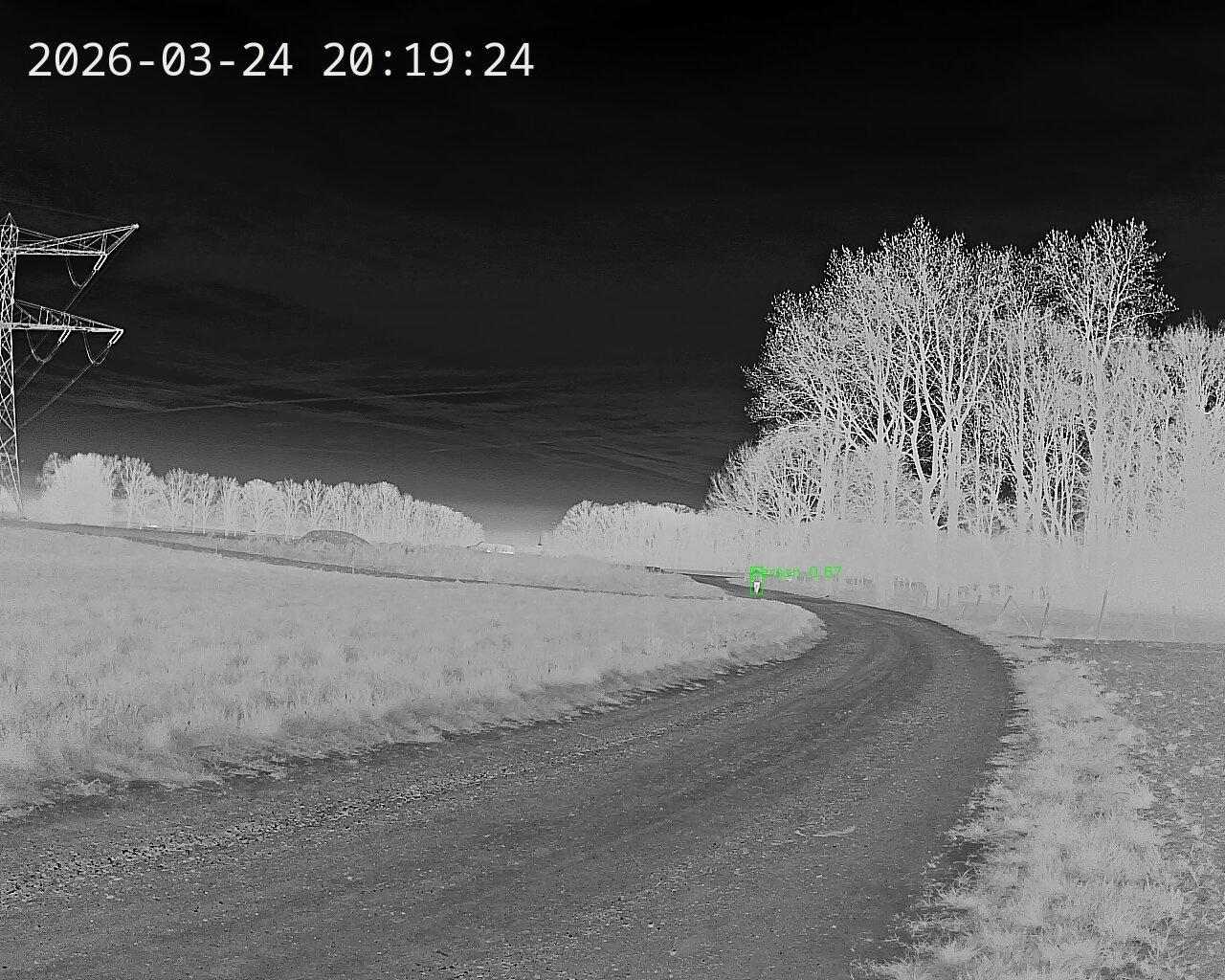
On this note, if the application was poacher detection, then with the general purpose lens on this module it can detect a person with AI in complete darkness at 100m. As in this photo.
15 May 2026 8:18pm
Hi Kim,
Pretty impressive camera! How much are these going for? We are hoping to find some cameras that can withstand the Canadian winter. Do you have any comparable recommendations that might be available in these parts (Toronto, Ontario)?
We've developed real-time monitoring pipeline for basic behaviours in tigers and polar bears at the Toronto Zoo using CCTV Livestreams and are now hoping to configure a standalone camera system with a microcontroller and 4G-enabled router for real-time monitoring and alerts in a mobile deployment.
For your particular camera, you had mentioned in another thread that an export license is required outside of the EU for various camera resolutions - why is that?
Thanks in advance for your input!
Li
17 May 2026 6:03pm
That 1280x1024 resolution thermal camera is extremely expensive. It's more than 10,000 euros.
As to standing low temperatures the thermal modules are rated to -40C. I guess I'll find out soon enough if they can stand the cold temperatures as two of these units will be going to Greenland soon.
Our thermal systems will not run on micro-controllers. They come with either a Raspberry Pi based host of a NVidia Jetson based host.
About export licenses. Thermal imaging technology is deemed dual-use tech. And it's governed in Europe by what's called the Wassenaar agreement or ITAR. Canada is on the list of countries for which less restrictions apply. Export doesn't need a license for up to 384x288 resolution. But 640 resolution or higher require a license. We apply for such licenses to export for our clients. There's potentially up to an 8 week wait for a license, but there's also a wait for typically 6-8 weeks to get new stock unless I happen to have some spare.
The 640x512 based system is sold with an outdoor box and 3D printed enclosures suitable for outdoor wildlife monitoring and the host computer and software and is in the vincity of 3000 euros, but the price varies with the chosen components and also what's happening in the markets. Currently Raspberry Pi hardware is crazy expensive to what it used to be priced at due to the memory shortage.
16 June 2026 3:21pm
Hi Kim,
I come from automotive CV where false positives around vulnerable road users are a constant challenge, especially with edge cases at night and in low-visibility conditions (in Greenland or Canada winter conditions might skew the video clarity).
I’m curious about how this is handled in conservation/anti-poaching setups, particularly in IR-based detection systems that can pick up humans at range in darkness.
In automotive we rarely try to classify object intent, rather just direction of movement and proximity, so I’m wondering how systems in your context avoid over-interpreting a detection (e.g. differentiating a hiker or worker from a genuine threat scenario), and what role something like restricted location, known poacher trails, activity, or time of day might play into interpreting the detection.
Is the system usually designed to be triggered based with a manual triage backend or if there might be some degree of automated triage? Or if the methods you use are mostly for animal detection a la camera traps and human detections are an added benefit?
Would be great to hear how you structure that pipeline in practice.
Thanks,
Ron
17 June 2026 7:45am
Great questions! Actually, I added AI object detection with large models to my system back in 2019, before I got involved in wildlife, it was for security purposes. I got involved in wildlife in 2023. I think the vast majority of wildlife users of AI are using very small models deployable on low power systems. So they would have many false positives and negatives I expect.
My systems have not yet been used for poacher detection. When I developed it for security, I needed to make it so reliable that I could have it wake me at night. So false positives and misses had to be very small. To that end I wrote the software so it could combine several other mitigating factors. Such as multiple modules at the same time, statistical based triggers etc. For example, we could make it detect a person requiring both a high confidence thermal match and a low confidence visible match in order to trigger. That sort of thing. It can be made very reliable.
I don't think you need to determine intent with the system. That can be left to the humans. So long as they can be notified. With our systems, in addition to getting the notification they can then come in live and view the situation from multiple camera actions. Very effective visibility is the key and rapid detection and clear notification. For my home security setup, I'm using yolov6 large model with inference on 1280x1280 images. The large model is a 140 million parameter model. It's very good with both recall and accuracy. I can't remember the last time any false detection woke me. And it never misses anything.
It also had from the very start a flexible state machine built in that can be menu configured to combine all kinds of state before it triggers.
(I'll find out about low visibility situations soon as I'll be deploying some thermal systems to Greenland next month).
17 June 2026 8:00am
BTW. On my roadmap is to develop a very long distance IR system that could detect humans at 1km with reliably in complete darkness but I don't have the funding for it at the moment. It would use a zoomable IR system with a 30-180mm thermal zoom at 1280x1024 resolution. It's kind of a dream system on mine and I'm determined to build it.
Kim Hendrikse