

Henry Rees
- @HRees
- | Him/His
WILDLABS
Fauna & Flora





In 2025 we received exactly 999 individual applications, which is an astonishing 334% increase from last year! These insights offer valuable information for the community, and we will use this discussion thread to share the most relevant statistics.

This year, we focused our communications on increasing representation from developing economies. We were delighted to see that 73.8% of the team leaders who applied identified as being from the Global South, with Africa as the most represented continent at 41.8%. These results demonstrate that our outreach efforts were successful, meeting our goal of achieving at least 50% representation from developing economies.

Additionally, our goal this year was to achieve at least 50% representation of women among both team members and team leaders. We were pleased to see that 1,096 team members identified as women, representing 50.3% of the total. However, women accounted for 44.8% of team leaders, falling slightly short of our target. This highlights the need to strengthen our efforts to support and encourage women in leadership roles going forward.
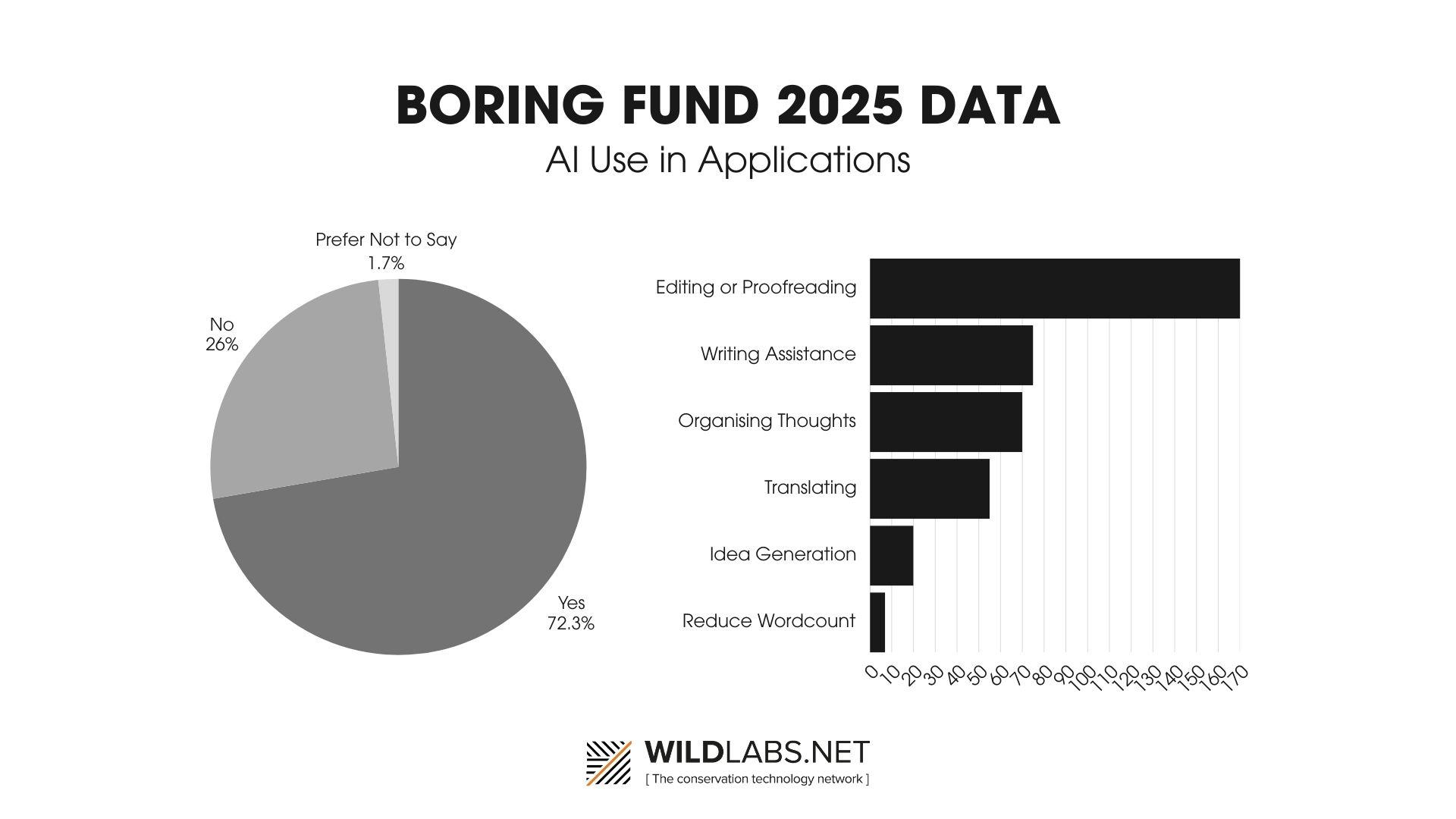
This year, we also introduced a transparent question on the application form, asking whether applicants had used AI in developing any aspect of their proposal, while reassuring them that this would not affect the selection process. The question was answered honestly, with 72.3% of respondents indicating that they had used AI. Most reported using it for Editing or Proofreading, followed by Writing Assistance. Many also mentioned using AI for Translating. Combined with the fact that the majority of applications came from the Global South, this suggests that AI may be a particularly valuable tool for applicants whose first language is not English. Interestingly, some respondents also noted using AI for Idea Generation.

Applicants were also asked to indicate which category of “boring issue” their project addressed, with some projects spanning multiple categories. Knowledge Transfer (e.g., training) emerged as the most common focus area, followed by non-live Training Materials, Data Mobilisation, and Documentation & Guidance. Interestingly, a number of projects also focused on Cybersecurity. Although this was the smallest category, its presence highlights an emerging issue and a capacity gap that appears to be increasingly important for the sector.

Applicants were also asked to indicate which technologies were being used in their projects, and fittingly, we saw a strong presence of technologies that could be considered more “boring.” Data Management & Mobilisation Platforms were the most commonly cited, followed by Non-AI Computational Tools. These were then followed by Mobile Applications, GIS & Remote Sensing, and AI Tools. By contrast, more “exciting” field-based technologies such as camera traps, acoustic devices, and biologgers appeared further down the list, showing that applicants clearly understood the unique purpose of the Boring Fund.
We are currently reviewing The Boring Fund finalists and hope to announce them in the coming weeks. We have been astonished with the response this year and delighted by all the ideas shared by our community. We hope to keep the momentum up in the future, please stay tuned for more information on The Boring Fund!
18 September 2025 8:51am
Thanks for the stats' @HRees ! I'm curious what kind of data management and mobilisation platforms applicants are using? And what boring stuff they need the money for? Like, hosting, license costs or development?



23 September 2025 9:26pm
I consider data work more boring than any other conservation technology and we have a substantial number of project in taht category. This statistics is really useful and impressive
Frank van der Most
RubberBootsData