

Henry Rees
- @HRees
- | Him/His
WILDLABS
Fauna & Flora





The WILDLABS Awards 2026 are entering their final stage after receiving 523 applications across the $50,000 and $10,000 grant categories. Following an initial review by the WILDLABS team, 429 eligible applications were assessed, with 30 applicants shortlisted for the $10,000 grants and 22 shortlisted for the $50,000 grants to advance to the final judging stage. For more data from the awards process, please follow this link.
The judging panel is made up of 16 experts from across the conservation technology sector, each bringing extensive experience in their field. The panel reflects a diverse range of genders, nationalities, and conservation technology specialisations, helping to reduce similarity bias and ensure a balanced review process.
As outlined in the Awards announcement article, applications are being evaluated against five key criteria:
- Conservation Problem & Importance
- Technology
- Team Capacity & Partnerships
- Knowledge Sharing & Ethics
- Feasibility & Application Quality
This week, the judges will make their final deliberations and select the 15 awardees. Successful applicants will be contacted directly before the winners are announced publicly.
Meet the judges below!
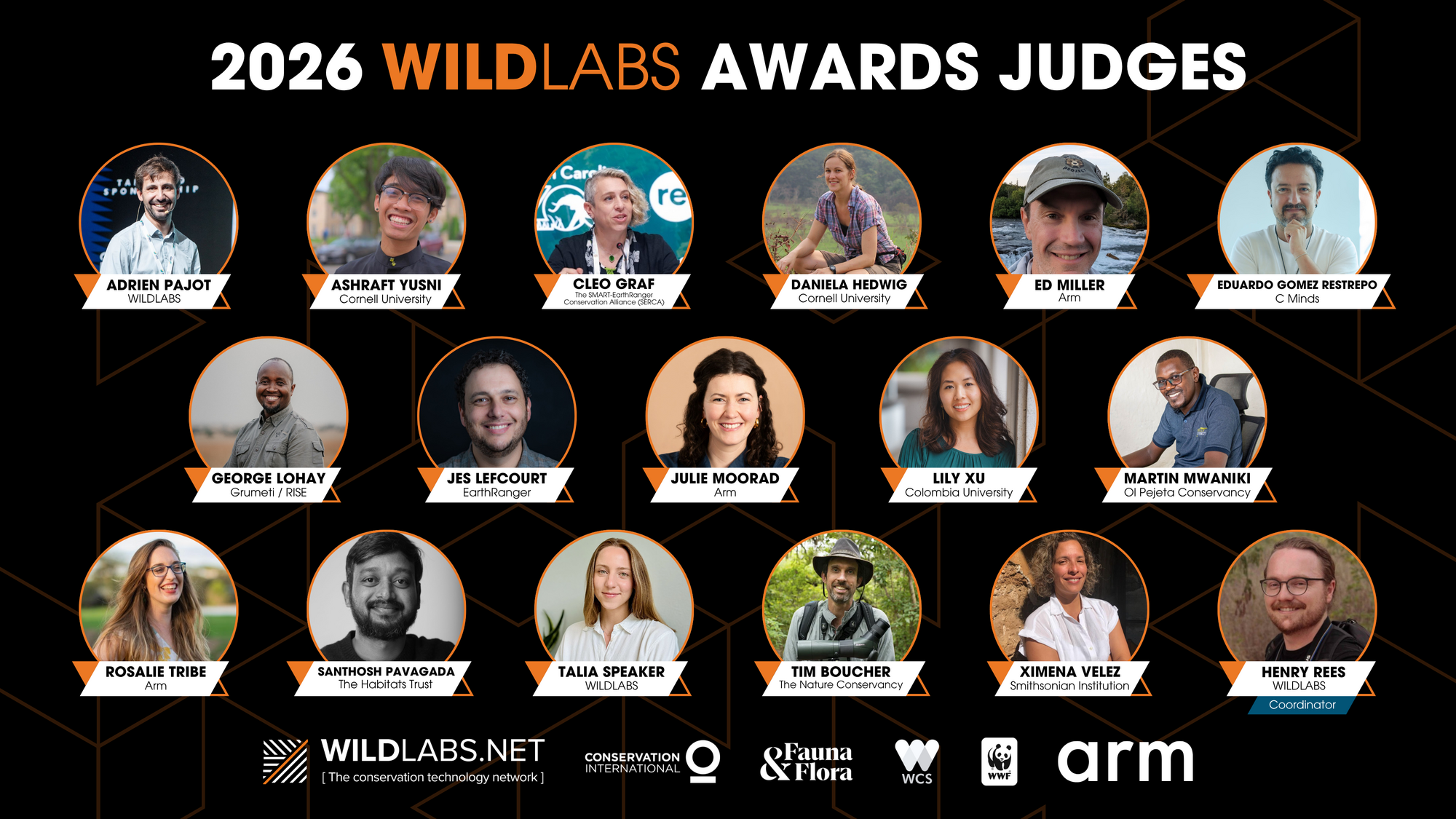
Adrien Pajot: WILDLABS - Adrien is a Project Manager at WILDLABS and a dedicated conservation engineer. Having spent the last three years running and shaping the WILDLABS Awards, he knows the program intimately and brings an insider’s perspective. Driven by a lifelong passion for ornithology, marine mammals, and entomology, Adrien thrives at the intersection of technical engineering and field ecology, working hand-in-hand with the conservation tech community. He is also the co-founder of the Nocturnal Bird Migration (NBM) NGO, leveraging bioacoustics and machine learning to monitor avian movements.
Ashraft Yusni: Cornell University - Ashraft is a wildlife biologist actively involved in the conservation and monitoring of asian hornbills in Malaysian Borneo. His work focuses on the use of passive acoustic monitoring (PAM) to study hornbill ecology and support long-term biodiversity monitoring initiatives. He is involved in multiple acoustic monitoring projects, including the Locally Led East Asian Flyway Acoustics (LEAFA) initiative, which promotes collaborative and community-driven conservation research across the region.
Cleo Graf: SERCA - Cleo is the Executive Director of the SMART EarthRanger Conservation Alliance, SERCA, a global conservation technology alliance working to improve conservation management effectiveness. She brings 26 years’ experience in conservation, including extensive work with protected and conserved areas. Cleo works across strategy, governance and partnerships, with a focus on practical technology that helps conservation teams turn field data into clearer decisions and measurable results on the ground.
Daniela Hedwig: Cornell University - Daniela is a behavioral and conservation biologist who studies mammalian vocal communication and its applications for conservation. Her current research focuses on African forest elephants, exploring how vocalizations support social relationships and how acoustic data can improve passive acoustic monitoring. By combining behavioral ecology with conservation technology, her work helps develop innovative, noninvasive methods for monitoring threatened species in the wild.
Ed Miller: Arm - Ed is a Software Director at Arm, where he leads a team engaging strategic partners on software and AI. He is also a co-founder and director of the BearID Project, developing AI models and applications for wildlife monitoring in his free time. With a background spanning hardware and software from edge to cloud, Ed brings deep engineering expertise to bear on advancing wildlife conservation.
Eduardo Gomez Restrepo: CMinds - Eduardo is a biotechnologist and Head of the NaturaTech LAC Studio at C Minds, where he facilitates co-creation processes with communities, scientists, and technologists to develop pluriversal solutions for biocultural regeneration. His work focuses on connecting ancestral, traditional, and scientific knowledge systems with emerging technologies to support community-led biodata governance and locally rooted bioeconomies.
George Lohay: Grumeti/RISE - George is a Tanzanian biologist with over 10 years of experience in wildlife conservation and research. He is currently a research scientist at RISE and previously served as a Postdoctoral Scholar in the Biology Department at Penn State University. His work focuses on the population genetics and connectivity of African savannah elephants and Masai giraffes in Tanzania, including research on how habitat loss and fragmentation impact wildlife corridors. George earned his Ph.D. in Biology from Penn State University in 2019, where he studied genetic connectivity in African elephants. He is also passionate about mentoring graduate students and supporting conservation research programs that strengthen scientific capacity and advance opportunities for researchers in the sector.
Jes Lefcourt: EarthRanger - Jes serves as the Director of EarthRanger, a product of the Allen Institute for Artificial Intelligence (Ai2) to help conservation organizations around the world protect endangered wildlife and their habitats. With a passion for applying his product and technology experience to solving unique challenges in conservation, Jes leads the EarthRanger program with a wide range of goals, from monitoring conservation area security operations and coordinating anti-poaching activities to better understanding continent-wide migration patterns of animals. Before joining EarthRanger, Jes was the Vice President of Digital Product for National Geographic Society, focused on impactful storytelling and education to encourage environmentally conscious decision making.
Julie Moorad: Arm - Julie is Head of Climate at Arm, where she leads the company’s global climate strategy. Her work focuses on advancing decarbonization across Arm’s operations and value chain, embedding sustainability into business strategy, and evaluating the environmental risks, business implications, and opportunities associated with the rapid global transition to AI. Previously, Julie was Director of Nature at Salesforce, where she developed and implemented the company’s integrated nature program, leading the creation of Salesforce’s Nature Positive Strategy and Water Program. She also led the company’s international sustainability strategy and EMEA sustainability program, including EU and UK advocacy. Originally from California, Julie now calls London home.
Lily Xu: Colombia University - Lily is an Assistant Professor at Columbia University where she runs the caPP Lab, advancing Computation and Algorithms for People and the Planet. She develops AI methods across machine learning, optimization, and causal inference for planetary health challenges, with a focus on biodiversity conservation. Her work provides novel algorithms to enable practitioners to make effective decisions in the face of limited data, taking actions that are robust to uncertainty, effective at scale, and future-looking. Lily holds a PhD in computer science from Harvard and was a postdoc at Oxford with the Leverhulme Centre for Nature Recovery.
Martin Mwaniki: Ol Pejeta Conservancy - Martin is the Manager, Technology & Innovations at Ol Pejeta Conservancy, where he leads digital transformation and conservation technology initiatives that support wildlife conservation, operational effectiveness, and organizational resilience. His work focuses on bridging technology and field operations through ICT systems, digital platforms, and innovative tools that enhance monitoring, decision-making, and service delivery. With experience in both enterprise technology and conservation-focused innovation, Martin is passionate about developing practical and scalable solutions that respond to real-world challenges in protected area management and conservation operations.
Rosalie Tribe: Arm - Rosalie is a Senior Manager, Social Impact & Innovation at Arm, where she is leading global initiatives that leverage technology to drive positive social change. Rosalie plays a key role in shaping strategic partnerships that advance innovation for sustainability, inclusion, and global development. Passionate about the power of collaboration, she works to ensure technology is a force for good, creating lasting impact in communities worldwide.
Santhosh Pavagada: The Habitats Trust - Santhosh leads the Technology for Conservation programme at The Habitats Trust, combining engineering and ecological expertise to design solutions for conserving grasslands, coral reefs, and other ecosystems beyond protected areas. With over 15 years of experience at the intersection of technology and conservation, and driven by a “do-anything-for-conservation” mindset, he has worked across outreach, applied conservation, advocacy, and conservation technology, including corridor monitoring in tiger and other key landscapes across India. A passionate embedded and machine learning engineer, he engages hands-on from PCB soldering to AI development, applying interdisciplinary and systems-thinking approaches to conservation challenges. A Chevening scholar, he holds an MSc in Applied Ecology and Conservation from the University of East Anglia and believes well-designed technology can significantly accelerate conservation impact.
Talia Speaker: WILDLABS - Talia is the Executive Manager of WILDLABS, the global conservation technology network. In this role, she helps connect conservation practitioners, technologists, researchers, funders, and decision-makers to strengthen the sector and support the responsible use of innovative tools for biodiversity and ecosystem protection. She brings 10 years of experience in conservation technology, spanning wildlife management, ecological monitoring, and the human dimensions of conservation. Her work focuses on building inclusive communities, expanding access to conservation technology, and helping translate emerging innovations into practical impact for people and nature.
Timothy Boucher: The Nature Conservancy - Timothy is a passionate conservation scientist with many years of experience working on global conservation projects. His career has taken him to remarkable places, where he has specialized in remote sensing, spatial analysis, ecological metrics, and biodiversity assessments across various scales. Timothy enjoys blending technology and fieldwork to gather and analyze data about wildlife and their habitats. His work in acoustics has been particularly rewarding, allowing him to listen in on the natural world and assess habitat conditions in unique ways. He is dedicated to tackling the complex challenges of conserving nature while ensuring that people’s needs are met, and always strives to stay on the cutting edge of conservation science.
Ximena Velez: The Smithsonian Institute - Ximena is a marine molecular ecologist and Research Associate at the Smithsonian Conservation Biology Institute’s Center for Conservation and Sustainability in Peru. Her work combines community ecology, genetics and genomics, and biodiversity monitoring to support science-based conservation and reduce the environmental impacts of development projects. She leads long-term biodiversity monitoring initiatives in Peru, including South America’s first MarineGEO coastal observatory, which integrates science, technology, and stakeholder collaboration to advance marine science and support conservation. Ximena has co-authored more than 60 scientific and outreach publications, mentored more than 30 students and conservation practitioners, and collaborates with government, industry, and local communities to advance evidence-based conservation in the region.
Henry Rees: WILDLABS Awards Coordinator - Henry is a Programme Development Manager at WILDLABS, where he coordinates the WILDLABS Awards and Boring Fund, alongside capacity-building programmes such as Women in Conservation Technology. Previously, Henry worked with the Conservation Leadership Programme, where he provided grants to early-career conservationists worldwide and supported the monitoring, training, and development of international project teams. He brings a strong background in bioacoustics and bat survey research, alongside extensive experience in conservation capacity building and grant-making.
About the WILDLABS Awards
With the support of Arm, the company building the future of computing, the 2026 WILDLABS Awards will distribute $350,000 to advance conservation technology across 15 projects worldwide. The Awards continue to offer two grant levels of $10,000 and $50,000, designed to support initiatives at both early and more advanced stages of conservation technology development and deployment.
The WILDLABS Awards are open to innovators working across the conservation technology space, from developing new tools and technologies, to applying technical expertise in the field, to building collaborative platforms and resources for the global community. They also support cutting-edge approaches that push the boundaries of how technology can be used to address conservation challenges.
Whether you are advancing a new idea or scaling an established solution, the WILDLABS Awards provide funding and support to help turn innovative concepts into real-world conservation impact.
Add the first post in this thread.