


Panicked Encounters: An Unforeseen Threat

The wild boar is one of the most widely distributed mammals in the world. It occupies an extremely wide range of habitat types, where they feed opportunistically on plant and animal species (including crops and livestock). In addition, wild boars have the highest reproductive rates among ungulates, and their local density can double in one year. Consequently, the widespread increase in numbers and geographical range of this species might have a remarkable impact on many plant and animal species, habitat structure, and crop and livestock production.
Wild boars are not inherently malicious, but their unpredictable nature can lead to dangerous situations. When a wild boar wanders into a human settlement, it is often as frightened and disoriented as the people it encounters. This mutual panic is what turns a chance meeting into a violent confrontation.
For instance, a woman in Kalpetta, Kerala was seriously injured when a startled boar ran into the shop where she was standing. In a panic, she tried to close the shutters, but the charging animal caused her to fall. Similarly, a rubber tapper was attacked while working in a plantation, an incident likely sparked by the sudden and unexpected presence of both the man and the boar. These events highlight a tragic reality: the harm caused is not born out of aggression, but out of fear and the instinct to flee, a clash of panicked reactions in a shared space.
The Unintended Victims: A Flawed Defense
Current solutions to the wild boar problem often create a new set of tragedies. Measures intended to keep boars away from farms and villages, such as electric fences and traps, are indiscriminate. While they may deter some boars, they pose a grave and often unforeseen danger to other wildlife. Elephants, with their vast territories and foraging routes that often intersect with human settlements, are particularly vulnerable.

Nowhere was this tragic collateral damage more heartbreakingly illustrated than in the death of a pregnant elephant in Palakkad. The bait was not meant for her; it was a pineapple stuffed with powerful firecrackers, a crude and illegal device left for wild boars that raid crops. The unsuspecting elephant, searching for food, consumed the fruit. The explosion was catastrophic, shattering her jaw and tongue and leaving her in searing pain. For days, she was unable to eat or drink, worried more about the unborn calf inside her than her own agony. She was found standing silently in the Velliyar River, her head and trunk submerged in the water for relief from the excruciating pain.She died there, standing in what became her water tomb. Her death was a gut-wrenching, unintended consequence, a horrific testament to how solutions aimed at one animal can lead to the slow, agonizing death of another, far more visible, victim.

The Solution: "Sentient Canopy" Network
While no single solution can completely eliminate human-wildlife conflict, we can significantly reduce the instances of dangerous encounters. By deploying AI-powered acoustic sensors on trees, we can create an invisible perimeter that listens for the specific sounds of wild boars and elephants. This system can provide an early warning to farmers and villagers, long before a physical confrontation becomes inevitable. It's a non-invasive approach that respects the animals' presence while prioritizing human safety. The key is not to build higher walls, but to create smarter warnings.
The Sentient Canopy is an intelligent, self-sustaining early warning system designed to make a plantation's environment aware of itself. It transforms a dangerous space into a collaborative network that protects both people and animals.
This project leverages the unique strengths of two powerful, rugged off-the-shelf devices the Nordic Thingy:53 and the Nordic Thingy:91, to create a robust, tiered solution.

The Nordic Thingy:53 can be a transformative tool for rubber farmers, providing an approach to increase profits and safety.

By utilizing the integrated BME688 sensor, these compact devices can be distributed throughout a plantation to continuously monitor localized humidity and temperature, two critical variables affecting latex yield.

This data provides actionable insights for optimizing tapping schedules and identifying the most productive zones.

Furthermore, the Thingy:53's onboard microphone can be paired with an embedded AI model trained to distinguish the specific sounds of wild boars and elephants. When a threat is detected, the device instantly sends an early warning notification directly to the farmers' phones, allowing them to take preventative measures without resorting to crude methods like firecrackers that cause collateral damage. In the dense and often remote environment of a rubber estate, plantation workers, or "tappers," can manage the network during their rounds by recharging the devices with portable batteries or hot-swapping them to collect logged data, ensuring continuous operation. This creates a simple, scalable, and investment-worthy solution that directly addresses yield optimization and human-wildlife conflict.

To create a cohesive network across the plantation, the individual Thingy:53 units communicate using Bluetooth Mesh. This protocol allows sensor data and wildlife alerts from distant trees to be relayed from one node to another, effectively creating a self-healing network that blankets a large area without needing a direct connection from every device to a central point. A strategically placed Thingy:91 can then act as a central gateway, aggregating all the information collected from the mesh. In this implementation, the gateway communicates directly with a farmer's smartphone via a standard Bluetooth Low Energy connection whenever it's in range, delivering consolidated notifications. This project is designed as an adaptable framework; in countries with robust cellular IoT infrastructure, the Thingy:91's cellular modem could be used for NB-IoT connectivity. However, NB-IoT is currently avoided because network access is often restricted by carriers to large commercial clients deploying a thousand devices or more, making it financially and logistically inaccessible for a hobbyist or small-scale farmer.
On-Device Acoustic Classification of Wildlife for Ecological Monitoring
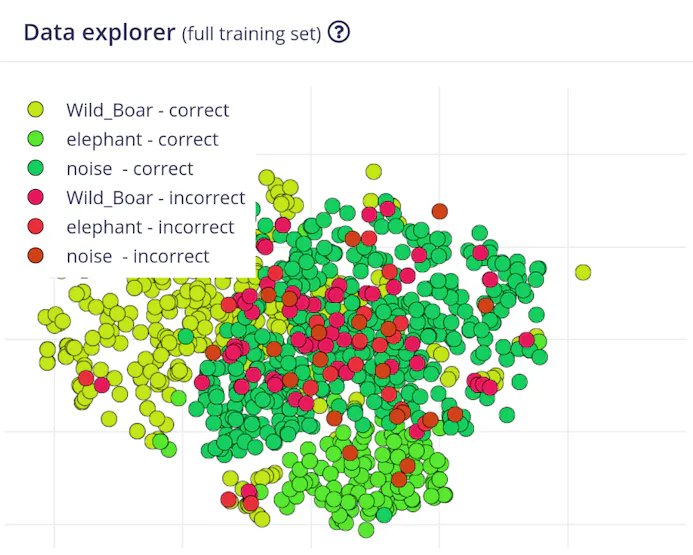
An efficient, on-device classifier was successfully developed to distinguish between the sounds of wild boars, elephants, and ambient noise. The dataset for this project was compiled from two distinct sources. Audio samples for the 'Wild Boar' and 'Elephant' classes were curated from copyright-free videos, while the 'noise' class was captured through real-world recordings using a Nordic Thingy:53 development board to represent authentic environmental conditions.
The technical approach was grounded in established audio processing principles. Raw audio waveforms were converted into a feature-rich spectrogram using a Short-Time Fourier Transform (STFT), followed by a Mel-scale transform to reduce dimensionality and focus on perceptually relevant frequencies. A Convolutional Neural Network (CNN) architecture was chosen for its proven reliability in audio pattern recognition tasks. The entire model was trained and optimized for deployment using the Edge Impulse platform and its EON™ Compiler.

Further improvement and expansion of this technology hold significant potential for real-world impact. Deployed as low-power, remote sensor networks, such systems could enable non-invasive ecological monitoring of animal populations and migration patterns. Critically, they could also function as early-warning tools to mitigate human-wildlife conflict by detecting the proximity of animals to agricultural areas or settlements, thereby enhancing safety for both local communities and wildlife and supporting broader conservation initiatives.
Add the first post in this thread.